Wart vs Skin Cancer: How to Spot Key Differences
Warts are common harmless viral growths, while skin cancers are abnormal growths that may require prompt treatment. Because some skin cancers can resemble warts, a lesion that changes, bleeds, hurts, does not heal or persists should be examined by a qualified clinician.
Wart vs Skin Cancer: A Side-by-Side Comparison
When comparing wart vs skin cancer, the most important difference is that a wart is usually a benign viral skin growth, while skin cancer involves abnormal cells that can grow into surrounding tissue. Appearance can offer clues, but it cannot confirm the diagnosis. Some cancers, particularly squamous cell carcinoma (SCC), may be scaly, thickened or rough enough to resemble a wart.
| Feature | Typical wart | Possible skin cancer |
|---|---|---|
| Cause | Usually infection with human papillomavirus (HPV) | Abnormal skin-cell growth, often related to ultraviolet exposure and other risks |
| Surface | Often rough, firm and skin-colored; may show tiny dark dots | May be scaly, crusted, pearly, ulcerated, tender or uneven |
| Change over time | May slowly enlarge or spread to nearby skin | May grow, change color or shape, bleed, crust, ulcerate or fail to heal |
| Common locations | Hands, fingers, feet, knees and areas exposed to skin contact | Often sun-exposed skin, including face, ears, scalp, neck, arms and hands |
| Symptoms | Usually painless; plantar warts may hurt with pressure | May be painless, itchy, tender, painful or prone to bleeding |
| How it is confirmed | Usually clinical examination | Clinical examination, dermoscopy and often biopsy if suspicious |
A comparison table is useful for orientation, but there is considerable overlap. A wart can be irritated or bleed after picking, and a skin cancer can be subtle and painless. Any new or persistent lesion that is difficult to classify deserves professional review rather than repeated self-treatment.
How Can I Tell if My Skin Growth Is a Wart or Skin Cancer?
It is not always possible to tell the difference between skin cancer and a wart by looking alone. Warts commonly have a rough, grainy surface and may interrupt normal skin lines. On the hands and feet, tiny black or red pinpoints can represent small clotted blood vessels. They may occur in groups and can spread through skin contact or scratching.
Features that make a lesion less typical of a simple wart include a sore that does not heal, repeated spontaneous bleeding, a steadily enlarging bump, a new lesion in later adulthood, marked tenderness, irregular dark pigmentation, or an open or crusted area that keeps returning. These signs do not automatically mean cancer, but they are appropriate reasons for assessment.
Location matters as well. A wart vs skin cancer on face comparison may be particularly difficult because facial skin receives substantial sun exposure and is more easily irritated by shaving, cosmetics or skin care products. A persistent crusted, pearly, scaly or bleeding facial spot should not be assumed to be a wart without an examination.
Online photographs and discussions, including wart vs skin cancer Reddit posts, can be useful for understanding why lesions may look alike, but they cannot diagnose an individual skin change. Lighting, image quality, skin tone and the absence of a physical examination all limit online comparisons.
Can You Mistake Skin Cancer for a Wart?

Yes. Skin cancer can be mistaken for a wart, especially when it is rough, raised or scaly. SCC is one of the conditions most likely to create confusion in a wart vs SCC comparison. It can appear as a persistent red, pink, skin-colored or scaly bump, sometimes with a crusted surface or a small ulcer.
Basal cell carcinoma may also be mistaken for an irritated bump, pimple or wart. It often develops on sun-exposed areas and may look pearly, shiny, pink or flesh-colored. Some lesions have visible small blood vessels, a rolled edge, or a recurring sore that seems to heal and then reappears.
Less commonly, a thickened or raised melanoma can have a wart-like appearance. The concern is not that every rough growth is dangerous, but that visual similarity can delay diagnosis. A clinician can assess the lesion’s structure, pigment pattern, blood vessels and borders using a dermatoscope, then recommend a biopsy when the diagnosis remains uncertain.
People should not use home freezing products, acids or cutting tools on a growth that is changing, bleeding, unusually pigmented, or not clearly a familiar wart. Such treatment can irritate the area and may delay a correct diagnosis.
Does Melanoma Ever Look Like a Wart?
Melanoma can sometimes look like a wart, although this is not its most typical presentation. Some melanomas are raised, firm or uneven in texture, and a nodular melanoma may grow as a dome-shaped bump. A lesion may be pink, red, brown, black, blue-gray or close to the surrounding skin color, so color alone is not enough to rule melanoma in or out.
Changes are particularly important. A spot that is new and growing, looks different from a person’s other moles, has uneven color or borders, becomes raised quickly, bleeds, itches persistently or develops a sore should be assessed. The familiar ABCDE approach can help people notice concerning mole changes: asymmetry, border irregularity, color variation, diameter that increases, and evolution over time.
Not all melanomas follow every ABCDE feature, and not all suspicious lesions are pigmented. For this reason, a rapidly changing lesion or an “ugly duckling” spot that looks unlike the person’s other marks should be reviewed promptly. Early assessment is the safest way to distinguish a wart-like growth from melanoma or another skin condition.
What Is the 2 Week Rule for Skin Cancer?
The “2 week rule” is not a universal diagnostic rule for skin cancer. In some healthcare settings, it refers to an urgent referral pathway intended to help people with concerning symptoms be seen quickly, often within two weeks. It does not mean that a lesion must be present for exactly two weeks before medical advice is needed.
For skin changes, a practical message is to seek assessment if a new or unusual spot is growing, changing, bleeding, painful, or not healing over a short period. A sore or crusted area that persists for several weeks, repeatedly returns, or does not improve as expected should be checked, particularly on sun-exposed skin.
People with a personal history of skin cancer, a weakened immune system, extensive sun damage, prior Brain Tumour and Brain Cancer: Diagnosis, Outlook, and Modern Treatment Approaches" class="ahp-ilk">Brain Cancer Radiation Treatment: Options and Outlook" class="ahp-ilk">radiation treatment, or a strong family history of melanoma may need a lower threshold for review. A doctor or dermatologist can advise on the urgency based on the lesion and the person’s individual risk factors.
How a Clinician Tells Them Apart
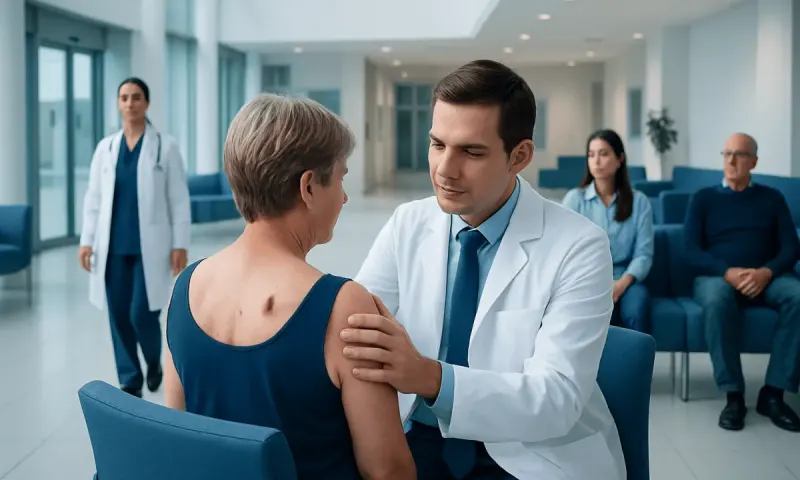
A clinician begins by asking when the lesion appeared, how it has changed, whether it bleeds or hurts, and whether there has been sun exposure, immune suppression, previous skin cancer or contact with someone who had warts. The examination includes the lesion’s size, texture, edges, color and location, as well as a review of nearby skin.
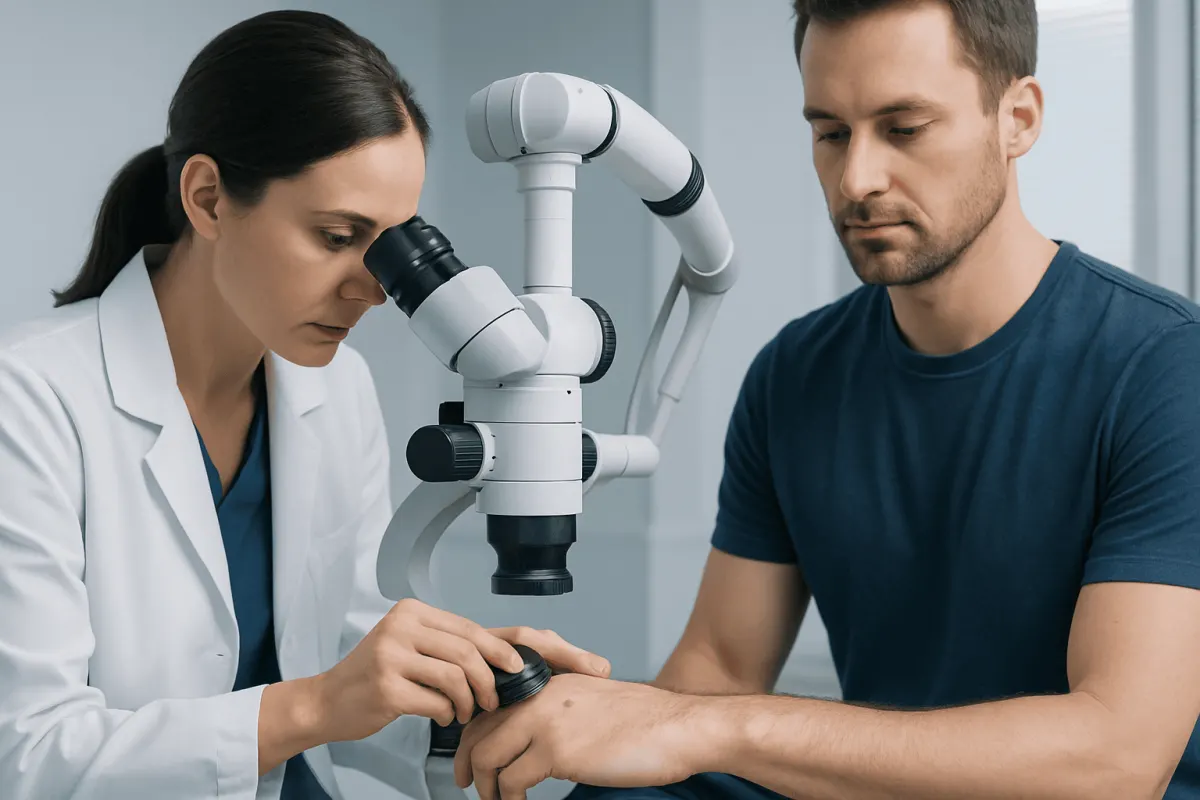
Dermoscopy is a noninvasive examination using a magnifying lighted device. It allows the clinician to see patterns beneath the skin surface that are not visible to the naked eye. This can help distinguish common warts from lesions that require further investigation, although it does not replace biopsy when cancer is suspected.
A biopsy is the definitive way to diagnose many suspicious lesions. Under local anesthetic, a small sample or the entire lesion may be removed and examined by a pathologist. The result guides treatment and helps distinguish skin cancer from warts, benign keratoses, moles and inflammatory skin conditions.
Diagnosis should not be delayed because a lesion resembles a common wart. Early review can provide reassurance when a growth is benign and allows timely treatment when a more serious condition is found.
What to Do for a Wart and What to Do for Skin Cancer
For a typical wart, a clinician may recommend watchful waiting, topical treatments, cryotherapy or other office-based options depending on its location, symptoms and duration. Warts can resolve naturally, but treatment may be useful when they are painful, spreading, persistent, cosmetically troubling or affecting daily activities. Avoid picking at warts, as this can spread the virus to nearby skin.
If a lesion is confirmed as skin cancer, treatment depends on the cancer type, size, depth, location and the person’s overall health. Options may include surgical removal, curettage and cautery, cryotherapy for selected superficial lesions, topical medicines, radiation therapy or other specialist treatments. Management for melanoma and higher-risk cancers is individualized and may involve a broader specialist team.
Sun protection is important for everyone: use shade, protective clothing, sunglasses and broad-spectrum sunscreen, and avoid intentional tanning. Regularly checking the skin can help identify new or changing lesions, especially in difficult-to-see areas with help from a partner or mirror.
Acıbadem Health Point’s multidisciplinary specialists and JCI-accredited hospitals support international patients who need evaluation and treatment for suspicious skin lesions and confirmed skin cancers.
When to Seek Medical Care
Medical assessment is advisable for any growth that is new, changing, rapidly enlarging, persistently scaly, ulcerated, painful, itchy, bleeding without clear injury, or failing to heal. A lesion that returns after apparent healing, especially on the face, ears, scalp, lips, hands or other sun-exposed areas, should also be reviewed.
Prompt evaluation is particularly important for a dark or multi-colored spot with irregular borders, a lesion that looks unlike other moles, or a raised bump that changes quickly. People should also arrange a skin examination if an over-the-counter wart treatment has not helped and the diagnosis is uncertain.
Urgent care may be appropriate for heavy bleeding that does not stop with firm pressure, signs of serious infection such as spreading redness with fever, or a rapidly worsening wound. In most cases, a primary care doctor or dermatologist can assess a concerning skin growth and advise on the next steps.
Frequently asked questions
01Are warts usually cancerous?
No. Common warts are benign growths caused by certain types of human papillomavirus and are not skin cancer. However, a rough or raised lesion should not automatically be assumed to be a wart if it is new, changing, bleeding or persistent.
02What does squamous cell carcinoma look like compared with a wart?
Squamous cell carcinoma may appear as a scaly, crusted, red, pink or skin-colored bump, which can resemble a wart. It is more concerning when it grows steadily, becomes tender, bleeds, develops an open sore or does not heal. A clinical examination and sometimes a biopsy are needed for confirmation.
03Can a wart bleed?
A wart can bleed if it is picked, shaved, rubbed or otherwise injured. Bleeding that happens repeatedly without obvious trauma, or a lesion that crusts and does not heal, should be assessed by a clinician.
04Should a wart on the face be checked by a doctor?
A facial growth should be checked if its diagnosis is uncertain, particularly if it is persistent, changing, crusted, pearly, painful or bleeding. Because sun-exposed facial skin is a common location for several skin cancers, avoiding self-treatment until it has been assessed is sensible.
05How long should I wait before having a possible wart examined?
There is no need to wait if the lesion is changing, bleeding, painful, unusually colored or difficult to identify. A typical stable wart can be discussed at a routine appointment, but a sore or growth that persists for several weeks or repeatedly returns should be evaluated sooner.
06Can a dermatologist tell immediately whether a lesion is a wart?
Often, a dermatologist can make a likely diagnosis during examination, sometimes with dermoscopy. If the appearance is atypical or cancer cannot be excluded, a biopsy may be recommended to provide a definite answer.
This article is for general information only and is not a substitute for professional medical advice. Please consult a qualified doctor about your individual situation.
Hair transplant in Turkey — costs, graft counts & a free assessment
JCI-accredited · board-certified surgeons · reply within 24h
Add us as a Preferred Source to see more of our trusted health content across Google Search, AI Overviews and Discover.