

VO2 Max by Age: What Is Normal?
- 9 min read
- Published November 28, 2026
Key Takeaways
- VO2 max reflects cardiorespiratory fitness, not overall worth or health by itself.
- Healthy VO2 max values vary by age, sex, training level, and testing method.
- Regular physical activity can help preserve aerobic capacity across the lifespan.
- A low VO2 max may point to deconditioning or a medical issue that deserves evaluation.
- Exercise tests should be interpreted by a clinician, especially when symptoms are present.
VO2 max by age is one way to understand how well the body uses oxygen during exercise, and it can help frame fitness in a more practical, age-aware way. While the number often declines with age, a person's health, training history, and medical conditions all influence what is considered normal.
Overview
VO2 max is a measure of how much oxygen the body can use during intense exercise. In simple terms, it gives an idea of how efficiently the heart, lungs, blood vessels, and muscles work together when the body is under effort. Because aerobic capacity naturally changes with age, people often look at VO2 max by age to understand what a result may mean in context.
That context matters. A single number can be useful, but it does not tell the full story of someone’s health. A lifelong runner, a person returning to activity after illness, and someone who has never been formally tested may all have very different VO2 max values, even at the same age. For this reason, VO2 max should be viewed as one part of a broader fitness and medical picture.
Many people first encounter VO2 max through sports watches, gym equipment, or supervised exercise testing. Consumer devices can offer a rough estimate, while lab-based testing is more precise. When a person is considering evaluation abroad, particularly for training-related concerns or unexplained exercise intolerance, it helps to know what the test can and cannot answer before travel and follow-up are planned.
Symptoms and What a Low VO2 Max May Feel Like
VO2 max itself does not cause symptoms, but a lower-than-expected value may be associated with reduced exercise tolerance. Some people notice that they become short of breath sooner than peers of a similar age, recover more slowly after exertion, or feel unusually fatigued during activities they once handled easily.
These experiences are not specific to VO2 max. Poor sleep, stress, lack of conditioning, anemia, asthma, heart disease, and several other conditions can affect how the body responds to exercise. That is why clinicians look at the whole pattern rather than relying on a fitness number alone.
Common reasons someone may seek assessment include:
- Unexpected breathlessness during ordinary activity
- Reduced stamina compared with past performance
- Difficulty returning to exercise after illness or surgery
- Sports performance questions in adolescents or adults
- Concerns about heart or lung fitness after a medical diagnosis
If symptoms are new, worsening, or accompanied by chest discomfort, fainting, or palpitations, they should be evaluated promptly rather than attributed to “just being out of shape.”
Causes & Risk Factors

VO2 max usually declines gradually with age, even in people who stay active. This is partly related to natural changes in heart function, muscle mass, and oxygen delivery. However, the pace of decline varies widely, and regular aerobic exercise can slow it considerably.
Several factors influence VO2 max by age. Genetic background plays a role, as do body composition, training status, and sex assigned at birth. Medical conditions such as chronic lung disease, heart disease, uncontrolled diabetes, obesity, anemia, and some inflammatory disorders may lower aerobic capacity as well.
Risk factors for a lower VO2 max include:
- Sedentary lifestyle or prolonged inactivity
- Smoking or ongoing exposure to tobacco
- Long-standing heart or lung disease
- Poorly controlled metabolic or hormonal conditions
- Recent deconditioning after hospitalization, injury, or surgery
In international patients, the question is often not simply “What is my number?” but “Why is this number lower than expected for my age and lifestyle?” That distinction helps clinicians decide whether a result is a training issue, a recovery issue, or a sign that further medical workup is needed.
How VO2 Max Is Measured and Interpreted
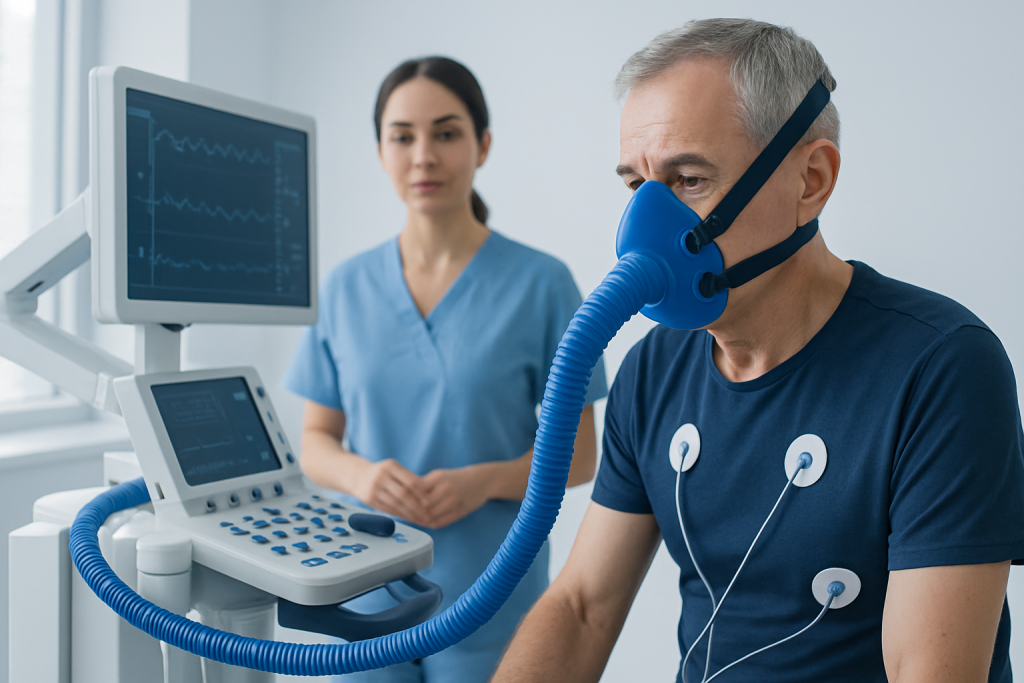
The most accurate way to measure VO2 max is through cardiopulmonary exercise testing in a clinical or sports-performance setting. During this test, the person exercises on a treadmill or bicycle while breathing through specialized equipment that measures oxygen use and carbon dioxide output. Heart rate, blood pressure, and symptoms are typically monitored at the same time.
Consumer wearables estimate VO2 max using heart rate data, pace, and other signals. These estimates can be helpful for spotting trends over time, but they are not equivalent to a formal test. They may be less reliable when exercise is irregular, when the person has rhythm changes, or when the device algorithm is not suited to a person’s activity pattern.
Interpretation depends on more than age. Clinicians consider sex, body size, training status, the test protocol used, and whether the exercise effort was maximal and safe. A number that appears “low” on paper may still be appropriate for a person’s circumstances, while a seemingly acceptable number may not explain symptoms if endurance has clearly changed.
What Normal Looks Like by Age
There is no single normal VO2 max value for every person of the same age. Instead, results are usually compared with reference ranges that account for age and sex, and sometimes with athletic norms. These ranges are best used as guides rather than strict pass-or-fail cutoffs.
In general, VO2 max tends to be highest in early adulthood and then gradually decreases with age. People who train consistently, especially with aerobic and interval exercise, often maintain higher values than inactive peers. Even so, an older adult with an active lifestyle may have a healthier functional capacity than a younger adult with low activity levels.
A useful way to think about VO2 max by age is to ask three questions: Is the number consistent with the person’s age and background? Has it changed over time? Does it match how the person actually feels during daily life and exercise? These questions often provide more value than comparing against online charts in isolation.
Treatment Options
There is no treatment for VO2 max as a standalone number. Instead, care focuses on identifying and addressing the reason for reduced aerobic capacity, then building a safe plan to improve it. For some people, the answer is structured exercise guidance; for others, it is management of a medical condition that limits exertion.
If low fitness is the main issue, a clinician or rehabilitation specialist may recommend gradually increasing aerobic activity, resistance training, or supervised exercise sessions. If a heart, lung, blood, or hormonal problem is found, treatment targets that condition first. In many cases, both approaches are used together.
When the person is traveling for care, a clear plan for testing and follow-up is especially important. It is helpful to arrange records, imaging, medication lists, and post-visit instructions before leaving, so the recovery and training plan can continue smoothly at home.
Depending on the situation, a care plan may include:
- Supervised exercise or cardiac rehabilitation
- Medication review and adjustment
- Treatment of anemia, asthma, thyroid disease, or heart conditions
- Nutritional support and weight-management guidance when appropriate
- Follow-up testing to track improvement over time
Prevention & Self-care
The most practical way to support VO2 max over time is to stay consistently active. A balanced routine that includes moderate aerobic exercise, some higher-intensity intervals when appropriate, and strength training can help preserve functional capacity with age. The right plan depends on current health, prior training, and any medical limits.
Recovery habits matter too. Sleep, hydration, gradual progression, and adequate rest between sessions all support better exercise adaptation. People returning after illness, surgery, or a long break should ease back in rather than trying to match their previous level immediately.
Helpful self-care habits include:
- Choose activity that can be repeated week after week
- Warm up before harder sessions and cool down afterward
- Increase duration or intensity gradually
- Stop and seek advice if exercise causes chest pain, dizziness, or unusual breathlessness
- Keep chronic conditions well controlled
For international patients, it can be useful to ask for a written exercise and follow-up plan before returning home. That makes it easier to continue care with a local clinician and helps preserve the gains made during treatment or rehabilitation.
When to See a Doctor
A doctor should evaluate VO2 max concerns when the result is unexpectedly low, when exercise tolerance is clearly changing, or when symptoms appear during activity. This is especially important if a person has known heart or lung disease, a history of anemia, or risk factors such as smoking or diabetes.
Medical review is also appropriate if consumer device readings are confusing, if the person is training for sport and wants a safer performance assessment, or if there is uncertainty about whether reduced stamina reflects fitness, recovery, or illness. A clinician can decide whether formal exercise testing, blood work, cardiac evaluation, or lung testing is the best next step.
Seeking help sooner is wise if exercise brings chest pressure, fainting, marked palpitations, or severe shortness of breath. These symptoms deserve prompt medical attention, regardless of age or fitness level. At Acibadem Health Point, multidisciplinary specialists and JCI-accredited hospitals can diagnose and treat this condition for international patients, with coordinated testing and follow-up support.
Frequently asked questions
01What does VO2 max by age mean?
It means comparing aerobic fitness with age-based reference ranges rather than using one universal number. Because VO2 max naturally changes across the lifespan, age helps put the result into perspective.
02Is a low VO2 max always a medical problem?
No. It can reflect low activity, recent deconditioning, or an inaccurate wearable estimate. But if the result is clearly low or symptoms are present, a doctor should look for possible medical causes.
03Can VO2 max improve with exercise?
Yes, often it can. Regular aerobic training, gradual progression, and overall health management may improve or preserve VO2 max, though the amount of change varies from person to person.
04Are smartwatch VO2 max estimates reliable?
They can be useful for tracking trends, but they are not as precise as clinical exercise testing. Their accuracy depends on the device, the activity, and how consistently the person wears it.
05Does VO2 max decline with age even in healthy people?
Yes, a gradual decline is common with aging. Staying active can slow that decline and help maintain good everyday function.
06When should someone get formal testing instead of relying on an app?
Formal testing is better when there are symptoms, a medical condition, or a need for accurate performance assessment. It is also useful when a clinician needs to understand why stamina has changed.
This article is for general information only and is not a substitute for professional medical advice. Please consult a qualified doctor about your individual situation.
Heart care in Turkey — expert evaluation and treatment
JCI-accredited · board-certified surgeons · reply within 24h
Add us as a Preferred Source to see more of our trusted health content across Google Search, AI Overviews and Discover.


How can we help you today?
Meet an Acibadem specialist by secure video, before you travel.
Book a video visit