Veneers in Turkey: Cost, Clinics and What to Expect

Key Takeaways
- Most veneer treatment plans abroad are completed in one visit of roughly five to seven days, though the schedule depends on the individual case and the dentist's assessment.
- Prices are normally shared as indicative bands per tooth or per arch; a firm figure is only possible after clinical records and photographs are reviewed.
- Accreditation such as JCI, verifiable dentist credentials, and a written treatment plan matter more than headline pricing.
- Packages vary widely — always confirm in writing what is and is not included, especially imaging, temporaries, and any revision policy.
- Veneers involve irreversible enamel reduction in many cases, so a second opinion before committing is reasonable and often encouraged.
- Arrange follow-up with a local dentist at home before traveling, and ask for full records, shade details, and material information to take back.
Patients considering turkey veneers usually plan a single stay of about five to seven days, or occasionally two shorter visits, with costs presented as per-tooth bands rather than fixed quotes. This guide explains how the journey is coordinated, what packages generally include, and how to evaluate clinics and plan aftercare once home.
Why patients consider turkey veneers
Interest in turkey veneers has grown largely because Turkey has developed an established infrastructure for international patients: airline connections from major US hubs, hospital groups and clinics accustomed to English-speaking visitors, and coordination teams that bundle appointments, transfers and accommodation into a single itinerary. For many people in the United States, the appeal is a combination of cost planning and the ability to complete several appointments within one trip rather than spreading them across months.
It is important to frame this realistically. Veneers are thin, custom-made shells bonded to the front surface of teeth to change color, shape or alignment. They are an elective, largely cosmetic treatment, and for many designs the dentist must remove a small amount of enamel — a change that cannot be reversed. Traveling for care does not alter the clinical decision-making involved; it simply changes the logistics around it.
A good international dental journey therefore starts with an honest assessment rather than a price list. Reputable coordination teams ask for recent photographs, a panoramic X-ray if available, and a summary of any gum disease, grinding, root canal work or missing teeth. Some people who inquire about veneers are advised that whitening, orthodontic alignment, bonding or gum treatment would serve them better, or that underlying problems must be resolved first. Hearing that before booking flights is a sign of a careful process.
How the patient journey is coordinated
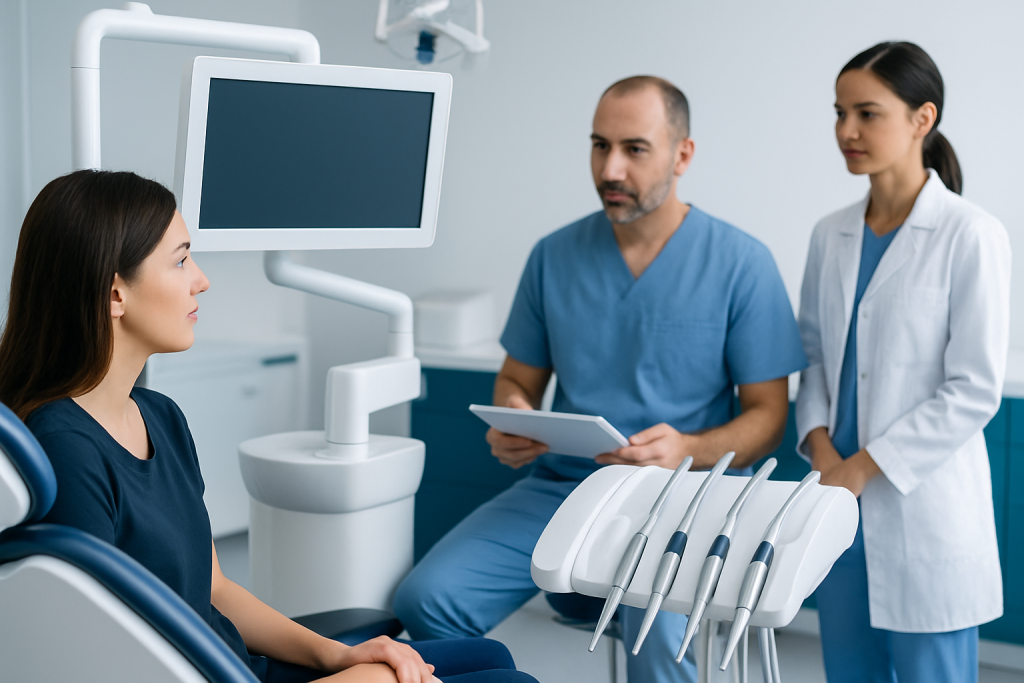
The process usually begins remotely. A patient contacts a coordination team, shares photographs and any existing dental records, and completes a short medical and dental history. These materials are reviewed by a dentist, and where useful a video consultation is arranged so the patient can ask questions directly and discuss expectations regarding shade, tooth shape and how much change is realistic for their smile.
From that review, an indicative plan is drafted. It typically outlines the likely number of veneers, the material under consideration, the expected number of clinic visits, and an approximate length of stay. Coordination teams then help with the practical layer: guidance on entry requirements and documentation for travel, hotel options near the clinic, airport and clinic transfers, and interpreter support where needed. Appointments are scheduled around the flight dates rather than the other way round.
On arrival, the plan is confirmed in person. This first appointment generally includes a clinical examination, updated imaging, photographs, and often a digital scan or impressions. Only at this point can the dentist finalize the number of teeth involved and the definitive cost. Patients should expect — and welcome — the possibility that the in-person plan differs from the remote estimate, because a screen cannot replace an examination.
What treatment packages typically include

Package contents differ significantly between providers, which is why comparing two quotes on price alone can be misleading. Before committing, patients are advised to request a written, itemized plan and to read it carefully. If something is not written down, it is safer to assume it is not included.
- Initial in-person consultation, clinical examination and diagnostic imaging
- Tooth preparation, digital scanning or impressions, and laboratory fabrication
- Temporary veneers worn between appointments
- Try-in appointment, adjustments and final bonding
- Airport and clinic transfers, and sometimes hotel nights for a set number of days
- Interpreter support and a named coordinator during the stay
Items that are frequently not included deserve equal attention: flights, extra hotel nights if the schedule extends, gum treatment or fillings discovered during examination, root canal treatment, crowns where a veneer is not appropriate, night guards for patients who grind their teeth, and any revision work that would require a return flight. Clarify the policy on remakes and how long any manufacturer or clinic warranty on the ceramic itself lasts, and what conditions apply to it.
Patients should also confirm which material is planned — for example feldspathic porcelain, lithium disilicate, or zirconia-based restorations — and whether the plan involves true veneers or full-coverage crowns. These are different procedures with different amounts of tooth reduction, and the distinction should be explained clearly in advance, not discovered in the chair.
Realistic cost planning and price bands
Dental costs abroad are best approached as planning bands rather than fixed figures. Clinics generally quote per tooth, and the total depends on how many teeth are treated, the material selected, the laboratory used, and whether any preparatory work is needed first. A ten-veneer plan and a twenty-veneer plan are very different financial commitments, and the number of teeth is a clinical decision as much as an aesthetic one.
Many US patients find that the per-tooth band quoted in Turkey sits below what they have been quoted at home, but the size of that difference varies by clinic, city and material, and it must be weighed against flights, accommodation, time away from work, and the cost of any follow-up care needed once home. A responsible provider will not issue a guaranteed final price before an examination, and will explain in writing how the figure could change if additional treatment proves necessary.
Be cautious with unusually low all-inclusive offers that cover a large number of teeth for a single flat figure, particularly where the plan is set before any records are reviewed. Ask what laboratory produces the restorations, how many appointments are allocated for try-in and adjustment, and how much chair time is scheduled. Rushed treatment is rarely a saving in the long run.
Choosing a clinic: accreditation and credentials
Accreditation is a useful starting filter. Joint Commission International (JCI) accreditation applies to healthcare organizations that have undergone an external assessment of patient safety and quality processes, including infection control, medication management and patient identification. It does not rate individual cosmetic results, but it does indicate that structured safety systems are in place and are audited by an outside body.
Alongside the facility, look at the clinician. Patients can reasonably ask for the treating dentist’s name, dental school and year of qualification, whether they hold postgraduate training in restorative or prosthetic dentistry, their registration with the Turkish Ministry of Health, and their membership in professional societies. Ask to see unretouched before-and-after photographs of cases similar to their own, taken over time rather than immediately after bonding.
- Is a written, itemized treatment plan provided before payment?
- Who performs the work, and will the same dentist see the case through?
- What happens if a veneer debonds or fractures after returning home?
- Are full records, shade codes and material details supplied at discharge?
- Is a second opinion welcomed rather than discouraged?
A clinic that answers these questions plainly, in writing, and without pressure to book quickly is demonstrating something more meaningful than any marketing claim.
Timing, recovery and traveling home
Veneer treatment is not surgery, and most people feel well throughout, but the schedule still needs breathing room. A typical plan involves an examination and preparation appointment, a period of a few days while the laboratory fabricates the restorations, a try-in appointment, then final bonding — commonly spread across five to seven days in one city. Some cases are staged across two shorter trips, which can suit patients who want more time to review the try-in stage. The exact schedule is decided by the treating dentist.
During the temporary phase, teeth may feel sensitive to hot and cold, and the gums can be tender for a day or two after preparation. Temporaries are more fragile than final veneers, so soft foods and care with sticky or hard items are usually advised. After final bonding, sensitivity often settles over days to weeks, and the bite may need a small adjustment — which is why patients should avoid booking a flight for the same evening as the bonding appointment.
Plan at least one buffer day after the final appointment. This allows time to return to the clinic if the bite feels uneven, a contact point catches floss, or a shade or contour concern emerges. Adjustments are far simpler to make before departure than after crossing an ocean.
Aftercare once back in the United States
Aftercare is the part of medical travel most often underestimated. Before leaving Turkey, patients should collect a complete record set: the treatment note, imaging, the shade and material used, the laboratory details, care instructions, and the clinic’s direct contact for follow-up questions. If a night guard was recommended for grinding, it is worth arranging before departure or shortly after arriving home.
Identify a local dentist willing to see the case for routine check-ups and cleanings, ideally before traveling. Veneers do not remove the need for ordinary dental care — the underlying teeth and gums still require monitoring, and a hygienist should know that ceramic restorations are present so appropriate instruments are used. Should a veneer chip or debond, a local dentist can often re-bond or temporize while the original clinic advises on next steps.
Good coordination platforms keep a channel open after discharge, so patients can send photographs and receive guidance from the treating team remotely. Acibadem Health Point coordinates care for international patients across Acıbadem’s JCI-accredited hospitals and clinics, arranging remote review, in-person appointments with multidisciplinary specialists, and structured follow-up communication after the return home.
When to speak to a patient coordinator
It is worth contacting a coordinator early — before flights are booked — rather than after a decision has been made. At the inquiry stage, a coordinator can arrange for a dentist to review photographs and imaging, organize a video consultation, and give an honest indication of whether veneers are a reasonable option, whether another treatment would be more appropriate, or whether preparatory dental work is likely to be required first.
Coordinators are also the right point of contact for the practical questions that determine whether a trip is feasible: how many days to allow, what travel documentation is needed, whether a companion can be accommodated, and how appointments would be rescheduled if a flight is delayed. For patients with medical conditions, blood-thinning medication, or a history of jaw joint problems, this is the moment to disclose that information so the clinical team can plan accordingly.
Finally, speak to a coordinator again if anything changes after returning home — persistent sensitivity, a chipped edge, an uncomfortable bite, or gum irritation around a veneer margin. Prompt communication with both the treating clinic and a local dentist gives the best chance of resolving a problem simply. Anyone experiencing severe pain, swelling, fever, or difficulty swallowing should seek urgent local dental or medical care rather than waiting for remote advice.
Frequently asked questions
01How many days should someone plan for veneer treatment in Turkey?
Most treatment plans are scheduled over roughly five to seven days in one visit, allowing time for examination, tooth preparation, laboratory fabrication, try-in and final bonding. Some cases are staged across two shorter trips. The dentist confirms the schedule after an in-person examination, and it is wise to add a buffer day before flying home for any final adjustments.
02Why are exact prices not given before an examination?
The final cost depends on the number of teeth treated, the material chosen, and whether any gum treatment, fillings or other preparatory work is needed. These factors can only be confirmed after a clinical examination and up-to-date imaging. Clinics therefore share indicative bands remotely and a firm itemized figure once the patient has been assessed in person.
03Does JCI accreditation guarantee a good cosmetic result?
No. JCI accreditation means a healthcare organization has been independently assessed against international patient safety and quality standards, covering areas such as infection control and patient identification. It is a meaningful indicator of organizational safety systems, but it does not evaluate individual aesthetic outcomes. Reviewing the treating dentist's training, experience and case photographs remains important.
04What happens if a veneer chips or comes loose after returning to the United States?
Contact both the treating clinic and a local dentist promptly. A local dentist can often re-bond a debonded veneer or place a temporary solution, while the original clinic advises on whether a remake is needed and what its policy covers. Keeping full treatment records, including the shade and material used, makes this process much easier.
05Are veneers reversible?
In most cases, no. Many veneer designs require removing a thin layer of enamel so the restoration fits naturally, and enamel does not grow back. Some very conservative or no-preparation techniques exist but are only suitable for certain cases. Because of this, seeking a second opinion before committing to treatment is entirely reasonable.
06Can any dental problem be treated with veneers?
No. Veneers address the appearance of the front teeth and are not a treatment for gum disease, decay, infection, significant bite problems or missing teeth. A dentist may recommend whitening, bonding, orthodontic alignment, crowns or periodontal treatment instead, or may need to resolve underlying issues before cosmetic work can proceed safely.
07What should be arranged before traveling for dental treatment abroad?
Confirm the written treatment plan and what the package includes, check travel documentation requirements, review travel and medical insurance coverage, and identify a dentist at home for follow-up care. It also helps to share a full medical history, including medications and any history of teeth grinding or jaw joint problems, with the treating team in advance.
This article is for general information only and is not a substitute for professional medical advice. Please consult a qualified doctor about your individual situation.
Explore treatments in Turkey — costs, top hospitals & a free quote
JCI-accredited · board-certified surgeons · reply within 24h
Add us as a Preferred Source to see more of our trusted health content across Google Search, AI Overviews and Discover.