Totipotent vs Pluripotent Stem Cells: Key Differences
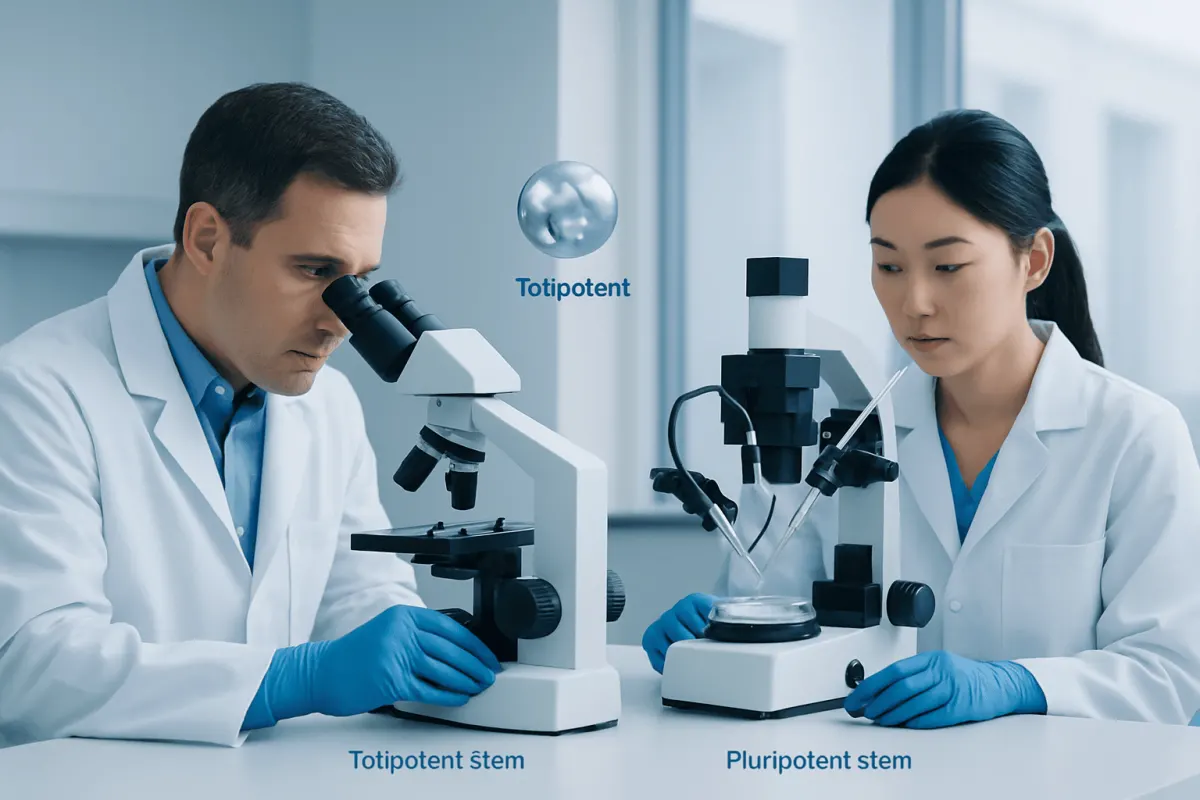
Totipotent and pluripotent stem cells are defined by what they can become. Totipotent cells can produce both the developing embryo and supporting tissues such as the placenta, whereas pluripotent cells can form nearly all body cell types but not the complete supporting structures needed to form an entire organism.
Overview: Totipotent vs Pluripotent Stem Cells
In the comparison of totipotent vs pluripotent stem cells, the central difference is developmental range. A totipotent cell has the potential to make every cell needed for a complete developing organism, including embryonic cells and extraembryonic supporting tissues. A pluripotent cell can make almost every specialized cell in the body, but it cannot independently make all of the supporting tissues required for implantation and complete development.
These terms are mainly used in embryology and stem-cell research. They describe a cell’s biological potential, not a diagnosis and not a promise that a cell can treat every disease. In clinical care, the choice of a stem-cell-based treatment depends on the condition, the type of cells involved, the quality of evidence, regulatory standards, and the individual’s health needs.
Stem-cell science is advancing, but many proposed stem-cell uses remain experimental. People considering a stem-cell procedure should discuss the expected benefits, possible risks, alternatives, and whether the approach is established or part of a properly supervised clinical trial with a qualified medical team.
Side-by-Side Comparison of Stem-Cell Potency
Stem-cell potency describes how many different types of cells a stem cell may be able to produce. Totipotent cells have the widest potential, while pluripotent cells have a very broad but more limited potential. The distinction reflects a normal sequence in very early development.
| Feature | Totipotent stem cells | Pluripotent stem cells |
|---|---|---|
| Developmental potential | Can form embryonic cells and extraembryonic supporting tissues | Can form cells from all three embryonic germ layers |
| Ability to form a complete organism | In principle, may contribute all required embryonic and supporting cell types | No; cannot form all extraembryonic supporting structures on their own |
| Typical timing | Earliest stages after fertilization, including the zygote and early cleavage-stage cells | Later in early embryonic development, including cells of the inner cell mass |
| Examples of cells they may form | Body tissues plus structures involved in supporting early development | Nerve, heart, skin, blood, bone, pancreas, liver, and other body cell types |
| Research relevance | Understanding the earliest developmental decisions | Disease modeling, drug testing, and development of regenerative therapies |
Adult stem cells are different again. They are usually multipotent, meaning they can produce a limited group of related cell types. For example, blood-forming stem cells can generate blood and immune cells, and are used in established bone marrow transplant care for selected blood diseases and cancers.
What Does It Mean If a Stem Cell Is Totipotent?

If a stem cell is totipotent, it has the greatest known developmental flexibility. It can give rise to cells that form the embryo itself as well as extraembryonic tissues that help support early development, including tissues involved in placental formation. This potential is naturally present for only a brief period at the beginning of development.
In humans, the fertilized egg, called a zygote, is considered totipotent. Cells produced during the earliest divisions may also retain totipotent potential for a limited time. As development continues, cells become more specialized and their potential narrows.
Totipotency should not be confused with a clinical treatment category. There are no routine medical treatments in which a clinician selects totipotent cells for a patient. The concept is chiefly important for understanding human development, reproductive biology, and foundational laboratory research.
What Can Pluripotent Stem Cells Not Differentiate Into?
Pluripotent stem cells cannot differentiate into all extraembryonic tissues required to support an entire developing embryo. In particular, they do not independently form the complete set of placental and related supporting structures needed for implantation and development into a whole organism.
They can, however, differentiate into cell types from the three germ layers formed during embryonic development. Ectoderm can produce tissues such as skin and the nervous system; mesoderm can produce muscle, bone, blood, and heart tissue; and endoderm can produce tissues including parts of the lungs, liver, pancreas, and digestive system.
This broad capacity makes pluripotent cells valuable in research. Scientists may use embryonic stem cells or induced pluripotent stem cells, often called iPSCs, to study disease mechanisms, test medicines in human cell models, and explore carefully regulated regenerative medicine approaches. A laboratory ability to generate a cell type does not necessarily mean that it is ready or appropriate for patient treatment.
How Do Stem Cells Differentiate Into Specific Cell Types?
Stem cells differentiate when they receive signals that change which genes are active. These signals may come from nearby cells, chemical messengers, the surrounding tissue environment, mechanical forces, and timing during development. Together, they guide a cell toward a more specialized identity.
For example, a developing cell may receive cues that activate genes associated with nerve cells while reducing activity in genes linked to muscle or blood-cell development. Epigenetic changes, which affect how genes are switched on or off without changing the DNA sequence, help stabilize that specialized identity.
In research laboratories, scientists use precisely controlled culture conditions and signaling molecules to encourage pluripotent cells to develop into particular cell types. The resulting cells must be assessed carefully for identity, maturity, purity, function, and safety. This quality control is especially important because incompletely differentiated cells or unexpected cell types may create risks in a therapeutic setting.
How Clinicians and Scientists Tell Stem Cells Apart
Stem-cell potential cannot usually be determined by simply looking at cells under a microscope. Scientists begin with the cell’s origin and developmental stage. A cell collected at the earliest post-fertilization stage is evaluated differently from cells derived from the inner cell mass of a blastocyst, adult tissue, or a laboratory reprogramming process.
Laboratories also assess molecular markers, patterns of gene activity, chromosome health, growth characteristics, and the types of specialized cells a stem cell can generate under validated conditions. For pluripotent cells, testing may demonstrate the ability to form representatives of the three germ layers. Such testing is performed under strict ethical, scientific, and regulatory oversight.
In patient care, clinicians generally focus less on labeling a cell as totipotent or pluripotent and more on whether a specific cell product has a proven role for the patient’s condition. They review the diagnosis, disease severity, prior treatment, transplant suitability where relevant, and the evidence supporting the proposed approach.
What to Do for Each Situation
For someone learning about early development, totipotent cells are mainly an educational concept. Questions may arise during fertility counseling, embryo development discussions, or genetic counseling. A fertility specialist can explain how embryology terms relate to the individual’s care while respecting ethical and legal considerations.
For someone with a condition that may involve stem-cell therapy, the relevant question is usually not whether totipotent or pluripotent cells are “better.” Instead, it is whether an established therapy exists for that condition. Hematopoietic stem-cell transplantation, for example, may be considered for selected cancers, inherited blood disorders, and serious immune conditions; it is different from experimental pluripotent-cell therapies.
People should be cautious about clinics that claim stem cells can cure many unrelated diseases, minimize risks, or do not clearly explain the cell source, regulatory status, follow-up plan, and supporting evidence. A qualified specialist can help interpret claims and discuss standard care, research options, and realistic expectations.
Acıbadem Health Point’s multidisciplinary specialists and JCI-accredited hospitals evaluate and treat eligible international patients using evidence-based approaches, including established transplant care where medically appropriate.
When to Seek Medical Care
Understanding stem-cell terminology does not usually require urgent medical care. However, a person should seek advice from a qualified doctor if they are considering a stem-cell procedure, have been offered an unproven treatment, or are unsure whether a proposed intervention is suitable for their diagnosis.
Prompt medical assessment is important for symptoms that may indicate a serious underlying condition, such as persistent unexplained fever, marked fatigue, unusual bruising or bleeding, recurrent infections, or unintentional weight loss. These symptoms have many possible causes and should not be self-diagnosed as a stem-cell problem.
People undergoing approved transplant treatment should follow their care team’s instructions and contact the team promptly about fever, signs of infection, breathing difficulty, severe vomiting or diarrhea, new rash, or other concerning changes. Early communication allows clinicians to assess symptoms safely and provide timely support.
Frequently asked questions
01What is the main difference between totipotent and pluripotent stem cells?
Totipotent cells can form both the embryo and the extraembryonic supporting tissues needed for early development. Pluripotent cells can form nearly all body cell types but cannot independently form all of those supporting tissues. Totipotency occurs earlier in development than pluripotency.
02Are embryonic stem cells totipotent or pluripotent?
Embryonic stem cells derived from the inner cell mass of a blastocyst are pluripotent. They can generate cell types from the three germ layers, but they do not have the full extraembryonic developmental potential of totipotent cells. The zygote and the earliest cleavage-stage cells are associated with totipotency.
03Can pluripotent stem cells become any cell in the human body?
Pluripotent stem cells can potentially become a very wide range of body cell types, including nerve, muscle, blood, and liver cells. Their differentiation depends on appropriate biological signals and carefully controlled laboratory conditions. Their ability to form body cells does not mean they can form a complete organism.
04Are induced pluripotent stem cells the same as embryonic stem cells?
Induced pluripotent stem cells are adult cells that have been reprogrammed in a laboratory to regain pluripotent-like properties. They share many characteristics with embryonic stem cells, but their origin and some biological features may differ. Both are important research tools and require rigorous safety assessment for possible clinical applications.
05Do patients need to choose between totipotent and pluripotent stem-cell treatment?
Usually, no. Totipotent cells are not used as a routine patient treatment option, and many pluripotent-cell applications remain under research. A clinician instead considers whether there is an established, evidence-based treatment for the person’s specific condition.
06Are all stem-cell treatments proven and safe?
No. Some stem-cell treatments, such as hematopoietic stem-cell transplantation for selected conditions, are well established. Many other uses are experimental or unproven, and they may carry important risks. Patients should discuss any proposed procedure with an appropriately qualified specialist and ask about evidence, regulation, alternatives, and follow-up.
This article is for general information only and is not a substitute for professional medical advice. Please consult a qualified doctor about your individual situation.
Explore treatments in Turkey — costs, top hospitals & a free quote
JCI-accredited · board-certified surgeons · reply within 24h
Add us as a Preferred Source to see more of our trusted health content across Google Search, AI Overviews and Discover.