Testicular Torsion Treatment: Emergency Surgery
Torsion testicular treatment usually involves emergency surgery to restore blood flow by untwisting the spermatic cord and securing both testicles in the scrotum. Fast assessment is essential because the chance of preserving the affected testicle generally falls as the interruption to blood supply lasts longer.
Overview: what torsion testicular treatment involves
Torsion testicular treatment is emergency surgical care for testicular torsion, a condition in which the spermatic cord twists and reduces or blocks blood flow to a testicle. The aim is to untwist the cord as soon as possible, restore circulation where possible and prevent the same problem from happening again. It is not a condition that should be managed at home, because delays can affect testicular function.
The operation is commonly called scrotal exploration with orchiopexy. The surgeon examines the affected testicle through a small scrotal incision, untwists the spermatic cord and evaluates whether the tissue appears viable. In most cases, both testicles are secured to the inside of the scrotum with stitches because the underlying anatomy that allows torsion may be present on both sides.
Doctors may use an ultrasound with Doppler blood-flow imaging when it can be arranged without delaying necessary surgery. However, when symptoms and examination strongly suggest torsion, surgery may be recommended promptly rather than waiting for tests. Testicular torsion is therefore treated as a time-sensitive diagnosis.
When to seek medical care
Sudden pain in one testicle needs emergency medical assessment, particularly when it is severe, persistent or accompanied by swelling, nausea, vomiting, lower abdominal pain or a testicle that sits higher than usual. Testicular torsion can occur at any age, but it is especially common in newborns and adolescents.
A person should go to an emergency department immediately rather than wait for a routine appointment. Pain that improves by itself still needs urgent assessment, as intermittent twisting and untwisting can occur and may return as complete torsion. Parents and caregivers should seek emergency care promptly for a child or teenager with sudden scrotal, groin or lower abdominal pain.
Other problems, including infection, injury or an inguinal hernia, can also cause scrotal pain. These conditions require medical evaluation as well, but it is not possible to safely distinguish them from torsion based on symptoms alone.
How torsion testicular treatment works
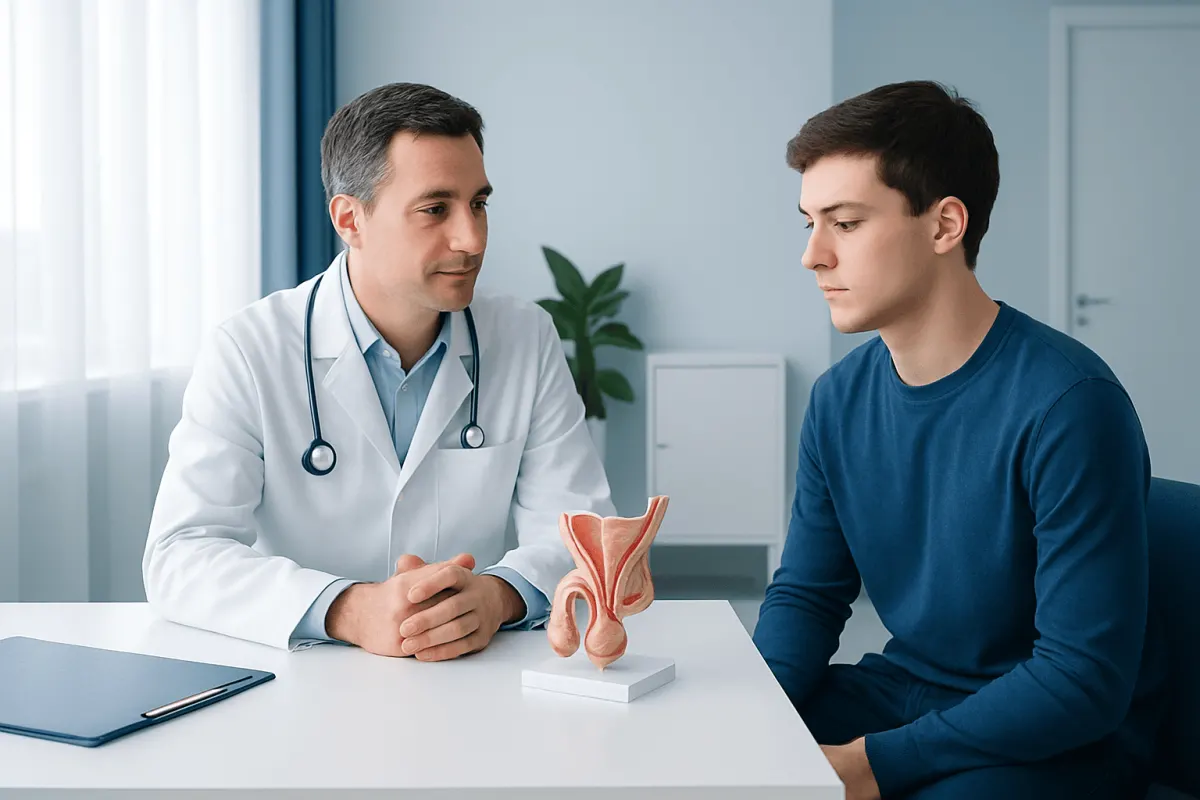
The spermatic cord carries blood vessels, nerves and the vas deferens between the abdomen and the testicle. With torsion, the cord twists around itself. This obstructs venous drainage first and can then stop arterial blood from reaching the testicle, causing increasing pain and swelling.
Under general anesthesia, a urologist makes an incision in the scrotum and gently brings out the affected testicle. The cord is untwisted, and the surgeon assesses color, circulation and tissue response. Warm saline packs may be used briefly while circulation is reassessed. If the testicle is healthy enough to preserve, it is fixed in place with orchiopexy.
Occasionally, if blood supply has been absent for too long and the testicular tissue is no longer viable, removal of the affected testicle may be necessary. This is called orchiectomy. The other testicle is still normally secured during the same operation to help prevent torsion on that side.
Emergency scrotal exploration and orchiopexy surgery provide the definitive approach when torsion is suspected. Manual untwisting performed by a clinician may sometimes temporarily improve blood flow in selected situations, but it does not replace surgery because the testicle still needs examination and fixation.
Who may need surgery and what happens step by step
Anyone with suspected testicular torsion is a potential candidate for urgent surgery. The decision is based on the pattern of symptoms, physical examination and, when appropriate, imaging findings. Surgery can be appropriate even when ultrasound is uncertain if the clinical concern remains high.
Before the procedure, the clinical team reviews medical history, allergies, recent food or drink intake and current medicines. Blood tests may be performed, although they should not delay emergency treatment. General anesthesia is typically used so the patient is asleep and does not feel the operation.
- The patient is prepared for anesthesia and the scrotal area is cleaned.
- The surgeon makes a small scrotal incision and examines the affected side.
- The spermatic cord is untwisted and the testicle is assessed for recovery of blood flow.
- If viable, the testicle is secured; if not viable, it may need to be removed.
- The unaffected testicle is usually secured during the same procedure.
- The incision is closed, and the patient is monitored while waking from anesthesia.
Securing both sides is an important part of care because a common predisposing feature, sometimes called a bell-clapper deformity, can allow increased testicular movement on either side. Orchiopexy is designed to reduce the risk of a future twist, although new scrotal symptoms should always be checked urgently.
Is testicular torsion surgery fast?
Yes. Testicular torsion surgery is usually organized as an urgent procedure because time matters. The exact timeline depends on emergency assessment, operating-room availability, anesthesia preparation and whether imaging is needed, but the medical team works to avoid unnecessary delay.
The operation itself often takes less than an hour, although the total time in hospital is longer because it includes assessment, anesthesia, preparation and recovery monitoring. If the diagnosis is uncertain, an ultrasound may help, but clinicians generally prioritize rapid surgical evaluation when torsion is strongly suspected.
Prompt surgery offers the best opportunity to restore blood flow and preserve the affected testicle. It is important not to delay going to the hospital in hopes that pain will settle, and not to eat or drink if emergency surgery may be needed unless the treating team advises otherwise.
Benefits, risks and recovery timeline
The main benefit of urgent surgery is the opportunity to save the affected testicle and relieve torsion. Fixing both testicles also greatly reduces the chance of torsion happening again. If one testicle must be removed, the remaining healthy testicle often produces enough testosterone and sperm for normal puberty, sexual function and fertility, although individual outcomes vary.
As with any operation, possible risks include bleeding, infection, bruising, scrotal swelling, anesthesia-related complications, persistent discomfort and changes in testicular size or function. Even after technically successful surgery, a testicle that had prolonged loss of blood flow can sometimes shrink over time. Follow-up helps clinicians monitor healing and discuss any concerns.
Many patients return home on the day of surgery or after a short observation period. During the first days, soreness, swelling and bruising are expected and usually improve gradually. The care team may recommend supportive underwear, rest, prescribed or over-the-counter pain relief when suitable, and cold packs wrapped in cloth for short periods.
Most people can resume gentle daily movement as they feel able, but should avoid strenuous exercise, cycling, heavy lifting and sexual activity until their surgeon confirms healing. This is commonly several weeks, though the right timeline depends on the procedure and recovery. Urology care can provide individualized aftercare and follow-up planning.
How painful is testicular torsion on a scale of 1-10?
Pain is personal, so no single number applies to everyone. However, testicular torsion often causes sudden, intense pain that many people would describe as severe, often around 7 to 10 out of 10. It may begin in the testicle but can also be felt in the groin or lower abdomen.
The pain may be accompanied by nausea, vomiting, swelling or tenderness. A testicle may look enlarged, appear higher than the other one or sit at an unusual angle. Severe pain is not the only warning sign, though: milder or intermittent pain can still represent torsion and requires urgent assessment.
Taking pain medicine may reduce discomfort temporarily, but it does not restore blood flow or rule out torsion. Any sudden testicular pain should be treated as an emergency until a qualified clinician has assessed it.
Can ejaculating fix testicular torsion?
No. Ejaculation cannot untwist the spermatic cord or restore blood flow to a testicle affected by torsion. Attempting to manage testicular pain through ejaculation, sexual activity, exercise, massage or a home remedy can delay essential emergency care.
Testicular torsion is a mechanical twisting problem, and its definitive treatment is surgical exploration and fixation. Some people may notice symptoms fluctuate if a partial twist resolves temporarily, but this does not mean the problem has been safely treated. Urgent medical evaluation is still needed because torsion can recur.
Sexual activity should also be avoided during early surgical recovery until the treating surgeon says it is safe. This helps protect the incision and reduce discomfort or swelling while the scrotum heals.
How painful is testicular torsion recovery?
Recovery discomfort is usually much less severe than the pain of untreated torsion, but it varies between people. It is common to have tenderness, tightness, bruising and swelling around the scrotum for several days. Pain generally improves gradually with rest, scrotal support and the pain-relief plan recommended by the surgeon.
Patients should contact their care team if pain is worsening rather than improving, if there is fever, increasing redness, pus-like drainage, heavy bleeding, trouble urinating or marked swelling. These symptoms do not always indicate a serious problem, but they need prompt clinical advice.
Follow-up appointments allow the surgeon to check wound healing and assess the testicles. Acıbadem Health Point’s multidisciplinary specialists and JCI-accredited hospitals provide assessment and treatment for international patients with urgent urological conditions.
Frequently asked questions
01What is the main treatment for testicular torsion?
The main treatment is emergency surgery to untwist the spermatic cord and secure the testicle in the scrotum. The surgeon usually secures the other testicle during the same procedure because it may have a similar risk of twisting.
02Can testicular torsion go away without surgery?
Sometimes a twisted testicle may temporarily untwist, and pain can lessen. However, this does not reliably solve the problem, because torsion can recur and cause loss of blood flow. Urgent medical assessment and usually surgical fixation are still needed.
03Will an ultrasound always be done before surgery?
An ultrasound may be used to evaluate blood flow when it can be performed promptly. If symptoms and examination strongly suggest torsion, clinicians may recommend immediate surgery rather than delay treatment for imaging.
04How long does it take to recover from testicular torsion surgery?
Many people can return to light daily activities within days, but scrotal soreness and swelling may take longer to settle. Strenuous exercise, cycling, heavy lifting and sex are usually postponed until the surgeon confirms it is safe, often for several weeks.
05Can a person have children after testicular torsion?
Many people retain normal fertility, especially when the affected testicle is treated quickly or when the other testicle is healthy. If one testicle is removed, the remaining testicle often provides adequate hormone and sperm production, though a doctor can discuss individual fertility questions.
06What should be done for sudden testicular pain?
Sudden testicular pain should be assessed immediately in an emergency department. It is important not to wait for the pain to improve or try home treatments, because testicular torsion is time-sensitive.
This article is for general information only and is not a substitute for professional medical advice. Please consult a qualified doctor about your individual situation.
Persistent digestive symptoms? Get evaluated in Turkey
JCI-accredited · board-certified surgeons · reply within 24h
Add us as a Preferred Source to see more of our trusted health content across Google Search, AI Overviews and Discover.