Squamous Cell Carcinoma: Symptoms, Causes, and Treatment Options

Have you noticed a rough, crusted spot on your face, ears, or hands that just won’t heal? It could be squamous cell carcinoma, a common form of skin cancer that develops from squamous cells, most often in sun-exposed areas such as the face, ears, scalp, neck, and hands. The good news: it is usually treatable, especially when found early. So if you have a scaly, crusted, or changing skin lesion that keeps hanging around, get it checked by a doctor.
Overview
Squamous cell carcinoma is a type of skin cancer that begins in the squamous cells, which make up much of the skin’s outer layer. It most often develops on areas exposed to ultraviolet (UV) radiation over time, including the face, lips, ears, scalp, neck, chest, forearms, and hands. It can also arise on scars, chronic wounds, or less commonly in areas not regularly exposed to the sun.
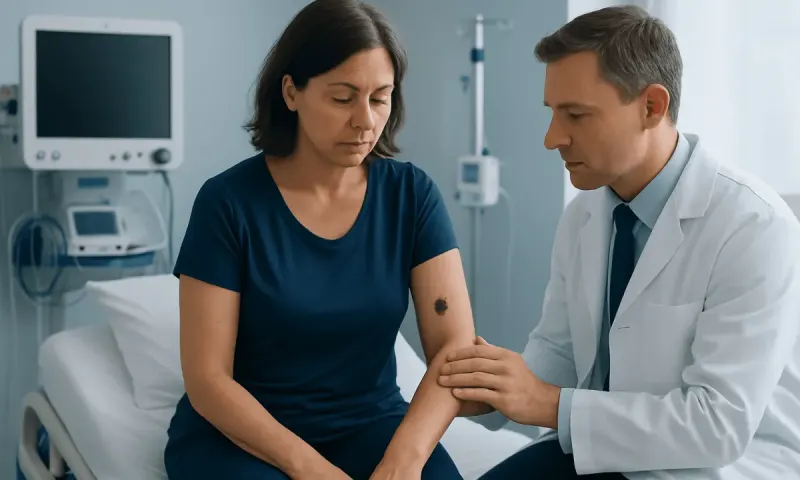
Many people first notice squamous cell carcinoma as a spot that looks rough, thickened, crusted, tender, or different from the surrounding skin. Some lesions resemble a wart, while others appear as an open sore or a firm red bump. Because these changes can be subtle at first, it is easy to mistake them for irritation, eczema, or a harmless growth.
Compared with some other skin cancers, squamous cell carcinoma has a greater chance of growing deeper into the skin and, in some cases, spreading to nearby lymph nodes or other parts of the body. That risk varies from person to person and is influenced by the tumor’s location, size, depth, and the person’s overall health. Even so, most cases can be treated effectively when diagnosed early.
It helps to know how this cancer differs from related conditions. It is not the same as basal cell carcinoma, another common skin cancer that usually grows more slowly. It can also develop from actinic keratosis, a precancerous sun-related skin change — one more reason regular skin checks matter if you have a lot of sun damage.
Symptoms and how it may look

The appearance of squamous cell carcinoma can vary. A person may notice a persistent rough or scaly patch, a raised growth with a central dip, a crusted sore, or a lump that feels firm to the touch. The surface may bleed easily, ooze, or repeatedly crust over after seeming to heal. On the lips, it may look like a chronic sore or a thickened, scaly area.
Unlike a minor cut or rash, the lesion tends to persist and slowly enlarge. It may become tender, itchy, painful, or more noticeable over weeks to months. Some tumors are small and flat at first, while others become thickened or ulcerated, meaning the surface breaks down and forms an open sore.
Common warning signs include:
- A scaly red patch that does not go away
- A wart-like growth
- A firm, dome-shaped bump
- An open sore that crusts or bleeds
- A lesion that grows, changes shape, or becomes painful
- A persistent rough or cracked area on the lip, ear, or scalp
Not every suspicious spot turns out to be cancer. But if a spot is new, changing, or not healing, have a professional look at it. And if you’ve had one skin cancer, you’re at higher risk of another — including melanoma or additional nonmelanoma skin cancers.
Causes and risk factors

The main cause of squamous cell carcinoma is cumulative ultraviolet exposure. This includes sunlight over many years as well as artificial UV sources such as tanning beds. UV radiation damages the DNA in skin cells, and repeated damage can eventually lead to uncontrolled growth.
Some people are more likely to develop this cancer than others. If you have fair skin, light-colored eyes, or light hair — and especially if you burn easily — your risk is higher. That said, squamous cell carcinoma can affect any skin tone. In darker skin, it may show up in less sun-exposed areas and can sometimes be diagnosed later because it is less expected.
Other important risk factors include older age, a personal history of skin cancer, immune suppression, chronic inflammatory skin disease, nonhealing wounds, previous radiation exposure, and contact with certain chemicals. Organ transplant recipients and others taking long-term immune-suppressing medicines need particularly careful skin monitoring.
Precancerous and related conditions can also increase risk. Actinic keratoses are common sun-damaged patches that may progress to squamous cell carcinoma in some cases. Certain forms may develop from Bowen’s disease, an early form of squamous cell carcinoma limited to the top layer of skin. Smoking is another notable risk factor for squamous cell carcinoma of the lip and some other body sites.
How doctors diagnose squamous cell carcinoma
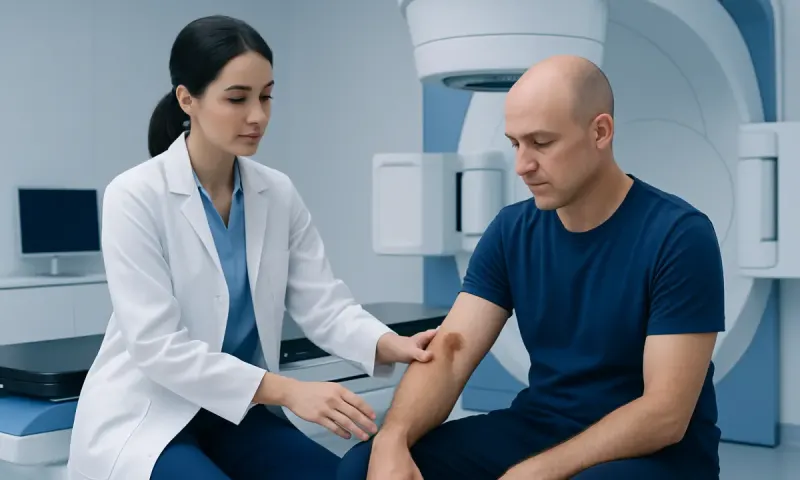
Diagnosis begins with a clinical skin examination. A doctor will ask how long the lesion has been present, whether it has changed, and whether there is a history of skin cancer, heavy sun exposure, tanning bed use, or immune suppression. The lesion’s size, texture, borders, and location all help guide the next steps.
If squamous cell carcinoma is suspected, the diagnosis is confirmed with a biopsy. This means removing all or part of the lesion and sending it to a laboratory for microscopic examination. A biopsy shows whether cancer is present and can provide information about how deeply it has grown and whether it has higher-risk features.
In selected cases, additional evaluation may be needed. A doctor may examine nearby lymph nodes if the tumor is large, deeply invasive, or located in a higher-risk area such as the ear or lip. Imaging tests are not needed for most small, early skin tumors but may be considered when spread is suspected or when a tumor has more aggressive characteristics.
People with frequent or complex skin cancers may benefit from coordinated care that includes dermatology, pathology, surgical specialists, and oncology. Depending on the case, doctors may also use dermatology evaluation and skin-focused care and advanced oncology assessment to plan the most appropriate treatment.
Treatment options
Treatment for squamous cell carcinoma is individualized. Doctors consider the tumor’s size, thickness, location, whether it has come back after previous treatment, and whether the patient has risk factors such as immune suppression. The main goal is to completely remove or destroy the cancer while preserving as much healthy tissue and function as possible.
Surgery is the most common treatment. For many tumors, simple surgical excision is effective. In some situations, especially when the cancer is on the face or in a cosmetically or functionally sensitive area, a tissue-sparing method such as Mohs micrographic surgery may be recommended. This approach removes the cancer layer by layer and checks each layer under a microscope until clear margins are reached.
Other Acne Treatment Options: Topical, Oral, and Procedure-Based Care" class="ahp-ilk">treatment options may be appropriate for select cases. These can include curettage and electrodessication for certain superficial lesions, cryotherapy in limited situations, radiation therapy when surgery is not suitable, and systemic therapies for advanced or metastatic disease. Reconstructive planning may sometimes be needed after removal of larger lesions, and this may involve plastic and reconstructive surgery when helpful.
Follow-up care matters — some people develop new skin cancers later. Your doctor will recommend skin checks based on the tumor’s risk level and your history. If the cancer is advanced, recurrent, or has spread, treatment may involve a multidisciplinary team and, in selected cases, radiation oncology or other cancer therapies.
Prevention and self-care
The most effective way to lower the risk of squamous cell carcinoma is to reduce UV exposure over a lifetime. This includes seeking shade during peak sun hours, wearing wide-brimmed hats and protective clothing, and using a broad-spectrum sunscreen with regular reapplication. Avoiding tanning beds is also important, since artificial UV radiation increases skin cancer risk.
Knowing your own skin helps you catch problems earlier. Check yourself from head to toe every so often — scalp, ears, lips, backs of the hands, even the soles of your feet. Take note of any rough, scaly, bleeding, crusted, or growing spot, and whether it sticks around beyond a few weeks.
People with a previous skin cancer, many actinic keratoses, or a weakened immune system should follow a doctor’s advice about regular professional skin exams. A clinician may recommend more frequent monitoring for higher-risk individuals. Good wound care and prompt evaluation of nonhealing ulcers or scars are also important, particularly in areas of chronic skin injury.
One warning: self-care is not a diagnosis. Don’t rely on creams, home remedies, or over-the-counter treatments instead of getting a suspicious lesion checked — waiting can let a tumor grow deeper. When in doubt, a qualified doctor can decide whether a biopsy is needed.
When to seek medical care
See a doctor about any skin lesion that does not heal, repeatedly crusts or bleeds, becomes tender, or clearly changes in size, color, or texture. The same goes for a rough spot on the lip, ear, scalp, or sun-exposed skin that persists despite basic skin care. These signs don’t always mean cancer — but they do deserve a professional look.
More urgent evaluation is reasonable if a lesion grows quickly, becomes ulcerated, causes significant pain, or is accompanied by a new lump in the nearby neck, armpit, or groin. People with immune suppression or a history of skin cancer should have a lower threshold for seeking care, since suspicious lesions in these groups can behave more aggressively.
After treatment, follow-up appointments are important to check healing and watch for recurrence or new skin cancers. Patients should ask what changes to monitor at home and how often they should return for skin exams. If additional support is needed, Acıbadem Health Point’s multidisciplinary specialists in JCI-accredited hospitals diagnose and treat squamous cell carcinoma for international patients.
Frequently asked questions
01Is squamous cell carcinoma a serious cancer?
Squamous cell carcinoma is a real skin cancer and should be taken seriously, but many cases are highly treatable when found early. The level of concern depends on factors such as the tumor’s size, depth, location, and whether it has spread.
02What does squamous cell carcinoma usually look like?
It often appears as a rough, scaly, crusted, or thickened patch, a wart-like growth, or a sore that does not heal. Some lesions bleed easily or keep returning after seeming to improve.
03Can squamous cell carcinoma spread?
Yes, it can spread, although many skin lesions are treated before that happens. The risk is higher for tumors that are larger, deeper, recurrent, on high-risk sites such as the lip or ear, or in people with weakened immune systems.
04How is squamous cell carcinoma confirmed?
A doctor confirms the diagnosis with a biopsy. This involves removing part or all of the suspicious lesion so it can be examined under a microscope.
05What is the best treatment for squamous cell carcinoma?
There is no single best treatment for every case. Surgery is commonly used, but the right option depends on the tumor’s features, where it is located, and the patient’s overall health.
06Can squamous cell carcinoma come back after treatment?
Yes, recurrence is possible, and some people also develop new skin cancers later. Regular follow-up visits and routine skin checks help detect recurrence or new lesions early.
This article is for general information only and is not a substitute for professional medical advice. Please consult a qualified doctor about your individual situation.
Hair transplant in Turkey — costs, graft counts & a free assessment
JCI-accredited · board-certified surgeons · reply within 24h
Add us as a Preferred Source to see more of our trusted health content across Google Search, AI Overviews and Discover.