Melanoma and Toenails: Causes, Symptoms, Diagnosis and Treatment

Key Takeaways
- Melanoma affecting a toenail often appears as a new or changing dark band, spot, or nail distortion.
- Not every dark nail change is cancer; trauma, fungal infection, and pigmentation can look similar.
- A doctor may need a nail exam, dermoscopy, biopsy, and sometimes imaging to confirm the diagnosis.
- Treatment usually depends on how deep the melanoma has grown and may include surgery and, in some cases, additional cancer therapies.
- Any nail pigment that is widening, painful, bleeding, or not improving should be assessed by a qualified clinician.
Melanoma can occasionally develop under or around a toenail, where it may look like a dark streak, a changing nail, or a persistent area of pigment. Early evaluation matters because nail melanoma can be mistaken for bruising or fungal changes, and prompt diagnosis helps guide the best treatment.
Overview
Melanoma and toenails are connected when a cancerous pigment-producing cell grows in or around the nail unit. This is sometimes called subungual melanoma when it begins beneath the nail plate. It is less common than melanoma on sun-exposed skin, but it deserves careful attention because it can be subtle at first and easy to mistake for a bruise, fungal infection, or harmless pigmentation.
For many people, the first clue is not pain but a visual change: a dark stripe, a patch of discoloration, a nail that begins to split, or pigment that spreads onto the surrounding skin. Because toenails are often hidden and slow to grow, changes can be overlooked for months. A timely medical review is important when a nail change does not have a clear explanation or does not grow out as expected.
In an international-patient setting, the practical concern is often deciding whether a nail change needs local follow-up or a more specialized evaluation. A specialist in dermatology or oncology can examine the nail carefully, determine whether biopsy is needed, and guide the next steps in a way that is understandable and coordinated.
Symptoms
The appearance of melanoma under a toenail can vary, but certain patterns are more concerning than others. The most recognized sign is a dark brown or black band running lengthwise along the nail. That band may become wider, darker, more irregular, or less even over time. In some people, the nail may lift, crack, or become distorted without a clear injury.
Other changes can include pigment that extends to the nearby skin at the nail edge or cuticle, a lump under the nail, bleeding, tenderness, or an ulcerated area. Sometimes the toenail becomes painful or develops a chronic wound-like appearance. These signs do not prove melanoma, but they do justify medical assessment, especially if they are new, persistent, or changing.
It helps to notice the difference between a stable, temporary injury and a lesion that evolves. A bruise from trauma often moves outward as the nail grows. Pigment from melanoma tends to persist, enlarge, or alter the nail plate and surrounding skin rather than simply grow out in a predictable way.
- A new or changing dark stripe in one toenail
- Irregular pigment reaching the cuticle or skin around the nail
- Nail splitting, lifting, or thickening without a clear cause
- Bleeding, pain, or a persistent sore under the nail
Causes & Risk Factors

Melanoma starts when melanocytes, the cells that produce pigment, develop abnormal changes and begin to grow uncontrollably. Why this happens in a toenail is not always clear. Unlike skin melanoma linked to sun exposure, nail melanoma may arise without any obvious trigger, which is one reason it can be difficult to predict.
Some factors are associated with a higher chance of melanoma in general, including personal or family history of melanoma, many atypical moles, fair skin, and older age. However, nail melanoma can still occur in people without classic risk factors. Trauma is sometimes mentioned because a nail injury may draw attention to a lesion that was already present, but trauma itself does not explain away a suspicious, persistent pigment change.
Because several common conditions can mimic melanoma, risk assessment is only one part of the picture. Fungal infection, bruising, benign melanonychia, medication-related pigmentation, and nail dystrophy can all create confusion. This is why the focus should stay on the pattern of change, not on appearance alone.
Diagnosis
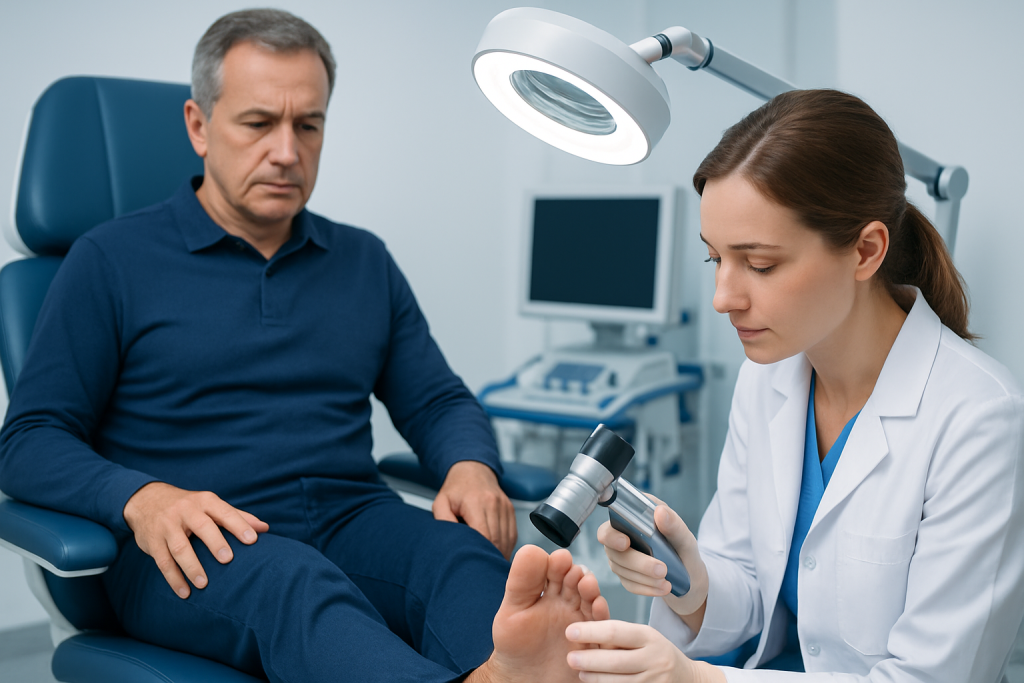
Diagnosis usually begins with a detailed history and close visual inspection of the nail and surrounding skin. A dermatologist or oncologist will ask when the change began, whether it has grown or darkened, whether there was trauma, and whether any other nails are involved. The doctor may use dermoscopy, a specialized magnified examination that can reveal pigment patterns not visible to the naked eye.
If the nail change is suspicious, biopsy is often the decisive test. Depending on the situation, the doctor may sample the nail matrix, nail bed, or nearby skin. This can sound intimidating, but it is the most reliable way to distinguish melanoma from non-cancerous causes. The exact biopsy method is chosen carefully so that the tissue most likely to show the diagnosis is examined.
After diagnosis, further tests may be used to stage the cancer and check whether it has spread. These may include imaging studies and, in some cases, evaluation of lymph nodes. The purpose is not to alarm the patient, but to map the extent of disease so the care team can choose the most appropriate treatment plan.
Treatment Options
Treatment for melanoma and toenails depends on how deep the tumor is and whether it is confined to the nail unit. Surgery is the main treatment for most localized cases. The aim is to remove the cancer completely while preserving function whenever possible. In some cases, this means removing part of the nail unit; in others, more extensive surgery may be recommended if the lesion is advanced.
If the melanoma has grown beyond the nail area or has spread to lymph nodes or other organs, additional treatment may be needed. This can include immunotherapy, targeted therapy, or other systemic cancer treatments, chosen based on the tumor’s features and the patient’s overall condition. These decisions are individualized and usually made by a multidisciplinary team.
Reconstructive planning, wound care, and mobility support can also matter, especially when a toenail or toe procedure affects walking or footwear. International patients often benefit from a coordinated pathway that includes pre-travel review, pathology confirmation, treatment scheduling, and follow-up planning before returning home. In that setting, Acibadem Health Point’s multidisciplinary specialists and JCI-accredited hospitals diagnose and treat this condition for international patients.
Prevention & Self-care
There is no guaranteed way to prevent melanoma of the toenail, but awareness helps. People should pay attention to new pigment in a single nail, especially when the change is slowly widening, irregular, or not behaving like a bruise. Photographing the nail every few weeks can help show whether the change is stable or evolving, which may be useful during a medical visit.
Self-care also means avoiding delays caused by assumptions. A nail that keeps getting treated as fungus, soaked, covered, or trimmed without improvement should be examined. If a clinician prescribes antifungal treatment and the problem does not respond as expected, it is reasonable to ask whether another diagnosis should be considered.
Protecting the feet from repeated injury, wearing well-fitting shoes, and keeping regular skin checks are sensible habits, especially for people with a personal or family history of melanoma. These measures do not replace medical evaluation, but they can support earlier recognition of changes that deserve attention.
- Track any new or changing nail pigment with photos
- Do not ignore pigment that spreads to the skin around the nail
- Seek reassessment if treatment for a presumed fungal problem fails
- Keep routine skin and nail examinations part of self-checks
When to See a Doctor
A doctor should evaluate any toenail change that is new, unexplained, persistent, or changing in appearance. This is especially important if only one nail is involved, the pigment is irregular, or the discoloration is accompanied by pain, bleeding, or nail destruction. Waiting to see whether it will simply grow out can delay diagnosis if the cause is melanoma.
Medical review is also appropriate when a nail lesion does not fit a common diagnosis. For example, a dark band that widens from the base of the nail, pigment touching the cuticle, or a spot that looks unlike a bruise should be taken seriously. A person does not need to be certain it is melanoma before seeking help; that uncertainty is exactly why examination matters.
People traveling from another country should bring any previous photos, reports, medication lists, and prior biopsy results to the appointment if available. Clear records help specialists compare changes over time and reduce unnecessary repetition of tests. Prompt evaluation offers the best chance of a straightforward treatment plan and a calmer path forward.
Frequently asked questions
01What does melanoma on a toenail usually look like?
It often appears as a dark brown or black band running lengthwise through the nail, but it may also look like a spot, nail cracking, or pigment spreading to the skin around the nail. The key concern is change over time rather than one fixed appearance. A persistent or widening mark should be checked by a doctor.
02Can a toenail melanoma be mistaken for fungus or a bruise?
Yes. Fungal infection, bruising, and benign pigment changes can resemble melanoma, especially early on. If the nail does not improve as expected or the color pattern is unusual, medical review is important.
03Is a biopsy always needed to diagnose nail melanoma?
A biopsy is often the most reliable way to confirm or rule out melanoma when a nail lesion looks suspicious. Not every nail change needs one, but if the doctor is concerned, biopsy is the test that provides the clearest answer. The type of biopsy depends on where the pigment appears to start.
04Does toenail melanoma always cause pain?
No, it may be painless at first. Some people notice only a color change or nail distortion. Pain, bleeding, or a sore can happen later, but their absence does not make the lesion harmless.
05Can melanoma under a toenail spread?
Yes, like other melanomas, it can spread if not treated. That is why early diagnosis is important even when the change seems small or slowly growing. Timely treatment gives the care team the best chance to manage it effectively.
06What should someone do if they notice a dark stripe in one toenail?
They should arrange an evaluation with a dermatologist or qualified doctor, especially if the stripe is new, widening, or irregular. Taking a photo and noting when the change began can be helpful. It is better to have it checked early than to assume it is harmless.
This article is for general information only and is not a substitute for professional medical advice. Please consult a qualified doctor about your individual situation.
Persistent digestive symptoms? Get evaluated in Turkey
JCI-accredited · board-certified surgeons · reply within 24h
Add us as a Preferred Source to see more of our trusted health content across Google Search, AI Overviews and Discover.