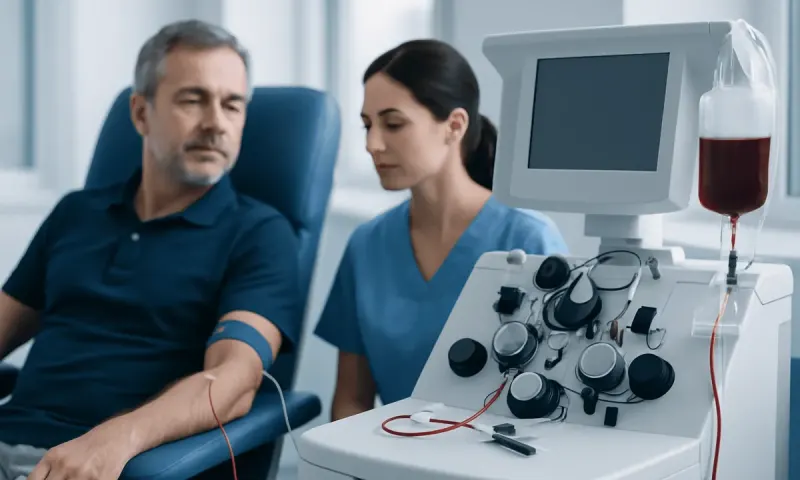
Why the Median Cubital Vein Is Used for Blood Draws

Roll up your sleeve for a blood test and you’ll notice the nurse tapping the same spot almost every time: the crook of your elbow. There’s a reason for that.
The vein they’re looking for is the median cubital vein, a superficial vein at the front of the elbow that commonly connects veins in the forearm and upper arm. It’s best known as a preferred site for blood sampling and intravenous access, because it is often visible, stable, and relatively easy to reach.
Overview: What the Median Cubital Vein Is
The median cubital vein is a superficial vein found in the antecubital fossa, the shallow hollow at the front of the elbow. In many people, it runs diagonally between the cephalic vein on the thumb side of the forearm and the basilic vein on the little-finger side. Its location close to the skin makes it easy to identify in many adults.
You’ll meet this vein during blood draws, blood donation, and when an intravenous line is placed. Clinicians reach for it because it is usually large enough to access, tends to stay relatively stable, and sits away from deeper major arteries and nerves compared with some nearby vessels.
Textbooks draw it as a neat connection between two veins, but the real pattern around the elbow differs from person to person. That variation is normal. Your healthcare professional picks the most suitable vein based on visibility, fullness, skin condition, and the reason for the procedure.
Anatomy and Function
The main job of the median cubital vein is to help return deoxygenated blood from superficial tissues of the forearm and hand toward the larger veins of the upper limb. It forms part of the superficial venous network, which lies above the muscles and fascia. This network eventually drains into deeper veins that return blood toward the heart.
Where it sits matters in practice. The vein lies superficially over a fibrous structure called the bicipital aponeurosis, which provides some separation from deeper structures. Underneath this area are the brachial artery and important nerves, so correct technique still matters, but the median cubital vein is often considered safer than attempting access in less stable superficial veins.
Normal variants are common. In some people the vein may be small, duplicated, absent, or connected differently than expected. Dehydration, low blood pressure, obesity, prior needle procedures, and certain medical conditions can also make the vein harder to see or feel. For that reason, vein selection is individualized rather than based only on textbook diagrams.
Why It Is Commonly Used for Blood Draws and IV Access

The median cubital vein is widely used in phlebotomy because it is often easy to anchor and less likely to roll under the skin than smaller superficial veins. This can make blood collection quicker and more comfortable. It is also frequently used during blood donation, where steady blood flow is important.
For intravenous access, the vein may be chosen when short-term fluids, medications, or contrast are needed. It can be suitable for some urgent situations because it is easy to reach without changing a patient’s position significantly. In many cases, however, clinicians may prefer a hand or forearm vein if repeated bending of the elbow could interfere with the IV line.
Common does not mean always best. Vein choice depends on age, skin fragility, the treatment planned, previous surgery, history of difficult access, and the need to protect veins for future care. In some circumstances, clinicians may use imaging-guided access, ultrasound guidance, or other techniques to improve safety and success.
Common Problems and Misunderstandings
Many people search for the median cubital vein because they notice bruising after a blood test or have been told this was the vein used. In most cases, temporary tenderness or a small bruise is not dangerous. Minor bleeding under the skin can happen when a needle passes through the vein wall or when pressure is not applied long enough after the needle is removed.
Another common concern is whether this vein is always visible. It is not. Even in healthy people, superficial veins can be difficult to access when a person is cold, dehydrated, anxious, or has naturally deeper veins. Visibility also changes with age, muscle mass, and skin thickness.
A lot of worry here comes from myths. The median cubital vein itself is not usually a source of disease, and a routine blood draw does not normally damage circulation in the arm. Problems are more often related to local irritation, bruising, or rarely inflammation of a vein known as superficial thrombophlebitis. Persistent or unusual symptoms should be assessed rather than guessed at. If clot-related concerns arise, doctors may evaluate for broader vascular issues such as deep vein thrombosis, although that condition typically affects deeper veins rather than the median cubital vein.
Possible Complications After Needle Access
Most procedures involving the median cubital vein are straightforward, but no needle procedure is completely risk-free. The most common minor effects are brief pain, a small bruise, mild swelling, or light-headedness. These usually improve with direct pressure, hydration, and time.
Less common complications include hematoma, where blood collects under the skin; phlebitis, which is inflammation of the vein; and infection at the puncture site. Occasionally, repeated attempts can irritate surrounding tissues. If a nearby nerve is touched, a person may feel a sharp, electric, or radiating sensation during the procedure.
In some situations, swelling of an arm vein can be associated with clotting or inflammation elsewhere in the venous system. If symptoms extend beyond the puncture site or involve significant arm swelling, color change, chest symptoms, or shortness of breath, urgent evaluation is needed. Diagnostic tests such as Doppler ultrasound may be used when a clinician needs to assess blood flow or look for a clot.
- Brief soreness for a day or two is usually mild and self-limited.
- A bruise that gradually fades is common after blood tests.
- Increasing redness, warmth, pus, or severe swelling is not typical and needs medical review.
- Repeated failed needle attempts may justify asking for a more experienced clinician or alternative access site.
How Doctors Assess Concerns Involving This Vein
Evaluation starts with a simple history and physical examination. A clinician asks when the problem started, whether a blood draw or IV was recently placed, and whether there is pain, swelling, redness, fever, numbness, or limited arm movement. They also consider medicines such as blood thinners and conditions that affect clotting or healing.
On examination, the healthcare professional looks at the skin, checks for bruising or a raised cord-like vein, and compares both arms. They may gently feel the area for warmth, tenderness, firmness, or fluid collection. If a deeper problem is suspected, pulse and nerve function may also be assessed.
Imaging is not necessary for every bruise or sore puncture site. However, if symptoms are persistent, extensive, or out of proportion to a routine procedure, ultrasound may help distinguish a superficial irritation from a clot, fluid collection, or another issue. In more complex cases involving broader circulation concerns, patients may be referred for vascular surgery assessment or other specialist care.
Self-Care, Prevention, and Recovery
After a blood draw or IV removal, the most helpful step is firm pressure on the site for several minutes, especially for people taking blood thinners. Keeping the arm still for a short time and avoiding heavy lifting immediately afterward can reduce bruising. Staying hydrated before planned blood tests may also help make veins easier to access.
If a small bruise develops, a cool pack for short periods during the first day may help with discomfort. Most bruises change color and slowly resolve over several days. Gentle movement of the arm is usually fine unless a clinician advises otherwise.
Much of this comes down to speaking up. People with difficult veins, previous fainting during blood tests, lymphedema, dialysis access, or prior surgery on an arm should tell the healthcare team beforehand. If one area has been repeatedly used or is tender, another site may be safer. For international patients who need evaluation of vein-related symptoms, Acıbadem Health Point’s multidisciplinary specialists in JCI-accredited hospitals diagnose and treat vascular concerns using evidence-based methods.
When to Seek Medical Care
Medical advice is appropriate if a puncture site becomes increasingly painful, red, warm, or swollen, or if there is ongoing bleeding that does not stop with pressure. A growing lump, pus, fever, or red streaking along the arm can suggest infection or significant inflammation and should not be ignored.
Prompt assessment is also important if numbness, weakness, hand discoloration, severe bruising, or reduced ability to move the arm develops after a blood draw or IV placement. These symptoms are not typical and may need urgent evaluation. Chest pain, shortness of breath, dizziness, or widespread swelling require immediate medical attention.
If something still bothers you, even if it looks minor, get it looked at. The median cubital vein is usually a normal, useful vein rather than a problem in itself, but lasting pain or swelling should be checked to rule out a preventable complication. A clinician can tell you whether reassurance, home care, or further testing is the right next step.
Frequently asked questions
01What is the median cubital vein?
The median cubital vein is a superficial vein located at the front of the elbow. It commonly connects the cephalic and basilic veins and is often used for blood draws because it is usually easy to access.
02Why do healthcare professionals often choose the median cubital vein for blood tests?
It is often chosen because it is close to the skin, usually has a good size, and tends to stay relatively stable during needle insertion. This can make blood collection easier and may reduce the need for multiple attempts.
03Is bruising after a blood draw from the median cubital vein normal?
A small bruise or mild tenderness is common after a blood draw and usually improves on its own. Applying pressure right after the needle is removed helps reduce bruising, but worsening pain or swelling should be checked by a doctor.
04Can the median cubital vein be absent or different from one person to another?
Yes. The vein pattern around the elbow varies naturally, and the median cubital vein may be small, differently positioned, or not obvious in some people. This is one reason clinicians assess each arm individually before a procedure.
05Can a blood draw damage the arm or circulation?
Routine blood draws do not usually harm overall circulation in the arm. Minor local effects such as bruising can happen, but serious complications are uncommon when proper technique is used.
06When should someone worry about pain at the median cubital vein site?
Medical review is a good idea if pain is increasing instead of improving, or if there is marked swelling, redness, warmth, numbness, or a firm lump. Fever, drainage, chest symptoms, or shortness of breath need urgent attention.
This article is for general information only and is not a substitute for professional medical advice. Please consult a qualified doctor about your individual situation.
Explore treatments in Turkey — costs, top hospitals & a free quote
JCI-accredited · board-certified surgeons · reply within 24h
Add us as a Preferred Source to see more of our trusted health content across Google Search, AI Overviews and Discover.