

Exercises for the Balance Ball: Safe Techniques That Actually Help
- 10 min read
- Published November 27, 2026
Key Takeaways
- Exercises for the balance ball can support core strength, balance, and posture when performed with control and correct form.
- A stable chair, wall, or trained spotter can make early practice safer, especially for beginners or older adults.
- People with back, neck, joint, or balance concerns should choose gentle exercises and avoid movements that worsen symptoms.
- The ball should be sized correctly and inflated firmly enough to allow steady sitting without sinking too deeply.
- Pain, dizziness, numbness, or repeated loss of balance are signs to stop and seek medical guidance.
Exercises for the balance ball can be a practical way to improve balance, core control, and posture when they are matched to a person’s ability and done with good technique. A safe routine starts with simple movements, builds gradually, and avoids positions that create pain, dizziness, or a fall risk.
Overview
Exercises for the balance ball are simple movements performed while sitting on, leaning against, or using a large inflatable stability ball. They are often chosen to improve core control, posture, coordination, and general mobility, especially when a person wants a low-cost tool that can be used at home or as part of rehabilitation.
The main advantage of the ball is not intensity but instability. Because the surface shifts slightly, the body has to recruit small stabilizing muscles to stay aligned. That makes even basic seated marching or gentle pelvic tilts more engaging than the same movement done on a stable chair.
For many people, the safest way to start is to use the ball as a support rather than a challenge. That means beginning with seated balance, wall-supported work, or supervised practice before moving into more demanding exercises such as planks or rollouts. The right level depends on age, fitness, joint health, and whether there is a history of falls or spine problems.
Used thoughtfully, a balance ball can fit into home exercise, physical therapy, pregnancy-related conditioning, and postural training. The key is to treat it as a tool for controlled movement, not as a test of how long a person can stay unstable.
Symptoms and goals people are trying to address
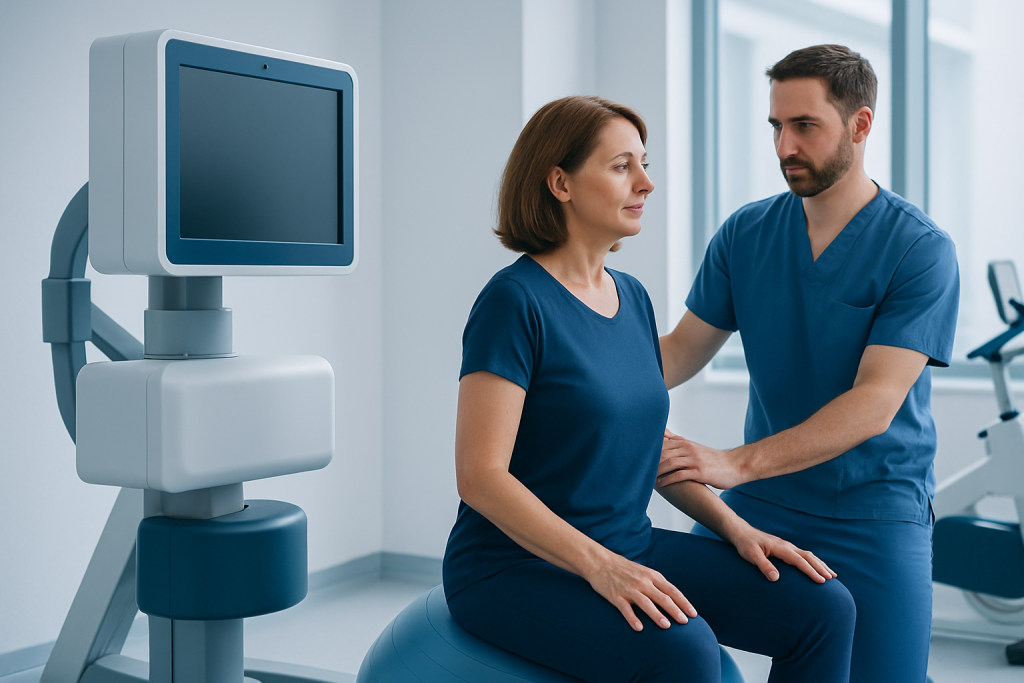
People usually look for balance ball exercises when they want to feel steadier, sit with better posture, or strengthen their abdominal and back muscles without heavy equipment. Others use the ball because it makes exercise feel more comfortable on the joints than higher-impact activities.
Common goals include better trunk stability, less slouching during desk work, improved coordination, and more confidence with everyday movement. In rehabilitation settings, the ball may also be used to retrain balance after an injury or to support gentle movement when a person is returning to activity.
It is important to separate “mild muscle effort” from warning symptoms. A workout may create fatigue in the abdomen, hips, or shoulders, but it should not cause sharp pain, spinning, numbness, tingling, shortness of breath out of proportion to effort, or a feeling that the person may fall. Those symptoms suggest the activity is not appropriate as performed.
Causes and risk factors for poor tolerance or injury

Balance ball exercises are not risky for everyone, but certain factors make them harder to use safely. The most obvious is poor balance, since the ball can roll or shift unexpectedly if the person cannot control their center of gravity.
Back, neck, shoulder, hip, or knee pain may also make some movements less suitable. For example, someone with spinal stiffness might tolerate gentle seated exercises but not deep back extensions or rollout-style movements. A person with a recent sprain, surgery, or neurological condition may need individualized guidance before using the ball at all.
Other common risk factors include using a ball that is the wrong size, placing it on a slippery floor, inflating it too little, exercising in socks on a smooth surface, or trying advanced moves before mastering basic ones. Fatigue and distraction matter too; a tired or rushed person is more likely to lose form and overreach.
For international patients who are already managing an injury or a chronic condition while traveling, those risks can be harder to judge alone. In that situation, a brief assessment before starting a new exercise routine can prevent setbacks and help choose safer progressions.
How the exercises are diagnosed, selected, or assessed
There is no medical test for deciding whether a balance ball routine is right. Instead, clinicians, physiotherapists, or exercise professionals typically assess posture, joint mobility, strength, balance, pain pattern, and past injury history to decide which movements are appropriate.
A practical assessment often includes watching how a person sits on the ball, stands up from it, and maintains alignment while performing simple movements. If a person cannot sit on the ball with feet flat and steady support, it may be better to begin with a chair, wall, or floor-based exercise before progressing.
For people with symptoms, diagnosis of the underlying problem comes first. Back pain, dizziness, repeated falls, neurological symptoms, or joint instability should be evaluated medically so that exercise recommendations match the real condition rather than the symptom alone.
In rehabilitation settings, the program is usually adjusted step by step. A therapist may start with one or two controlled exercises, observe how the body responds, and only then increase complexity, range of motion, or time spent on the ball.
Safe exercises for the balance ball
The safest exercises are the ones a person can control from start to finish. Beginners should work near a wall or sturdy surface and use slow, deliberate movement rather than large ranges or fast repetitions.
A simple starting routine may include seated balance, gentle marching, pelvic tilts, wall-supported squats with the ball behind the back, and light ball squeezes between the hands or knees. These movements encourage stability without demanding advanced strength or coordination.
- Seated balance: Sit upright on the ball with feet hip-width apart, hold a stable position, and practice breathing without slouching.
- Pelvic tilts: While seated, gently rock the pelvis forward and back to explore controlled trunk movement.
- Marching: Lift one foot a few inches at a time while keeping the torso steady and the movement slow.
- Wall-supported squats: Place the ball between the lower back and wall and bend the knees slightly, keeping the knees aligned and motion smooth.
- Ball squeeze: Press a small ball or cushion between the hands or knees to activate the inner thighs or upper body gently.
More advanced exercises, such as planks with the forearms on the ball, push-ups with the hands on the ball, bridges with the feet elevated, or rollout movements, should be reserved for people who already have strong core control and no major balance problems. Even then, these exercises are best introduced gradually and with supervision if the person is recovering from injury.
Treatment options and exercise progression
When balance ball exercise is part of a treatment plan, the “best” option is usually the least complicated exercise that still meets the goal. For example, someone recovering from deconditioning may do seated stability work first, while someone with athletic goals may later progress to dynamic core exercises.
Progression should be based on control rather than ego. A good rule is to increase one variable at a time: duration, repetitions, range of motion, or instability. Changing several factors at once makes it harder to know whether the body is adapting well.
In many programs, safe progression looks like this: sitting balance, then seated movement, then standing support exercises, then more demanding core or strength work. A therapist may also add breathing cues, posture coaching, or resistance bands to improve control without forcing the person into risky positions.
People with persistent pain, prior surgery, neurological disease, vestibular problems, or recurrent falls should not copy advanced online routines without professional input. A tailored plan is usually safer and more effective than a generic workout video.
Prevention and self-care
Good setup prevents many problems before they start. The ball should be the right size so the hips and knees are roughly level or slightly above level when seated, and the floor should be non-slip and clear of obstacles.
Appropriate footwear, a calm environment, and enough space around the ball also matter. Beginners may want to place the ball next to a wall, sturdy table, or countertop for added reassurance. People should avoid trying the first session when they are tired, dizzy, or in a hurry.
Self-care is just as important as the workout itself. Warm up with light walking or gentle mobility, breathe steadily during each movement, and stop before form starts to break down. Mild muscle fatigue is normal; pain that lingers after the session is a sign to scale back.
For people managing a long-term condition, travel, or recovery in another country, written instructions and a clear home plan can be especially helpful. A short, repeatable routine is often easier to continue safely than an ambitious plan that becomes inconsistent after the first few sessions.
When to see a doctor
A medical review is a good idea if a person has frequent falls, new dizziness, unexplained weakness, numbness, tingling, severe back or neck pain, or symptoms that worsen with exercise. These issues may point to an underlying condition that needs assessment before balance ball work continues.
It is also wise to seek care if the exercises consistently trigger pain in the joints, cause instability, or create fear of falling. A clinician or physiotherapist can modify the plan and help decide whether floor-based, chair-based, or equipment-free exercises would be safer.
People recovering from surgery, stroke, a spinal problem, or a recent injury should ask their treating team when it is appropriate to begin or resume balance ball training. If they are traveling for treatment, a coordinated plan before departure and follow-up afterward can help keep exercise goals realistic and safe.
Acibadem Health Point’s multidisciplinary specialists and JCI-accredited hospitals can diagnose and treat these conditions for international patients, with exercise guidance integrated into broader medical care when needed.
Frequently asked questions
01Are exercises for the balance ball good for beginners?
Yes, they can be good for beginners if the routine starts with simple seated balance and gentle movements. The safest approach is to use a stable surface nearby and progress slowly. Beginners should avoid advanced exercises until they can control basic positions comfortably.
02What muscles do balance ball exercises work?
They commonly engage the abdominal muscles, back muscles, hips, glutes, and shoulder stabilizers. Some movements also challenge the legs and inner thighs. The exact muscles depend on whether the person is sitting, squatting, bridging, or using the ball for support.
03Can balance ball exercises help with back pain?
They may help some people by improving posture, trunk control, and movement awareness. However, not every type of back pain responds the same way, and some movements can worsen symptoms. A healthcare professional can suggest safer exercises based on the cause of the pain.
04How long should someone sit on a balance ball?
There is no single ideal time, especially for beginners. Short periods with good posture are usually better than sitting for long stretches and losing alignment. The goal is controlled practice, not prolonged strain.
05Is it safe to do balance ball exercises every day?
It can be safe for some people if the routine is light, controlled, and does not cause pain or fatigue that carries into the next day. More intense sessions usually need rest between workouts. Consistency matters, but recovery is part of safe training.
06What should someone avoid when using a balance ball?
They should avoid slippery floors, overinflated or underinflated balls, fast or jerky motions, and advanced exercises before mastering the basics. It is also best to stop if dizziness, sharp pain, or loss of balance appears. Those signs mean the routine should be reassessed.
This article is for general information only and is not a substitute for professional medical advice. Please consult a qualified doctor about your individual situation.
Joint and spine care in Turkey — expert assessment & treatment
JCI-accredited · board-certified surgeons · reply within 24h
Add us as a Preferred Source to see more of our trusted health content across Google Search, AI Overviews and Discover.



How can we help you today?
Meet an Acibadem specialist by secure video, before you travel.
Book a video visit