Blood in Tears Often Comes From Outside the Eye Itself
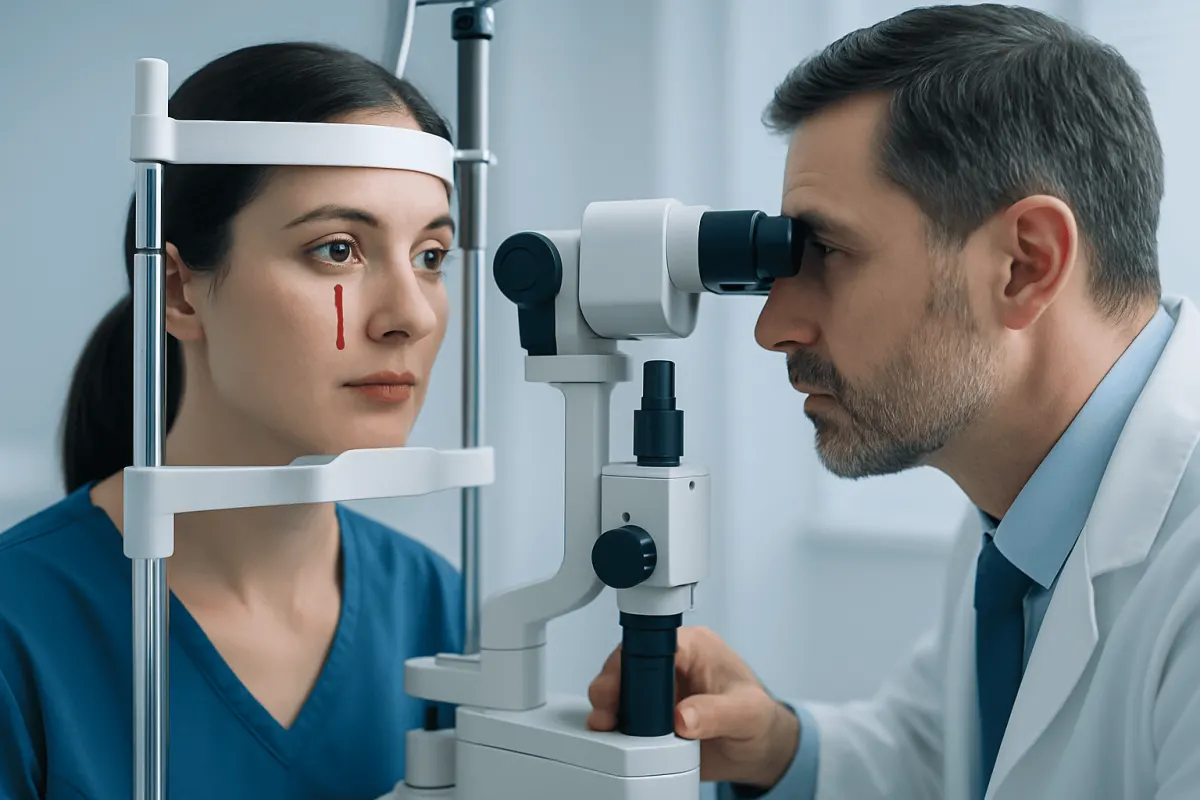
You wipe your eye and the tissue comes away pink. Or you glance in the mirror and see a rust-coloured streak running down your cheek. It is frightening to see, and understandably so.
Blood or blood-stained fluid in tears has a medical name: haemolacria. It is uncommon, and it is often linked to a treatable condition affecting the eye, the eyelids, the tear drainage system, the nose, or nearby tissues. That is why getting checked quickly matters.
What does crying blood mean?
Crying blood means tears that look pink, red, rust-coloured, or visibly mixed with blood. Doctors call it haemolacria. As alarming as it looks, it does not always mean the bleeding starts inside the eye. It may come from the surface of the eye, the eyelids, the tear drainage passages, or sometimes the nose and the structures around it.
The explanations range from minor irritation to conditions that need specific treatment. Please don’t try to work out the source from the colour alone — you can’t. An eye specialist, or another qualified clinician, can find where the blood is coming from and tell you whether it needs urgent attention.
Blood-stained tears can happen at any age, though the likely causes and the way doctors investigate them differ between newborns, children, and adults. The episode may involve one eye or both eyes, happen once, or recur. These details, along with associated symptoms such as pain, discharge, nosebleeds, bruising, or changes in vision, give important clues to the clinician.
How the eyes and tear ducts are connected
Tears are produced by glands around the eye and spread across the eye surface when a person blinks. They then drain through tiny openings at the inner corner of each eyelid, called puncta. From there, tears move through small channels into the lacrimal sac and nasolacrimal duct, eventually reaching the nose.
This normal connection helps explain why blood in tears may sometimes be linked to a nosebleed. Blood can occasionally move backward through the tear drainage system and emerge near the eye, particularly if there is pressure in the nose or a blockage in the drainage pathway. Conversely, bleeding near the eye may drain toward the nose.
Blood can also mix with tears because of a small cut on the eyelid, an inflamed conjunctiva, a scratched eye surface, or bleeding from tissue around the puncta. A careful examination is needed to distinguish these possibilities from bleeding that appears to come from deeper parts of the eye or from another source.
Possible causes of blood in tears

Minor local causes are relatively common. Rubbing the eye forcefully, a foreign particle, contact lens irritation, dry eye-related surface injury, or trauma can damage delicate blood vessels. Infections and inflammation involving the conjunctiva, eyelids, tear sac, or tear ducts may also lead to redness, discharge, swelling, tenderness, and occasionally blood-stained tears.
Nosebleeds are another possible explanation because the nose and tear drainage pathways communicate. Nasal inflammation, injury, severe congestion, or nosebleed management involving pressure may be relevant. Less commonly, abnormalities such as a growth, vascular lesion, stone-like deposit, or obstruction in the tear drainage system can cause repeated bleeding and require specialist assessment.
Some people bleed more easily because of medicines that affect clotting, including anticoagulants and antiplatelet medicines, or because of an underlying bleeding or platelet disorder. High blood pressure alone does not usually explain haemolacria, but it may be considered alongside other health factors. Rarely, bleeding can be associated with tumours or systemic disease, which is one reason recurrent or unexplained episodes should be investigated rather than ignored.
Sometimes no cause turns up despite appropriate testing, and doctors then call it idiopathic haemolacria. But that label belongs at the end of the process, only after a clinician has ruled out the more common and more important explanations.
Symptoms that may occur alongside crying blood
The appearance of the tears may range from a faint pink tinge to bright-red blood. A person may notice the blood while wiping tears, after waking, during a nosebleed, or in association with eye discomfort. How much blood you see tells you little about how serious the cause is — but heavy or persistent bleeding always needs prompt medical attention.
Associated eye symptoms may include itching, burning, a gritty sensation, redness, swelling, light sensitivity, eyelid tenderness, discharge, or a feeling that something is in the eye. These symptoms can point toward irritation, allergy, infection, inflammation, or injury. Pain inside the eye, marked sensitivity to light, or reduced vision can indicate a more urgent eye problem.
Other useful clues include nasal bleeding or congestion, easy bruising, bleeding gums, prolonged bleeding from small cuts, fever, recent facial injury, surgery, use of contact lenses, and recent changes in medicines. A clinician may ask whether the episode occurs during menstruation, since rare hormonally associated cases have been described, but other causes should still be assessed.
How doctors diagnose the cause
Evaluation usually begins with a medical history and examination of the eye area. The clinician may ask when the bleeding started, whether it has happened before, whether it affects one or both eyes, and whether there has been trauma, rubbing, infection symptoms, a nosebleed, or use of medicines that influence bleeding. Bringing a clear photograph of an episode can be helpful if the bleeding has stopped before the appointment.
An eye examination may include checking visual acuity, eye movements, eyelids, the eye surface, and the tear drainage openings. Special dyes or magnification may be used to look for corneal scratches, foreign material, inflammation, or small bleeding points. The doctor may gently assess the tear drainage pathway and may arrange an ear, nose, and throat evaluation if a nasal source is possible.
Depending on the findings, tests may include blood tests to assess blood cell levels and clotting, imaging of the orbit or sinuses, nasal examination, or assessment of the tear ducts. Testing is tailored to the individual rather than performed routinely for every person. The aim is to locate the source, identify factors that increase bleeding, and rule out conditions needing timely treatment.
Treatment and practical self-care
Treatment focuses on the cause of the bleeding. A superficial injury may need protective care and follow-up, while infection or inflammation may require prescription treatment selected by a clinician. Tear-duct blockage, a lesion, or a structural problem may require a procedure or surgery after specialist assessment. If a nosebleed is contributing, treatment may also address nasal irritation or bleeding.
People taking anticoagulants, antiplatelet medicines, or other medicines that may affect bleeding should tell the doctor about all prescriptions, over-the-counter products, and supplements. They should not stop or change these medicines on their own, as sudden changes can create important health risks. The prescribing clinician can advise whether any adjustment is appropriate.
Until assessed, it is sensible to avoid rubbing or pressing on the eye, wearing contact lenses if the eye is painful or red, and using medicated eye drops that have not been recommended. If a foreign object may be present, the eye should not be probed or rubbed. Jotting down when the episodes happen, which side is affected, and what else you notice can genuinely help with the diagnosis.
At Acıbadem Health Point, our multidisciplinary specialists and JCI-accredited hospitals can look at the eye, tear-duct, nasal, and general health factors behind haemolacria in international patients. Whatever the plan, it should be built on your own examination and test results.
When to seek medical care
Any first episode of crying blood should be discussed with a doctor or eye specialist, particularly if there is no obvious minor explanation. A same-day assessment is advisable when bleeding recurs, comes from one side repeatedly, follows an eye or facial injury, or occurs with eye redness, swelling, discharge, or nosebleeds. Children and newborns with blood-stained tears should also be assessed promptly.
Urgent medical care is needed if there is severe eye pain, sudden blurred or lost vision, double vision, a chemical exposure, a penetrating injury, uncontrolled bleeding, fainting, severe headache, or signs of significant illness. Emergency assessment is also important if there are widespread unexplained bruises, bleeding elsewhere in the body, or symptoms suggesting a serious reaction to an injury.
While waiting for care, a person may gently blot tears with a clean tissue or sterile gauze without applying pressure to the eye. If there has been a chemical splash, the eye should be rinsed immediately with clean lukewarm water for at least 15 minutes while urgent medical advice is sought. For suspected eye injury, it is safer not to attempt to remove an embedded object.
Frequently asked questions
01Is crying blood dangerous?
Crying blood can result from a minor problem, such as surface irritation or a nosebleed reaching the tear ducts, but it can also signal a condition that needs treatment. It should therefore be assessed by a qualified clinician, especially if it is recurrent or unexplained. Severe pain, vision changes, injury, or heavy bleeding require urgent care.
02Can a nosebleed cause blood to come from the eye?
Yes. The tear drainage system connects the inner corner of the eye to the nose, so blood can occasionally travel backward through this pathway during a nosebleed. This is uncommon, but it is anatomically possible. A clinician can help confirm whether the nose is the likely source.
03Can stress cause crying blood?
Stress and emotional crying do not usually directly cause haemolacria. However, crying, rubbing the eyes, raised pressure from straining, or an existing nosebleed may make an underlying issue more noticeable. Blood in tears should not be attributed to stress without a medical assessment.
04Can contact lenses cause blood-stained tears?
Contact lenses can contribute to eye-surface irritation or a scratch, particularly if they are worn for too long, are poorly fitted, or are used when the eyes are dry or infected. This can occasionally lead to blood mixing with tears. Contact lenses should be removed if there is pain, redness, bleeding, or reduced vision, and medical advice should be sought.
05What doctor should a person see for crying blood?
An ophthalmologist or eye doctor is often the most appropriate specialist, particularly if the blood seems to come from the eye or eyelids. Depending on the findings, care may also involve an ear, nose, and throat specialist, primary care doctor, or blood specialist. Urgent symptoms should be assessed through emergency services.
06Will crying blood go away on its own?
It may stop when a minor cause, such as brief irritation or a resolved nosebleed, settles. However, the visible bleeding stopping does not identify the cause or rule out recurrence. Medical review is recommended to determine whether treatment, monitoring, or further testing is needed.
This article is for general information only and is not a substitute for professional medical advice. Please consult a qualified doctor about your individual situation.
Explore treatments in Turkey — costs, top hospitals & a free quote
JCI-accredited · board-certified surgeons · reply within 24h
Add us as a Preferred Source to see more of our trusted health content across Google Search, AI Overviews and Discover.