CCTA vs Stress Test: Which Heart Test Fits?
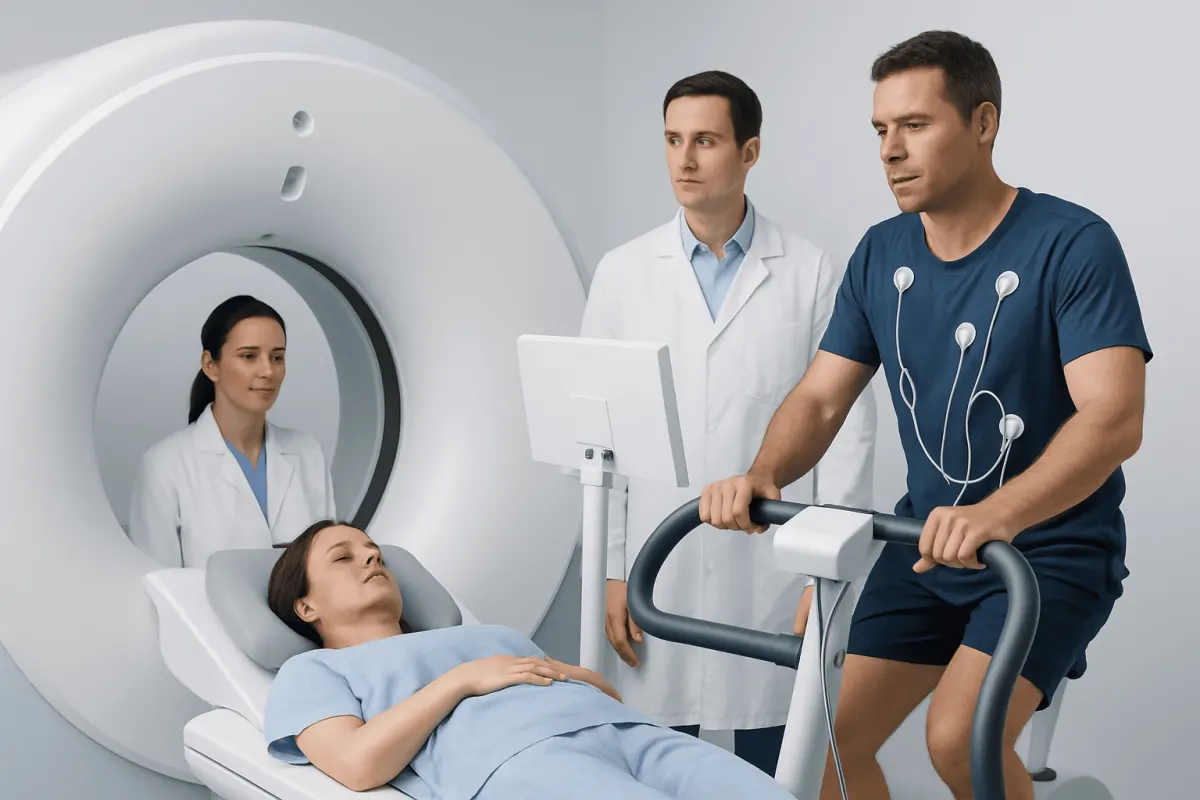
CCTA and stress tests answer different heart-health questions. CCTA looks directly at the coronary arteries for plaque or narrowing, while a stress test looks for evidence that the heart muscle is not receiving enough blood during exercise or medication-induced stress.
CCTA vs Stress Test: A Side-by-Side Comparison
In the comparison of CCTA vs stress test, the key difference is what each examination measures. Coronary computed tomography angiography (CCTA) uses CT imaging and contrast dye to create detailed pictures of the coronary arteries. It can identify calcified and non-calcified plaque and estimate whether an artery is narrowed.
A stress test evaluates how the heart performs when it is working harder. Exercise on a treadmill is commonly used, although medication can safely simulate stress when a person cannot exercise adequately. Depending on the test, clinicians assess ECG changes, heart-wall motion on ultrasound, or blood flow images obtained with a nuclear tracer.
| Feature | CCTA | Stress test |
|---|---|---|
| Main question | Are there plaque deposits or narrowings in the coronary arteries? | Is a narrowing reducing blood flow to the heart during stress? |
| Type of assessment | Anatomical | Functional |
| Common forms | CT coronary angiography, sometimes with calcium scoring | Exercise ECG, stress echocardiography, Echocardiogram: Which Heart Test May Be Better?" class="ahp-ilk">nuclear stress test |
| Exercise required | No | Often, but medication-based options are available |
| Radiation | Usually involves radiation | None with stress echo; possible radiation with nuclear stress testing |
| Contrast material | Iodine-based CT contrast is usually used | Nuclear testing uses a radiotracer; stress echo usually does not require contrast |
Both tests can be useful for evaluating possible coronary artery disease. A clinician considers the person’s symptoms, age, risk factors, kidney function, ability to exercise, prior test results and the local availability of appropriate imaging before recommending one test over another.
How Clinicians Tell the Tests Apart
CCTA is often particularly useful when a clinician needs to rule out or identify coronary artery plaque in a person with stable chest symptoms and no known coronary artery disease. A high-quality CCTA can be reassuring when it shows no plaque or no significant narrowing. It may also reveal early plaque that has not yet caused a measurable reduction in blood flow.
Stress testing is often useful when the clinical question is whether symptoms could be caused by ischemia, meaning insufficient blood supply to the heart muscle during exertion. An exercise ECG may be appropriate in selected people who can exercise and have an ECG that can be interpreted. Stress echocardiography uses ultrasound to look for changes in heart-wall motion, while nuclear stress testing compares blood flow at rest and during stress.
The differences between CCTA vs stress echo and CCTA vs nuclear stress test are therefore meaningful. Stress echocardiography avoids ionizing radiation and can assess valves and heart muscle function at the same time. Nuclear stress testing can be especially informative when clearer assessment of blood-flow distribution is needed, although it involves a radiotracer and radiation exposure.
Some people need more than one test. For example, CCTA may find an intermediate narrowing whose effect on blood flow is uncertain, or a stress test may suggest ischemia without showing which artery is responsible. The next step may be additional non-invasive imaging, medical treatment and follow-up, or—in selected cases—an invasive coronary angiogram.
Is a CCTA Better Than a Stress Test?

A CCTA is not universally better than a stress test; each test provides different information. CCTA is generally strong for detecting or excluding coronary plaque and narrowing, especially in people with stable symptoms and a low-to-intermediate likelihood of obstructive coronary artery disease. It can help clarify whether symptoms are likely to have an artery-related cause.
A stress test may be preferred when the focus is on whether a known or suspected narrowing limits blood supply during activity. It can also be practical for people who cannot receive iodinated contrast or who have certain CT-related limitations, such as an irregular or very fast heart rhythm that may reduce image quality. The choice should be individualized rather than based on a single rule.
CCTA may be less suitable for some people with severe kidney impairment, a serious prior contrast reaction, or extensive coronary calcification that makes images harder to interpret. Stress testing may be less definitive when a person cannot exercise and the selected testing method has technical limitations. A clinician will discuss benefits, limitations and preparation before testing.
For people with established heart disease, test selection also depends on prior stents, bypass surgery, medications and the current symptom pattern. Preventive care and treatment decisions are guided by the full clinical picture, not by a scan result alone.
What Is the Most Accurate Test for Heart Blockage?
There is no one test that is most accurate for every meaning of “heart blockage.” For finding plaque and narrowing in the coronary arteries non-invasively, CCTA is highly useful because it visualizes the artery anatomy directly. However, a visible narrowing does not always reduce blood flow enough to cause symptoms or require a procedure.
For determining whether a narrowing is functionally important, stress imaging can provide valuable evidence of ischemia. Stress echocardiography and nuclear stress tests assess the consequences of reduced blood supply during stress rather than simply the appearance of an artery. This is why ccta vs stress testing is not simply a contest between two tests.
Invasive coronary angiography remains an important reference procedure when there is a high concern for significant coronary disease, when non-invasive test results are unclear, or when treatment such as angioplasty may be needed. During angiography, clinicians can also use specialized pressure-wire measurements to assess whether a narrowing is limiting flow.
“Heart blockage” can also refer to an electrical conduction problem, such as heart block. Coronary imaging and stress tests do not diagnose electrical heart block; ECG monitoring and cardiology assessment are used for that different condition.
What Is the Average Coronary Calcium Score for a 60 Year Old?
There is no single average coronary calcium score that can reliably define what is normal for every 60-year-old. Calcium scores vary substantially by sex, ancestry, cardiovascular risk factors and whether a person already has known coronary disease. A score of zero means no calcified plaque was detected, but it does not exclude non-calcified plaque or eliminate all future cardiovascular risk.
Coronary calcium scoring is usually reported in broad categories: zero; 1 to 99; 100 to 399; and 400 or higher. Higher scores generally indicate a greater overall burden of calcified coronary plaque and a higher long-term cardiovascular risk. Clinicians may also compare a score with age- and sex-based percentiles rather than relying only on the absolute number.
A calcium score is not the same as CCTA. Calcium scoring is a non-contrast CT scan that measures calcified plaque, while CCTA uses contrast to evaluate the artery lumen and can show both calcified and non-calcified plaque. A person with chest symptoms may need CCTA or another appropriate test rather than calcium scoring alone.
Results are best discussed with a qualified clinician, who can place them alongside blood pressure, cholesterol, diabetes status, smoking history, family history and lifestyle. The aim is to support prevention and informed decision-making, not to create anxiety over one number.
What Does It Mean if My Echocardiogram Is Normal but My Stress Test Is Abnormal?
A normal resting echocardiogram with an abnormal stress test can occur because the two tests examine the heart under different conditions. A resting echocardiogram assesses heart chamber size, pumping function, valves and wall motion while the body is at rest. It may be completely normal even when blood-flow limitations only appear during exertion or medication-induced stress.
An abnormal stress test can suggest possible ischemia, but it does not automatically confirm a significant coronary blockage. Some results are false-positive, particularly when the ECG is difficult to interpret or when imaging quality is limited. Other causes of abnormal findings may include high blood pressure responses to exercise, rhythm disturbances, anemia, medication effects, or conditions affecting the heart’s smaller blood vessels.
The next step depends on the type and degree of abnormality, symptoms and overall risk. A clinician may review the original test, adjust medications, request CCTA or another imaging study, or refer for invasive angiography when concern is higher. New symptoms should be described clearly, including what brings them on, how long they last and what relieves them.
People should not stop prescribed heart medicines or begin strenuous exercise based only on a test result without medical advice. A cardiology review can help put apparently conflicting results into context.
What to Do Before and After Each Test
Preparation instructions vary by test center and by medication. For a CCTA, patients may be asked to avoid caffeine for a period beforehand, have blood tests to assess kidney function when appropriate, and report any previous contrast reaction. Heart-rate-lowering medication may be used by the clinical team to improve image quality in some cases.
For an exercise stress test, comfortable walking shoes and clothing are usually helpful. The care team may give specific instructions about food, caffeine, diabetes medicines, inhalers or heart medicines. People should not independently stop beta blockers, blood pressure medicines or other prescribed medication unless the testing clinician tells them to do so.
After CCTA, drinking fluids may be recommended when medically appropriate to support contrast clearance. After a stress test, most people can return to usual activities unless they are given different instructions. Results may be available promptly in some settings, but a complete interpretation should consider symptoms and medical history.
Healthy lifestyle measures remain important whether testing is normal or abnormal. These include not smoking, regular activity suited to the person’s health, a heart-healthy eating pattern, sleep, stress management and management of blood pressure, cholesterol and diabetes. Cardiology assessment can help create an appropriate prevention or treatment plan.
When to Seek Medical Care
Medical assessment should be arranged for recurring chest pressure, tightness, burning or discomfort brought on by exertion or emotional stress, particularly when it improves with rest. Evaluation is also appropriate for unexplained shortness of breath, reduced exercise tolerance, palpitations, dizziness or unusual fatigue, especially in people with cardiovascular risk factors.
Emergency care is needed for chest pain, pressure or discomfort that is severe, new, persistent, or accompanied by shortness of breath, sweating, nausea, fainting, pain spreading to the arm, jaw, back or shoulder, or a sense of impending collapse. Symptoms can vary, particularly in women, older adults and people with diabetes, so it is safer not to dismiss concerning changes.
People with an abnormal CCTA or stress-test result should follow up promptly with the clinician who ordered it. The result may require no urgent intervention, but it should be interpreted in context and used to guide the next appropriate step.
Acıbadem Health Point’s multidisciplinary specialists at JCI-accredited hospitals assess and treat heart conditions for international patients, with testing choices tailored to the individual clinical situation.
Frequently asked questions
01Is CCTA painful?
CCTA is usually not painful. It involves lying still on a CT table while contrast material is injected through an intravenous line; some people briefly feel warmth or a metallic taste. The scan itself is quick, although preparation can take longer.
02Can CCTA show a heart attack?
CCTA can show coronary plaque and narrowed coronary arteries that may contribute to a heart attack risk. It is not the main emergency test for diagnosing an active heart attack, which requires urgent clinical assessment, ECG testing and blood tests such as cardiac troponin. Emergency teams select imaging based on the individual situation.
03Which stress test is best: treadmill, stress echo or nuclear stress test?
The best stress test depends on the person’s ability to exercise, resting ECG, body habitus, symptoms and medical history. A treadmill ECG is simpler but provides less imaging information, while stress echo and nuclear testing add imaging of heart function or blood flow. A clinician can explain which option is most suitable.
04Can a normal CCTA rule out coronary artery disease?
A normal, high-quality CCTA is very reassuring for significant coronary artery narrowing and can show whether plaque is absent. However, no test eliminates all cardiac causes of symptoms, including small-vessel disease or non-coronary heart conditions. Persistent or worsening symptoms still need medical review.
05Why might a stress test be abnormal if CCTA is normal?
This can happen because stress testing and CCTA measure different aspects of heart health. An abnormal stress result may be a false-positive or may reflect small-vessel dysfunction, blood pressure changes, rhythm issues or another non-obstructive cause. A clinician may recommend further assessment based on symptoms and the exact findings.
06Does a coronary calcium score replace a stress test or CCTA?
No. A coronary calcium score measures calcified plaque and is mainly used to help estimate cardiovascular risk in selected people. It does not show blood-flow changes during stress and does not provide the same assessment of artery narrowing as contrast-enhanced CCTA.
This article is for general information only and is not a substitute for professional medical advice. Please consult a qualified doctor about your individual situation.
Explore treatments in Turkey — costs, top hospitals & a free quote
JCI-accredited · board-certified surgeons · reply within 24h
Add us as a Preferred Source to see more of our trusted health content across Google Search, AI Overviews and Discover.