Brain MRI Price: What Affects Your Final Cost?
A brain MRI price cannot be predicted from one figure because charges depend on the country, facility, insurance plan, scan protocol and whether contrast material is needed. Patients can usually get a clearer estimate by asking for the self-pay price, insurance estimate and separate professional fees before the scan is scheduled.
Brain MRI Price: The Answer Depends on Several Costs
Brain MRI price varies substantially, so there is no single amount that applies to every patient. The final charge may depend on where the scan is performed, whether it is done in a hospital or independent imaging center, the strength and type of MRI equipment, the need for contrast material, and whether the examination is routine or urgent.
Insurance coverage can also change what a patient pays. Some plans apply a copay, while others require the patient to meet a deductible or pay coinsurance. Before booking, patients can ask the imaging provider and insurer for an estimate based on the exact MRI order and their individual coverage. A written estimate is especially useful because facility, radiologist and contrast-related charges may be billed separately.
A brain MRI is usually requested to help clinicians investigate symptoms or monitor a known condition. Cost is an important practical consideration, but it is also important not to delay urgent assessment for warning signs such as sudden weakness, trouble speaking, a seizure, or an abrupt severe headache.
How a Brain MRI Works and Why It May Be Requested
MRI stands for magnetic resonance imaging. It uses a powerful magnetic field, radio waves and computer processing to create detailed pictures of the brain and nearby structures. Unlike X-rays and CT scans, MRI does not use ionizing radiation.
A clinician may recommend a brain MRI for persistent or unexplained neurological symptoms, changes seen on another test, follow-up after injury, or monitoring of a diagnosed condition. It can help assess structures including brain tissue, blood vessels, the pituitary area, nerves and the spaces around the brain. Depending on the clinical question, the order may be for an MRI without contrast, with contrast, or both.
Contrast is a medicine injected into a vein during some MRI examinations. It can make certain tissues, inflammation, blood vessels or abnormal areas easier to evaluate. The decision to use it is based on the reason for the scan, medical history and kidney function where relevant. A formal radiology report is then sent to the referring clinician, who interprets the findings in the context of the patient’s symptoms and examination.
Who May Need a Brain MRI and What Affects the Scan Plan

Brain MRI may be appropriate when a qualified clinician believes detailed brain imaging could help answer a specific medical question. Common reasons include ongoing headaches with concerning features, unexplained seizures, dizziness with neurological signs, changes in vision, weakness, numbness, balance difficulties, cognitive changes, suspected inflammation or infection, and follow-up of a known neurological disorder.
Not every headache, episode of dizziness or memory concern requires MRI. The clinician considers the symptom pattern, examination findings, age, medical history and results of other tests. In some situations, a CT scan, blood test, eye examination or observation may be more appropriate first steps.
Patients should tell the MRI team about implanted devices, previous surgery, metal fragments, kidney disease, pregnancy, allergies and claustrophobia. Many implanted devices are MRI-compatible, but they must be checked carefully before scanning. People with certain devices or metal in the body may need a modified approach or another imaging test.
- The type of MRI ordered: without contrast, with contrast, or both
- The body area and specialized imaging sequences needed
- Whether sedation, monitoring or accessibility support is required
- The setting: outpatient imaging center, hospital department or emergency service
What Happens During a Brain MRI?
Before the appointment, the patient is asked to complete a safety questionnaire and remove metal objects such as jewelry, watches, hearing aids, hairpins and some removable dental items. Clothing may need to be changed if it contains metal fasteners or fibers. The team checks for medical implants and confirms whether contrast will be used.
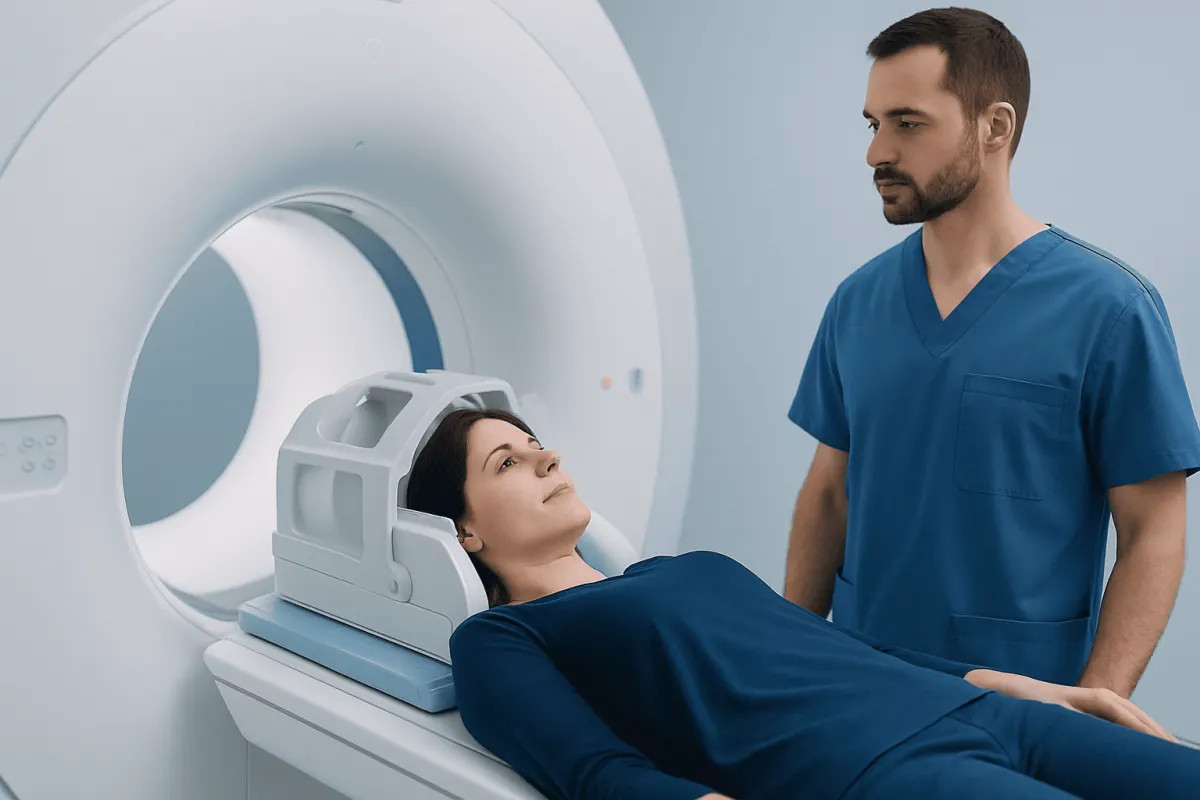
During the scan, the patient lies on a padded table that moves slowly into the MRI scanner. A special device, called a head coil, is placed around the head to help produce high-quality images. The patient needs to remain still, but can communicate with staff through an intercom. Ear protection is provided because the machine makes loud tapping and knocking sounds.
If contrast is needed, an intravenous line is placed and the contrast is given during part of the examination. Most brain MRI scans take roughly half an hour to an hour, although timing can vary with the protocol, the need for repeat images and the patient’s ability to remain comfortable and still. The imaging team can explain the expected steps before the scan begins.
Recovery, Benefits and Possible Risks
Most people can return to normal activities immediately after a brain MRI. The scan itself is painless, although lying still in a confined space can feel uncomfortable for some people. Those who receive medication for anxiety or sedation may need someone else to take them home and should follow the recovery instructions provided by the care team.
The main benefit of brain MRI is detailed imaging without ionizing radiation. It can provide information that helps clinicians confirm or rule out possible causes of symptoms, plan further testing, monitor treatment or decide whether specialist care is needed. However, an MRI result is only one part of medical assessment and may not always identify the cause of a symptom.
MRI is generally considered safe when screening procedures are followed. Potential concerns include anxiety in enclosed spaces, discomfort from lying still, and the risk posed by incompatible metal implants or fragments. Contrast reactions are uncommon but possible, and contrast may require special consideration in people with significant kidney problems. Patients should report any symptoms during or after the scan and discuss individual risks with their clinician.
How Much Would a Brain MRI Cost Without Insurance?
Without insurance, the brain MRI cost is set by the provider and can differ greatly by region and facility. A hospital-based scan may be priced differently from an outpatient imaging center, and the total can be higher when contrast, an urgent appointment, sedation, specialist monitoring or additional imaging sequences are required.
Patients paying themselves can ask the provider for a self-pay or cash price for the exact examination ordered. They should also ask whether the estimate includes the technical scan charge, radiologist interpretation, contrast material, intravenous supplies and any facility fee. Asking for the estimate in writing can make it easier to compare options and avoid confusion about separate bills.
A lower quoted price is not always the best choice if the center cannot perform the required protocol, cannot accommodate an implanted device, or cannot provide timely reporting. The referring clinician may be able to advise whether an accredited outpatient imaging center is clinically appropriate for the patient’s needs.
Why Is the MRI Copay So High?
An MRI copay may feel high because advanced imaging is often placed in a higher-cost benefit category by insurance plans. Depending on the policy, the patient may owe a fixed copay, coinsurance based on the insurer’s allowed amount, or the full cost until the annual deductible has been met.
Coverage also depends on network status, prior authorization rules and medical-necessity criteria. If a facility is out of network, the patient’s share may be higher. The insurer can explain the expected out-of-pocket cost, but the estimate may change if the ordered study, facility or coding changes.
Before the appointment, patients can contact their insurer with the planned facility and the MRI order details. It is reasonable to ask whether prior authorization is needed, whether contrast is covered, what amount remains on the deductible, and whether a different in-network imaging location may reduce the patient’s responsibility.
Do Doctors Get Paid for MRI Referrals?
In many healthcare systems, clinicians do not receive a direct payment simply for referring a patient for an MRI. A referral is generally made because the clinician believes imaging may be medically useful for diagnosis, treatment planning or follow-up. Payment rules differ by country, health system and practice arrangement, so patients can ask directly if they have concerns.
Some clinicians work within hospitals or integrated healthcare organizations that provide imaging services, but professional ethics and healthcare regulations require clinical decisions to be based on the patient’s medical needs. The ordering clinician should be able to explain why a brain MRI is being recommended, what question it is intended to answer, and whether there are reasonable alternatives.
Patients are entitled to participate in the decision. Asking about the expected benefit, possible limitations, urgency and cost can support informed care without implying that the test is unnecessary or inappropriate.
Can I Negotiate the Price of an MRI?
Patients may be able to discuss the price of an MRI, particularly when paying without insurance or facing a large out-of-pocket amount. Imaging providers may offer a self-pay rate, early-payment discount, payment plan or financial-assistance process. Availability and eligibility vary, so these options should be confirmed before the scan whenever possible.
Useful questions include whether the quoted price is all-inclusive, whether there is a lower rate for prompt payment, and whether the provider can offer a written good-faith estimate where applicable. Patients can also ask their insurer whether another in-network location is available and compare estimates for the same ordered MRI protocol.
It is important not to change or skip an examination solely on the basis of price without discussing it with the ordering clinician. If cost is a barrier, the clinician may be able to clarify how urgently imaging is needed or whether an alternative diagnostic plan is medically reasonable.
When to Seek Medical Care
Patients should seek urgent medical care for sudden neurological symptoms, especially new weakness or numbness on one side of the body, facial drooping, trouble speaking or understanding speech, sudden loss of vision, fainting, a first seizure, severe confusion, or a sudden and unusually intense headache. These symptoms require prompt assessment and should not wait for a routine outpatient MRI appointment.
Medical review is also advisable for persistent headaches that are changing in pattern, recurrent seizures, progressive balance problems, new personality or memory changes, or neurological symptoms after a significant head injury. A clinician can determine whether brain imaging is needed and how quickly it should be arranged.
For patients requiring specialist assessment, Acıbadem Health Point’s multidisciplinary specialists and JCI-accredited hospitals support diagnosis and treatment planning for international patients. The appropriate pathway may include neurological consultation and MRI imaging when clinically indicated.
Frequently asked questions
01How much would a brain MRI cost without insurance?
The cost without insurance varies by country, city, imaging facility and the exact scan ordered. Contrast use, hospital fees, urgent scheduling and radiologist interpretation can all affect the total. Patients should request a written self-pay estimate that identifies all expected charges.
02Why is the MRI copay so high?
MRI is often treated as an advanced imaging service under insurance plans, which may involve a deductible, coinsurance or a higher copay. The amount can also depend on whether the facility is in network and whether prior authorization was obtained. The insurer can explain the patient’s specific benefits before the scan.
03Do doctors get paid for MRI referrals?
Doctors generally do not receive a direct payment simply for referring a patient for an MRI. Referral practices and payment systems differ between healthcare settings, but imaging should be ordered because it is clinically appropriate. Patients can ask their clinician why the scan is recommended and what information it may provide.
04Can I negotiate the price of an MRI?
It is reasonable to ask about self-pay rates, payment plans, financial assistance or prompt-payment discounts. Patients can also compare estimates from appropriate in-network or outpatient imaging providers. They should discuss any decision to delay or change imaging with the ordering clinician first.
05Does a brain MRI use radiation?
No. MRI uses magnetic fields and radio waves rather than ionizing radiation. The MRI team still performs careful safety screening because certain implanted devices or metal fragments may not be compatible with the scanner.
06How long does a brain MRI take?
Many brain MRI examinations take about 30 to 60 minutes, but the length varies by the images needed and whether contrast is used. Additional time may be needed for safety checks, changing clothes, placing an intravenous line or helping a patient feel comfortable. The imaging center can provide a more specific estimate for the ordered protocol.
This article is for general information only and is not a substitute for professional medical advice. Please consult a qualified doctor about your individual situation.
Explore treatments in Turkey — costs, top hospitals & a free quote
JCI-accredited · board-certified surgeons · reply within 24h
Add us as a Preferred Source to see more of our trusted health content across Google Search, AI Overviews and Discover.