Bionic Hand Cost: Costs Beyond the Device
Bionic hand cost cannot be given as one reliable figure because the total includes the device, custom socket, clinical fitting, training, repairs and ongoing care. A prosthetic team can help patients compare appropriate options, expected lifetime costs and possible insurance or public funding support.
Bionic hand cost: what patients really pay
Bionic hand cost varies substantially, so there is no meaningful universal bionic hand price list. The overall amount depends on the type of hand, the level of limb difference or amputation, the custom socket and control system, clinical assessments, therapy, repairs, replacement parts and local funding arrangements. For this reason, an individual estimate should be prepared only after assessment by a prosthetist and rehabilitation team.
A bionic hand prosthesis cost discussion should also include long-term ownership. A powered hand may require servicing, batteries or charging equipment, software support, socket changes and periodic rehabilitation. Patients are usually best served by comparing the expected functional value of a device with the practical costs of maintaining it over time, rather than focusing on the initial device alone.
Some people benefit most from a powered hand with several grip patterns, while others may achieve their goals with a simpler body-powered or passive prosthesis. The most suitable option is not necessarily the most technologically advanced one; it is the one that can be used comfortably, safely and consistently in everyday life.
How a bionic hand works
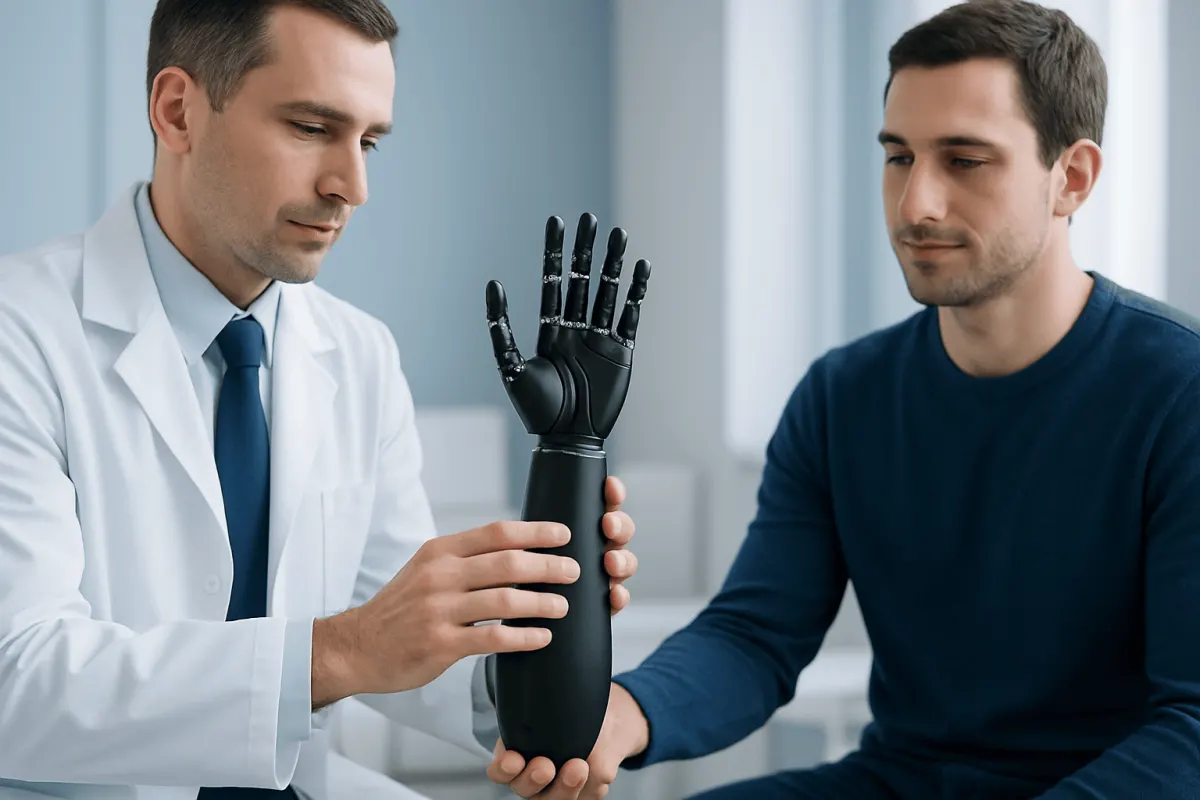
A bionic hand is a powered upper-limb prosthesis designed to support grasping and daily activities after hand or arm loss. Many models are myoelectric: small sensors placed inside the socket detect electrical activity from muscles in the remaining limb. These signals are interpreted by the prosthesis, allowing the user to open or close the hand or select a programmed grip.
The system usually includes a custom-made socket, electrodes, a powered wrist or hand, batteries and an outer cosmetic covering when desired. Some devices offer multiple grip patterns, adjustable grip strength and wrist rotation. These features may make certain tasks easier, but they also add weight, charging needs and training requirements.
Control is learned through repeated practice with an occupational therapist or prosthetic rehabilitation professional. The aim is not to restore a biological hand exactly, but to provide useful function for activities that matter to the individual, such as dressing, carrying objects, preparing food, using a phone or returning to selected work tasks.
Candidacy and assessment before fitting
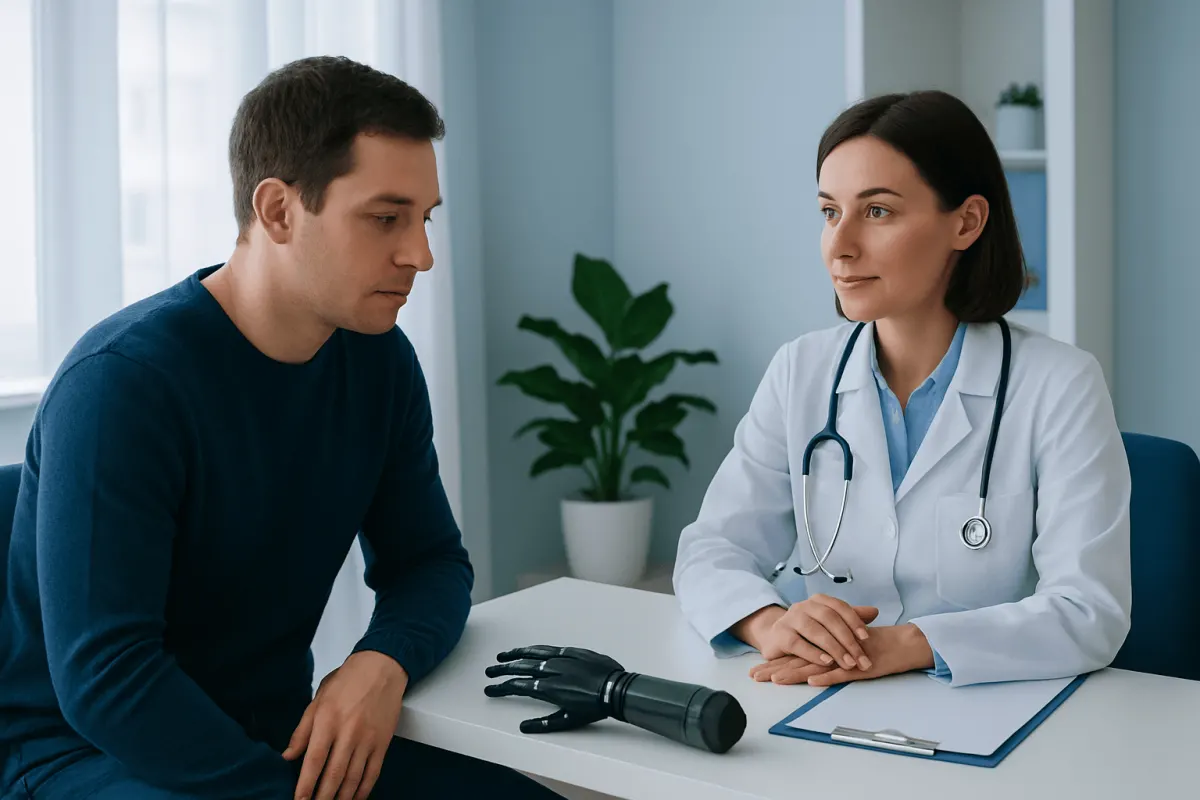
Potential candidates include people with an acquired upper-limb amputation and some people born with limb differences. Suitability depends on the level of limb absence, healing of the residual limb, skin health, range of motion, muscle signals available for control, strength, vision, daily activities and personal goals. A powered hand is not the right choice for every person or every situation.
Assessment is normally multidisciplinary. It may involve a rehabilitation physician, prosthetist, occupational therapist, physiotherapist and, when needed, pain, mental health or surgical specialists. The team considers comfort, expected function, whether the person can manage charging and care, and whether another device type may be more practical for certain activities.
People who have had an amputation may also need attention for scar sensitivity, residual-limb pain, phantom sensations, contractures or skin irritation before a final prosthesis is fitted. These concerns are common and can often be addressed with rehabilitation and medical care. The assessment should include realistic discussion of what the device can and cannot do.
The fitting process and recovery timeline
There is usually no single operation to receive a standard bionic hand. After an amputation, the surgical wound and residual limb need time to heal and settle before definitive fitting. In some cases, a temporary or preparatory prosthesis is used while limb volume changes. More advanced procedures, such as nerve or muscle surgery to improve prosthetic control, may be considered for selected patients by specialist teams.
The process commonly begins with a clinical evaluation and goal-setting discussion. The prosthetist then takes measurements or a digital scan to create a custom socket. After a trial fitting, electrodes and controls are adjusted, and the person learns how to operate the hand. Several appointments are often needed because fit and control may change as the user gains experience.
Rehabilitation continues after delivery. Early training focuses on putting on and removing the device, charging it, controlling basic opening and closing, and protecting the skin. Over subsequent weeks and months, therapy can progress to task-specific practice at home, school or work. Follow-up remains important because a socket may need refitting if body shape, activity level or comfort changes.
- Early phase: wound healing, swelling management, range-of-motion work and residual-limb care.
- Fitting phase: socket design, trial controls and device selection.
- Training phase: practical skill-building, confidence and safe use in daily tasks.
- Long-term phase: reviews, repairs, adjustments and replacement planning.
Benefits, limitations and possible risks
A bionic hand may improve independence in selected activities and may provide a more natural-looking or versatile option for some users. Multiple grip patterns can help with objects of different shapes, and powered movement may reduce the need for compensatory body positions. Successful use, however, depends on fit, training, comfort and the person’s individual priorities.
Limitations can include weight, noise, reduced performance in wet or dusty settings, limited battery life and the need for regular charging. Fine touch sensation is not routinely restored by standard devices, so users often rely on vision and learned feedback to judge grip force. A device may work well for some tasks but be less useful for others.
Potential problems include skin pressure, redness, blisters, sweating, discomfort, electrode-control difficulties and device malfunction. Poor socket fit can contribute to pain or skin injury if not addressed. Prompt review by a prosthetist is advisable when the prosthesis becomes painful, unstable, difficult to control or causes persistent skin changes.
Are bionic hands covered by insurance?
Insurance coverage for a bionic hand differs by country, insurer, policy type and clinical circumstances. Some plans or public funding systems may cover part or all of a medically necessary prosthesis, while others may have exclusions, limits, prior authorization requirements or restrictions on specific components. Coverage can also differ between an initial prosthesis, repairs, replacement sockets and rehabilitation sessions.
Insurers commonly ask for documentation showing limb loss or limb difference, functional goals, the clinical reason for the proposed device and the anticipated benefit compared with alternatives. The prosthetic provider may help prepare records, quotations and supporting reports, but approval is ultimately determined by the payer’s rules.
Before committing to a device, patients should ask for a written explanation of benefits, preauthorization requirements, deductibles or co-payments, coverage for therapy and repair policies. It is also sensible to ask whether a loan device or backup prosthesis is available during servicing. If funding is declined, the treating team may be able to discuss review or appeal pathways where these exist.
What is the most expensive prosthetic arm in the world?
There is no authoritative, universally accepted ranking for the most expensive prosthetic arm in the world. Costs are not directly comparable because packages vary in the type of hand, powered wrist or elbow components, custom socket design, control technology, rehabilitation, local taxes, servicing and funding arrangements.
Highly complex upper-limb systems can be more costly than simpler devices when they include several powered joints, advanced control interfaces and extensive custom fitting. However, a higher-cost system is not automatically better for an individual patient. A clinician should help match features to the person’s anatomy, practical needs, work environment and ability to maintain the device.
Rather than searching for a single “most expensive” model, patients can ask for a transparent written breakdown of the recommended system and alternatives. This makes it easier to understand which elements are clinically necessary and which options may be helpful but optional.
What is the best prosthetic hand in the world?
There is no one best prosthetic hand in the world for every user. The best choice depends on the person’s level of limb loss, muscle control, comfort in the socket, preferred activities, work or sport requirements, desired appearance, available therapy and access to repair services.
A multi-articulating myoelectric hand may be useful for someone who values several grip patterns and has reliable muscle signals. Another person may prefer a simpler, more durable device for physically demanding work, or may use different prostheses for different tasks. In some situations, a passive hand or body-powered prosthesis can be a valuable option.
A supervised trial, where available, can be especially informative. During a trial, the individual can test comfort, control, weight, grip performance and ease of daily use. The final recommendation should be based on functional goals and informed shared decision-making rather than brand reputation alone.
How long does a bionic arm last and when to seek medical care
How long a bionic arm lasts depends on how often it is used, the environment, the care routine and the manufacturer’s service recommendations. Individual components may wear at different rates, while the socket may need earlier changes because the residual limb can change in size or shape. Regular inspections and prompt repairs can help preserve safe function.
Patients should contact their prosthetist if the socket becomes loose, painful or difficult to put on; if there is persistent redness, broken skin, swelling or unusual odor; or if controls become unreliable. A clinician should assess increasing residual-limb pain, signs of infection such as spreading redness or fever, sudden weakness, or major changes in skin color or temperature.
Medical review is also appropriate when prosthetic use is limiting sleep, work, mobility or emotional well-being. Acıbadem Health Point’s multidisciplinary specialists and JCI-accredited hospitals can assess upper-limb rehabilitation needs and coordinate care for international patients.
Frequently asked questions
01What does bionic hand cost include?
The bionic hand cost may include the powered hand, custom socket, electrodes, batteries, fitting appointments and rehabilitation. It may also include future servicing, repairs and socket adjustments. Patients should request an itemized estimate that clearly separates initial and ongoing costs.
02Is a bionic hand the same as a myoelectric prosthesis?
The terms are often used interchangeably, but they are not always identical. A myoelectric prosthesis uses electrical signals from muscles to control powered movement, and many bionic hands use this approach. The exact design and available functions vary between devices.
03Can a bionic hand feel touch?
Most standard bionic hands do not restore natural touch sensation in the same way as a biological hand. Users generally rely on sight, sound, muscle effort and experience to judge grip force and object position. Research into sensory feedback is progressing, but availability varies.
04How long does it take to learn to use a bionic hand?
Basic control can begin during the fitting and training period, but confident everyday use usually develops gradually. The timeline depends on muscle control, socket comfort, complexity of the device and time spent practicing meaningful tasks. Ongoing occupational therapy can support progress.
05Are bionic hands covered by insurance?
Some insurance plans or public health systems may provide coverage when a prosthesis is considered medically necessary, but policies vary significantly. Prior authorization and clinical documentation are often required. Patients should confirm coverage for the device, therapy, repairs and future replacement parts before proceeding.
06What is the best prosthetic hand in the world?
There is no single best prosthetic hand for all people. The right device is one that fits comfortably, supports the user’s priority activities and can be maintained reliably. A prosthetist and rehabilitation team can help compare suitable options through assessment and, where possible, a supervised trial.
This article is for general information only and is not a substitute for professional medical advice. Please consult a qualified doctor about your individual situation.
Explore treatments in Turkey — costs, top hospitals & a free quote
JCI-accredited · board-certified surgeons · reply within 24h
Add us as a Preferred Source to see more of our trusted health content across Google Search, AI Overviews and Discover.