Teeth Whitening in Turkey: Costs, Methods and Results

Key Takeaways
- Whitening is a cosmetic dental procedure, not an emergency treatment — an oral health check should always come first, as decay, gum disease or cracked fillings need attention before any bleaching.
- Most whitening journeys are short: an assessment, one or more chairside sessions and sometimes take-home trays, typically within a two-to-four-day stay.
- Costs are best understood as bands rather than fixed prices; the method, the number of sessions, any preparatory dental work and whether trays are included all affect the total.
- Whitening agents do not change the colour of crowns, veneers, composite fillings or bridges, so existing restorations may need replacing to match a new shade.
- Accreditation (such as JCI), the treating dentist's registration and qualifications, and written informed consent are more useful selection criteria than photographs or promotional shade charts.
- Results vary between individuals and are not permanent; diet, smoking and routine hygiene strongly influence how long a shade change lasts.
Travelling for teeth whitening usually means a short, non-surgical trip: a dental examination, one or two in-chair whitening sessions and often take-home trays, generally spread over two to four days. This guide explains how such a journey is planned and coordinated, what packages tend to include, how costs are grouped into bands and what aftercare looks like once patients are back in the UK.
Teeth Whitening Turkey: How the Patient Journey Works
People searching for teeth whitening turkey are usually asking a practical question: how quickly can it be arranged, what does it involve, and what should be budgeted for? In most cases, the answer is that whitening is one of the shortest journeys in dental travel. It is a non-surgical, non-invasive cosmetic procedure, and a typical itinerary involves an initial dental examination on arrival, one or more chairside whitening sessions, and a review before flying home — commonly spread across two to four days, depending on the plan agreed with the treating dentist.
The coordination stage begins long before the flight. Patients are generally asked to send recent dental photographs, details of any existing crowns, veneers or fillings, a summary of their medical history and any information about sensitivity or grinding. Many patients also arrange a video consultation so that a dentist can explain what whitening can realistically achieve in their case, and whether an alternative approach — such as professional cleaning, replacing discoloured fillings, or simply improving home care — may be more appropriate.
It is worth being clear about what whitening is not. It does not repair damaged enamel, treat gum disease or correct the shape or alignment of teeth. Where discolouration is caused by trauma, root canal changes, medication staining or enamel defects, the outcome may be limited or uneven, and a dentist may recommend a different treatment pathway altogether. An honest assessment at the planning stage prevents disappointment later.
Whitening Methods Commonly Offered
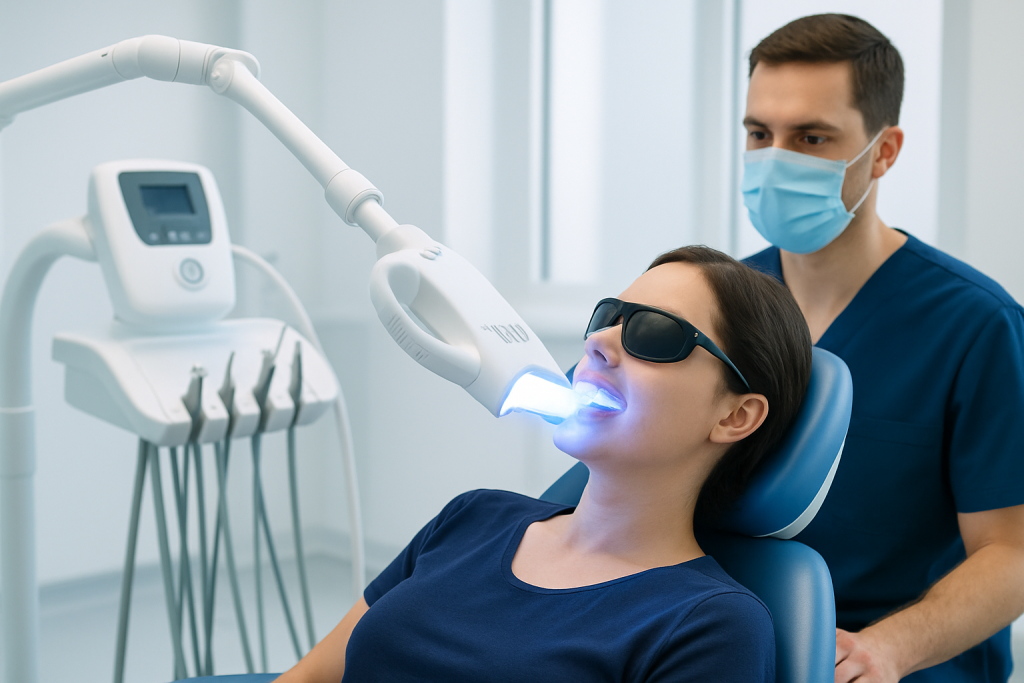
Professional whitening broadly falls into three approaches, and many treatment plans combine them. In-chair (also called in-office or power) whitening uses a professional-strength gel applied by a dental team, sometimes activated with a light or laser device, over one or more appointments in a single visit. Take-home whitening uses custom-made trays fabricated from impressions or a digital scan, worn at home with a lower-concentration gel over a period of days or weeks. A combined protocol uses an in-chair session followed by trays for gradual refinement and maintenance.
Internal or “walking” bleaching is a separate technique used for a single tooth that has darkened after root canal treatment, and it is carried out from inside the tooth. It requires careful case selection and follow-up, so it is not usually suitable for a compressed travel itinerary unless specifically planned.
- In-chair whitening: fastest visible change, done under professional supervision, gums protected with a barrier.
- Take-home trays: more gradual, easier to control sensitivity, useful for top-ups later.
- Combined protocols: often recommended where deeper or uneven staining is present.
- Hygiene appointment first: scaling and polishing removes surface stain and allows a more accurate assessment of the true tooth shade.
Patients should ask which whitening agent is used, at what concentration, and how this compares with the regulations they are familiar with in the UK, where whitening is legally restricted to dental professionals. Any reputable clinic will answer this openly and record it in the consent documentation.
Understanding Cost Bands and What Packages Include

Rather than quoting a single figure, it is more accurate to think in bands. The lowest band generally covers a hygiene appointment with polishing, which removes extrinsic staining but is not whitening in itself. A middle band typically covers take-home trays with gel, or a single in-chair session. A higher band covers combined protocols — multiple chairside sessions plus custom trays and maintenance gel. Costs rise further where preparatory dentistry is needed, or where existing crowns, veneers or front fillings must be replaced afterwards to match the new shade.
Package structures differ between clinics, so it is important to see in writing what is and is not included. Common inclusions are the initial consultation and examination, any necessary diagnostic imaging, the whitening sessions themselves, a review appointment, an interpreter, and airport and hotel transfers. Accommodation is sometimes bundled and sometimes arranged separately. Flights and travel insurance are almost never included.
Items that frequently sit outside the quoted package include treatment of decay or gum disease discovered during the examination, extractions, replacement restorations, night guards for grinding, and any additional whitening gel supplied for later top-ups. Patients should also budget for the possibility that a dentist advises delaying whitening until oral health issues are resolved — a responsible recommendation, but one that changes the plan and the cost. Requesting a written, itemised treatment plan before travelling, and asking how revisions would be handled, avoids uncertainty on arrival.
Choosing a Clinic: Accreditation and Clinician Credentials
Because whitening is elective and widely marketed, selection criteria matter. International accreditation, such as that awarded by Joint Commission International (JCI), indicates that a hospital or clinic has been independently assessed against standards for patient safety, infection control, medication management and record-keeping. It is not a comment on any individual result, but it does show that systems are audited by an external body.
Equally important is the clinician. Patients can reasonably ask for the treating dentist’s name, their registration with the Turkish dental authorities, their qualifications, and their experience with cosmetic and restorative dentistry. Where a treatment plan may extend beyond whitening — for example into veneers or crowns — the credentials of the prosthodontist or restorative dentist involved become relevant.
- Is a full examination and, where indicated, radiographic assessment carried out before whitening?
- Will a written treatment plan and informed consent document be provided in English?
- Which whitening system and concentration will be used, and how is sensitivity managed?
- How are dental records, shade photographs and receipts shared for a UK dentist to review?
- What is the process if the patient is unhappy with the outcome after returning home?
Care should be taken with before-and-after imagery and with any promise of a specific shade. Shade outcomes depend on the starting colour, enamel thickness, the cause of the staining and individual response — no clinician can guarantee a particular result in advance.
Planning the Trip: Timing, Appointments and Logistics
A practical whitening itinerary usually allocates the first day to arrival, consultation, photographs and often a hygiene appointment. Whitening sessions follow on the next day or two, with impressions or a digital scan taken for take-home trays if these form part of the plan. A short review before departure allows the dentist to check the gums, discuss sensitivity and hand over aftercare instructions and any gel supplied.
British citizens should check current entry requirements for Türkiye and ensure their passport validity meets the rules in force at the time of travel; a coordination team can provide guidance on documentation but cannot influence immigration decisions. Travel insurance that acknowledges planned treatment abroad is advisable, and it is sensible to confirm exactly what any policy covers.
Where flexibility helps most is in scheduling. Whitening is best avoided immediately before an important event, since sensitivity and a short “white diet” period are common in the first days. Patients planning a wedding or similar occasion are usually advised to complete treatment several weeks beforehand, allowing the shade to settle and any restorative work to be matched. Those combining whitening with other dental treatment should expect a longer stay or a two-visit plan agreed in advance.
Results, Sensitivity and Aftercare Back Home
Most people notice a change in shade after professional whitening, but the degree varies and results are not permanent. Yellowish discolouration tends to respond more predictably than grey or banded staining. Teeth may look brighter immediately after a session partly because of temporary dehydration, so the settled result is usually judged some days later. Existing crowns, veneers, bridges and composite fillings will not change colour, which is why plans sometimes include replacing visible restorations afterwards.
Short-lived tooth sensitivity and mild gum irritation are the most common side effects and typically settle within a few days. A dentist may suggest desensitising toothpaste or a specific product regime; patients should follow the individual advice they are given rather than general guidance found online. Anyone with persistent pain, swelling, ulceration or bleeding gums should seek dental assessment promptly rather than waiting.
For roughly the first 24 to 48 hours, and often longer with tray whitening, dentists commonly advise avoiding strongly coloured foods and drinks — coffee, tea, red wine, curry, tomato sauces, berries and cola — and not smoking. Long-term maintenance depends on routine care: brushing twice daily with fluoride toothpaste, cleaning between the teeth, limiting staining drinks and attending regular check-ups. Patients should register the treatment with their own dentist in the UK, share the records and photographs supplied, and arrange a review so continuity of care is maintained.
When to Speak to a Patient Coordinator or a Dentist
A conversation with a patient coordinator is helpful at the point where a patient has a general idea of what they want but needs the medical and logistical elements assembled: gathering records for review, arranging a video consultation with a dentist, clarifying what a treatment plan includes, organising interpreters, transfers and accommodation, and setting realistic dates. Coordinators do not give clinical opinions, but they connect patients with the clinicians who can.
Some situations warrant dental advice before any travel is booked. These include ongoing toothache, bleeding or receding gums, cracked or loose fillings, a single dark tooth after injury, pregnancy or breastfeeding, and being under the age of 18, since whitening is generally not recommended for children and young people. Patients taking medication that affects the gums, or with a history of severe sensitivity, should also raise this early.
Acıbadem Health Point coordinates dental and cosmetic care for international patients across Acıbadem’s JCI-accredited hospitals and clinics, where multidisciplinary teams assess each case, explain the options and arrange follow-up communication after patients return home. Whichever provider is chosen, a written plan, a named clinician and a clear aftercare route remain the foundations of a safe journey — and any decision should be made in discussion with a qualified dental professional.
Frequently asked questions
01How long does a teeth whitening trip to Turkey usually take?
Most whitening-only itineraries are planned around a two- to four-day stay, allowing time for an examination, one or more chairside sessions and a short review. If a hygiene appointment or take-home trays are included, an extra day is often added. Longer stays are needed when whitening is combined with other dental treatment such as fillings or restorations.
02Will whitening work on crowns, veneers or fillings?
No. Whitening agents act on natural tooth structure and do not change the colour of ceramic, composite or metal restorations. If visible crowns, veneers or front fillings no longer match after whitening, a dentist may suggest replacing them, which adds time and cost to the plan. This should be discussed before treatment begins.
03Is tooth sensitivity after whitening normal?
Mild, temporary sensitivity to cold and some gum irritation are common after professional whitening and usually settle within a few days. A dentist may recommend a desensitising toothpaste or an adjusted whitening schedule. Severe or persistent pain, swelling or bleeding is not expected and should be assessed by a dental professional promptly.
04How much does teeth whitening abroad cost?
Costs are best considered as bands rather than fixed figures. A hygiene appointment sits at the lower end, take-home trays or a single in-chair session in the middle, and combined protocols with multiple sessions and maintenance gel at the higher end. Any preparatory dentistry or replacement restorations is quoted separately, so an itemised written plan is essential.
05How long do the results last?
There is no fixed lifespan for whitening results. Longevity depends on diet, smoking, oral hygiene and the individual's enamel, with gradual re-staining being normal. Many people maintain their shade with occasional top-ups using custom trays, following the advice of their dentist. No clinician can guarantee a permanent outcome.
06Can whitening be done if there is decay or gum disease?
Whitening is not carried out on teeth affected by untreated decay or active gum disease, as the gel can cause discomfort and the underlying problem needs addressing first. A dental examination on arrival, or ideally during a video consultation beforehand, identifies these issues. Treatment is then sequenced so oral health is stabilised before any cosmetic step.
07What should be arranged before flying home?
Patients should leave with a written summary of what was done, shade photographs, receipts, any take-home trays and gel with clear instructions, and a contact route for questions. Registering the treatment with a UK dentist and booking a routine review helps maintain continuity of care. Anyone experiencing unexpected symptoms after returning should seek local dental advice without delay.
This article is for general information only and is not a substitute for professional medical advice. Please consult a qualified doctor about your individual situation.
Explore treatments in Turkey — costs, top hospitals & a free quote
JCI-accredited · board-certified surgeons · reply within 24h
Add us as a Preferred Source to see more of our trusted health content across Google Search, AI Overviews and Discover.