Sapphire FUE Hair Transplant in Turkey: Method, Cost and Who It Suits

Key Takeaways
- Sapphire FUE is a variation of standard FUE: grafts are harvested one by one and the recipient sites are opened with sapphire-tipped blades rather than steel.
- Most international patients plan a stay of roughly three to four days, with the procedure on one full day and a first wash and check before flying home.
- Package pricing in Turkey is usually quoted in bands that depend on graft count, technique, hospital and surgeon, rather than a single fixed figure.
- Accreditation such as JCI, verifiable surgeon credentials and an in-person or video assessment matter more than any advertised price.
- Not everyone is a candidate; donor density, the pattern and stability of hair loss, age and general health all influence suitability and expected coverage.
- Results develop gradually over many months, so a clear aftercare plan and a way to reach the team after returning home are essential.
Sapphire FUE is a follicular unit extraction technique in which the recipient channels are opened with sapphire-tipped blades, and Turkey has become a common destination for people planning this procedure abroad. This guide explains how the journey is organized, what packages usually include, realistic cost bands and how to plan travel, recovery and aftercare at home.
Sapphire FUE Hair Transplant Turkey: What the Method Involves
People searching for a sapphire fue hair transplant turkey option are usually asking two practical questions: what is actually done during the operation, and how is the trip organized from abroad. In short, sapphire FUE is a form of follicular unit extraction. Individual follicular units are removed one at a time from the donor area at the back and sides of the scalp using a small circular punch, and the recipient sites are then opened with blades made from synthetic sapphire instead of the traditional steel slit blades. The harvested grafts are placed into those channels in a pattern designed to follow the natural direction and angle of hair growth.
The sapphire tip is smoother and harder than steel, and surgeons who prefer it report that it allows fine, consistently sized channels. The core surgical principles, however, are unchanged: careful donor assessment, gentle graft handling, appropriate hairline design and correct channel angle remain the factors that shape the outcome. The instrument is one variable among many, and no blade type can compensate for limited donor supply or an unrealistic plan.
Turkey has developed a large hair restoration sector with high procedure volumes, experienced surgical teams and hospitals that are used to caring for international patients. That combination is what draws travelers, but it also means quality varies widely between providers. The rest of this article focuses on how a well-organized medical trip is planned and coordinated, rather than on clinical detail that should be discussed directly with a qualified surgeon.
How the Patient Journey Is Usually Organized
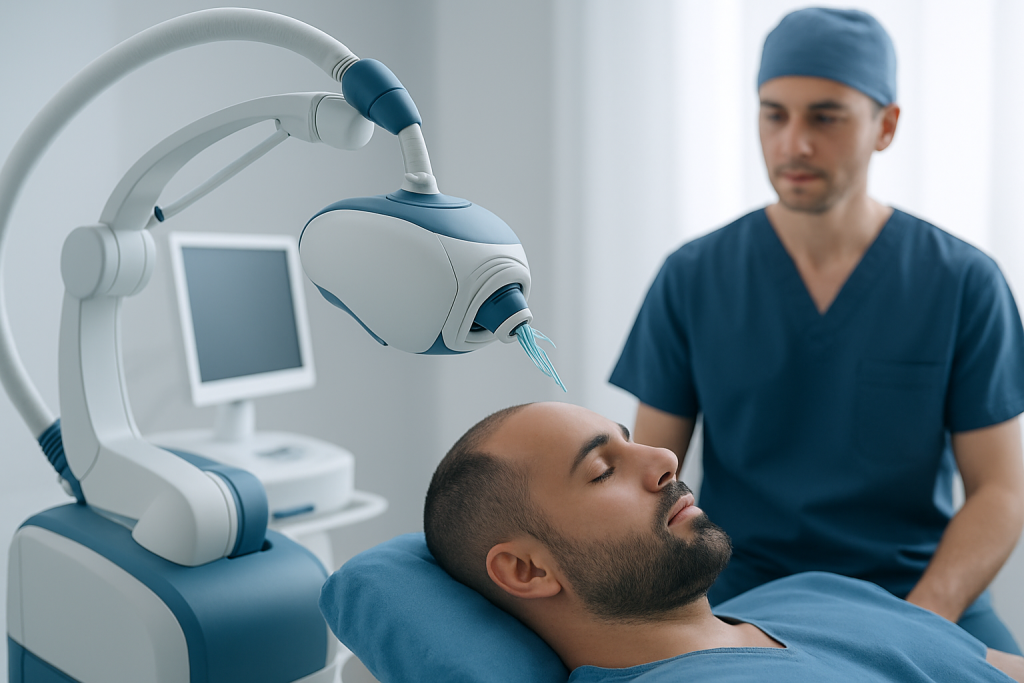
Planning normally begins remotely. Most international patients start by sending clear photographs of the front, top, crown and donor area, along with a short medical history covering medications, chronic conditions, previous scalp procedures and any family pattern of hair loss. A doctor or coordinator reviews this material and may arrange a video consultation to discuss what is realistically achievable, whether a single session is likely to be enough, and whether medical treatment of ongoing hair loss should run alongside surgery.
If the patient decides to proceed, the coordination team typically proposes dates, explains what documents are needed for travel, and arranges airport transfers, accommodation and interpreting support where required. Pre-operative blood tests are usually done on arrival, and the surgeon confirms the plan, the hairline design and the estimated graft number in person before anything begins. It is normal and appropriate for that final in-person assessment to modify what was suggested from photographs.
A typical itinerary looks something like this:
- Day 1: arrival, transfer, consultation, blood tests, hairline design and consent discussion.
- Day 2: the procedure, performed under local anesthesia over several hours with breaks.
- Day 3: first medical wash, dressing check, written aftercare instructions and supplies.
- Day 4: departure, with contact details for follow-up from home.
Some people prefer to stay an extra day or two for comfort, and anyone combining the trip with another procedure or with sightseeing should discuss timing with the medical team first.
Who Sapphire FUE Suits — and Who May Need a Different Plan

Suitability is decided by a doctor, not by a website, but a few general principles help set expectations. The technique is most often considered for adults with a stable, patterned pattern of hair loss and a reasonable density of permanent donor hair at the back and sides of the scalp. It is also used to refine or restore hairlines, to soften the appearance of previous surgery in some cases, and to address scarring or areas of loss after trauma, depending on the individual assessment.
Some situations call for caution or an alternative approach. Very early or rapidly progressing hair loss in a young person may be better managed medically first, so that surgery is not planned around a pattern that is still changing. Limited donor supply, active scalp inflammation, uncontrolled medical conditions, certain bleeding disorders and some autoimmune or scarring forms of hair loss all need to be assessed before any decision. Diffuse thinning without a clear donor reserve is another common reason a surgeon may advise against transplantation.
Honest expectation-setting is part of good care. A transplant redistributes existing permanent hair rather than creating new follicles, so coverage is finite. Many patients also need ongoing medical treatment to help preserve the hair they still have, and a second session in later years is not unusual as natural loss continues. A surgeon who explains these limits clearly is giving a better service than one who promises a specific density or a guaranteed look.
What Treatment Packages Typically Include
Most providers in Turkey present hair restoration as a package rather than an itemized bill, which makes it easier to compare offers if the inclusions are written down. Packages commonly cover the pre-operative consultation and blood tests, the procedure itself with local anesthesia and the surgical team’s time, the first medical wash, take-home products such as shampoo, lotion and a travel pillow, prescribed medication for the immediate recovery period, hotel accommodation for a set number of nights, airport and clinic transfers, and interpreting support.
Items that are frequently not included, and that are worth asking about explicitly, include flights, travel insurance, extra hotel nights, additional graft numbers beyond the agreed estimate, adjunct treatments such as platelet-rich plasma, long-term medications, and any second session that may be recommended later. Clarifying these points before booking prevents uncomfortable conversations on arrival.
Before confirming, patients often find it useful to ask for written answers to a short list of questions: which surgeon will perform the procedure and which steps are delegated to technicians, how the graft number is estimated and what happens if the plan changes on the day, what follow-up is offered after returning home, and what the policy is if the medical team decides the patient is not a suitable candidate after the in-person assessment.
Understanding Cost Bands and Planning a Budget
It is not possible to quote a meaningful single price for hair restoration, and any figure seen in an advertisement should be treated as a starting point rather than a final cost. Pricing depends on the number of grafts, the technique used, whether the case is a first procedure or a revision, the seniority of the surgeon, the hospital’s facilities and accreditation, and the level of hospitality included in the package. Currency movement and seasonality also affect quoted amounts.
In broad terms, comprehensive packages in Turkey are usually presented in bands, with entry-level offers at the lower end, mid-range packages that include a hospital setting and more surgeon involvement in the middle, and premium options at the upper end for complex cases, high graft counts or extended stays. Many patients find that the overall band sits below comparable private pricing in the United States even after flights are added, which is a common reason for traveling — but cost alone is a poor basis for choosing a provider.
A realistic budget should also allow for flights, insurance, meals, any additional nights, medications purchased at home and time away from work. If a quoted package appears substantially below every other offer, it is reasonable to ask what has been removed: surgeon involvement, hospital setting, graft numbers and follow-up are the elements most often reduced. Written, itemized planning information from a patient coordinator is far more useful than a headline number.
Choosing a Hospital and Surgeon: Accreditation and Credentials
Accreditation is one of the more objective signals available to someone comparing options from another country. Joint Commission International (JCI) accreditation indicates that a hospital has been assessed against international standards for patient safety, infection control, medication management and clinical governance. National licensing by the Turkish Ministry of Health is a baseline requirement, and patients can reasonably ask which license the facility holds and whether the procedure takes place in a hospital operating room or a stand-alone clinic.
Surgeon credentials matter just as much. Useful questions include which medical specialty the doctor trained in, how long they have been performing hair restoration, whether they are a member of recognized professional bodies in the field, and — importantly — which parts of the operation they personally perform. In high-volume settings, trained technicians often assist with graft extraction and placement; this is common practice, but patients are entitled to know how the work is divided and who is accountable.
Other practical selection criteria include the availability of a genuine pre-operative consultation rather than a sales conversation, transparent written information about risks such as bleeding, infection, folliculitis, temporary shock loss and visible donor-area thinning, a clear complaints and follow-up route, and consistent, unretouched patient photographs taken at comparable time points. Reviews are helpful context but should never replace verifiable credentials.
Recovery, Travel Timing and Aftercare Back Home
The first days after the procedure involve tiny crusts at the recipient sites, some redness, and swelling of the forehead that usually settles within the first week. Most people are advised to sleep with the head elevated for several nights, avoid direct pressure on the transplanted area, keep the scalp out of strong sun, and follow a specific washing routine that begins with a supervised first wash before departure. Strenuous exercise, swimming, saunas, alcohol and smoking are generally restricted for a period agreed with the surgeon.
Flying home is normally permitted a few days after surgery, with a loose hood or the clinic’s recommended head covering rather than a tight cap. Patients often plan around one to two weeks away from a public-facing job, since crusting and redness are visible for a while. Timing the trip so that there is no major event, wedding or presentation in the following weeks reduces pressure and disappointment.
Once home, aftercare continues for months. Transplanted hairs commonly shed in the first weeks before regrowth begins, and visible change typically develops gradually over many months, with continued refinement into the following year. A reliable follow-up channel is therefore essential: sending progress photographs at agreed intervals, being able to message a coordinator or nurse with questions, and having a local doctor or dermatologist for anything urgent. Anyone who develops spreading redness, pus, fever, severe pain or bleeding that does not settle should seek medical care promptly rather than waiting for a remote reply.
Patients planning treatment abroad often prefer to work with an organization that handles the medical and logistical sides together. Acibadem Health Point coordinates care for international patients across the group’s JCI-accredited hospitals, where multidisciplinary specialists assess suitability, plan the procedure and arrange follow-up after the return home. Speaking to a patient coordinator early — before booking flights — is the simplest way to confirm candidacy, understand indicative cost planning and set realistic dates.
Frequently asked questions
01How is sapphire FUE different from standard FUE?
The extraction step is the same in both: follicular units are harvested individually from the donor area. The difference lies in the blade used to open the recipient channels, where sapphire-tipped instruments are used instead of steel. Surgeons who prefer sapphire tips cite fine, consistent channel formation, but outcomes still depend mainly on donor supply, surgical planning and technique.
02How long should someone plan to stay in Turkey for the procedure?
Most packages are built around a stay of roughly three to four days, allowing time for consultation and blood tests, the procedure day, and a first medical wash with a final check before flying home. Some patients choose to stay an extra night or two for comfort. The exact schedule should be confirmed with the medical team, since individual cases vary.
03Why do quoted prices vary so much between providers?
Pricing depends on graft count, technique, surgeon seniority, whether the procedure takes place in an accredited hospital, and what hospitality and follow-up are included. Very low advertised figures often exclude elements such as surgeon involvement, higher graft numbers or aftercare. Asking for a written, itemized list of inclusions and exclusions is the most reliable way to compare offers.
04Does JCI accreditation matter when choosing where to have surgery?
Accreditation is one of the few independent, verifiable quality signals available to someone booking from abroad. JCI accreditation means a hospital has been assessed against international standards for patient safety, infection control and clinical governance. It does not replace checking the individual surgeon's training and experience, but it is a useful part of the selection process.
05When will results become visible after a hair transplant?
Transplanted hairs usually shed within the first several weeks, which is expected and not a sign of failure. Regrowth generally begins over the following months, with density and texture continuing to improve gradually across the first year and sometimes beyond. Because timelines differ between individuals, no clinic can promise a fixed schedule or a specific final density.
06What aftercare is needed after returning to the United States?
Patients typically follow a washing and product routine given at discharge, protect the scalp from sun and pressure, avoid strenuous activity for an agreed period, and send progress photographs to the treating team at intervals. Some also continue medical treatment for ongoing hair loss, prescribed by a doctor. Any sign of infection, spreading redness or fever should be assessed locally without delay.
07When is the right time to contact a patient coordinator?
It is best to make contact before booking flights or accommodation. A coordinator can arrange a photograph review or video consultation, explain what a package covers, outline indicative cost planning and advise on documentation and travel timing. This early conversation also helps identify cases where surgery may not be appropriate, which saves unnecessary expense and travel.
This article is for general information only and is not a substitute for professional medical advice. Please consult a qualified doctor about your individual situation.
Hair transplant in Turkey — costs, graft counts & a free assessment
JCI-accredited · board-certified surgeons · reply within 24h
Add us as a Preferred Source to see more of our trusted health content across Google Search, AI Overviews and Discover.