Peyronie’s Disease: Which Treatment Fits Curvature, Pain, or Stability

Key Takeaways
- Peyronie’s disease is caused by scar tissue, also called plaque, that can bend or shorten the penis.
- Pain is more common in the earlier, active phase, while curvature often becomes the main concern once the condition stabilizes.
- Treatment depends on the stage of the disease, the degree of curvature, erectile function, and the person’s goals.
- Some men are best served by observation, while others may benefit from medications, injections, traction, or surgery.
- A urologist can help match treatment to the pattern of symptoms and reduce guesswork.
Peyronie’s disease is a condition in which scar tissue inside the penis can lead to curvature, discomfort, or changes in erections. Treatment is often guided by whether the disease is still changing or has become stable, as well as how much the symptoms affect daily life and sexual function.
Overview
Peyronie’s disease develops when fibrous scar tissue forms beneath the skin of the penis, creating a firm area known as a plaque. As that tissue matures, it may pull on the surrounding structures and cause the penis to curve, shorten, narrow, or develop an indentation during erection.
The condition often raises practical questions rather than just medical ones: Is the curvature still changing? Is pain the main issue, or is the bigger problem difficulty with intercourse? Those details matter because treatment is not one-size-fits-all. A man with newly developing pain and mild curvature may be managed differently from someone whose deformity has been stable for many months.
Peyronie’s disease can feel personal and disruptive, but it is a recognized medical condition with several management paths. Many men do not need urgent treatment, yet they do benefit from an evaluation that clarifies what phase the disease is in and what options are most likely to help.
Symptoms

The most recognizable sign is a bend or curve in the erect penis. Some men also notice an hourglass shape, a loss of length, or a visible or palpable hard lump under the skin. The curve may point upward, downward, or to one side, and the degree can vary from mild to severe.
Pain is more common in the early or active phase, especially during erections, but it does not affect every patient. In some cases, pain fades over time even when the curvature remains. Erectile dysfunction can also occur, either because the condition affects the mechanics of erection or because the emotional impact makes erections harder to maintain.
- Curvature during erection
- Pain with erections or, less often, at rest
- Palpable plaque or firm area
- Penile shortening or narrowing
- Difficulty with penetrative sex
- Erection changes or associated erectile dysfunction
Because symptoms can evolve gradually, many men first notice changes when they compare photos, memory, or actual sexual function over time. That slow progression is one reason a detailed history is so helpful in the clinic.
Causes & Risk Factors
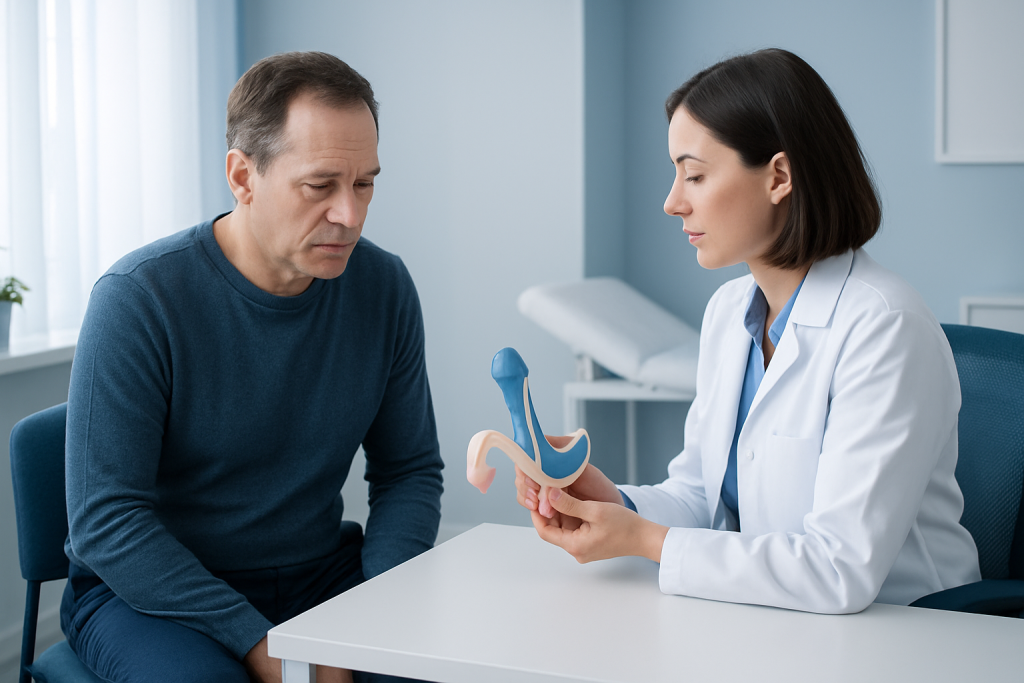
The exact cause is not always clear, but Peyronie’s disease is thought to begin after repeated micro-injury or stress to the penis leads to abnormal healing. Instead of remodeling smoothly, the tissue forms excess scar tissue that does not stretch like normal erectile tissue. Over time, that uneven stiffness can create the characteristic bend.
Not every man remembers an injury. In many cases, the triggering event may have been minor or unnoticed. Some people appear more likely to develop the condition because of how their body heals or because other health factors affect connective tissue.
Risk factors may include a family history of Peyronie’s disease, certain connective tissue disorders, older age, erectile dysfunction, diabetes, smoking, and previous penile trauma. Some men also have related hand conditions such as Dupuytren’s contracture, which can point to a tendency toward abnormal scar formation.
It is important to understand that Peyronie’s disease is not caused by poor hygiene or lack of sexual activity. When patients know what the condition is—and what it is not—many feel less burdened by guilt or uncertainty and can focus on realistic treatment goals.
Diagnosis
Diagnosis usually begins with a conversation about when the curvature started, whether it is still changing, and whether pain or erectile dysfunction is present. The clinician may ask about erections, sexual comfort, and whether intercourse remains possible. In a travel-care setting, it is especially helpful for patients to bring prior medical records, photographs of the erect penis if they are comfortable doing so, and a list of current medications or supplements.
A physical examination often includes feeling the plaque and assessing the penis when flaccid. In some cases, an in-office erection assessment or ultrasound is used to measure the curvature and look at blood flow. Ultrasound can also help define the plaque and guide treatment planning.
The phase of disease matters. The active phase typically involves pain and ongoing change in curvature, while the stable phase means the deformity has stopped changing for several months. This distinction helps determine whether a nonsurgical approach is reasonable or whether surgery may be more effective.
Treatment Options
Treatment is chosen based on symptoms, stage, and the impact on quality of life. For some men, careful observation is appropriate, especially if the curvature is mild and sex is still possible. For others, treatment aims to reduce pain, improve shape, preserve length, support erections, or make intercourse more feasible.
In the active phase, comfort and prevention of worsening may be the main goals. Pain can often be managed conservatively, and some men may be offered traction therapy or other non-surgical strategies depending on their situation. In selected cases, medications or injections may be considered to address plaque-related curvature, particularly when the disease has become stable enough for intervention.
Injection therapy is one of the better-known options for certain patients with stable curvature. These treatments are not suitable for every pattern of disease, and they typically work best when the curve falls within a range that is measurable and functionally significant. A urologist will also consider whether erectile function is adequate, because that often influences the best plan.
Surgery is usually reserved for stable disease when curvature is significant, sex is difficult or impossible, and conservative measures have not met the person’s goals. Surgical choices may include techniques that shorten the longer side, lengthen the shorter scarred side, or place a penile implant when erection quality is also a major issue. The right operation depends on anatomy, degree of deformity, and expectations.
Because the best treatment is often the one matched to the right stage, the question is not simply “What works?” but “What fits this particular curvature, pain pattern, and stability?” That is where a careful specialist evaluation makes a meaningful difference.
Prevention & Self-care
Peyronie’s disease cannot always be prevented, but some habits may support overall penile and vascular health. Men with diabetes or other chronic conditions may benefit from good long-term control, since general health can influence healing and erectile function. Avoiding smoking is also sensible because blood vessel health matters for erections and recovery.
Self-care is mostly about reducing strain, staying observant, and not ignoring changes. Some men choose to document the curvature over time, which can be useful during follow-up visits. If a clinician recommends traction or other conservative therapy, consistency matters more than force.
Emotional well-being is part of self-care too. Peyronie’s disease can affect confidence, intimacy, and communication with a partner. Open, calm discussion often reduces pressure and helps both people understand that this is a medical issue, not a reflection of attraction or masculinity.
For international patients, planning ahead can make care smoother: gather past test results, note when symptoms began, and be ready to discuss what outcome matters most—less pain, straighter erections, better function, or a fuller treatment plan that can continue after travel home.
When to See a Doctor
A urologist evaluation is a good idea when curvature is new, getting worse, or interfering with sex. It is also wise to seek assessment if there is persistent pain, a new lump in the penis, a clear change in length or shape, or trouble maintaining an erection.
Men who are unsure whether the condition is still active or already stable often benefit from a specialist visit, because treatment decisions depend heavily on that distinction. Even if the symptoms feel manageable, getting an early baseline can help future care if the curve changes later.
Prompt medical attention is especially helpful if the changes are causing distress, relationship strain, or uncertainty about sexual safety. A qualified doctor can explain the condition, rule out other causes of penile symptoms, and outline options without pressure. At Acibadem Health Point, multidisciplinary specialists and JCI-accredited hospitals diagnose and treat Peyronie’s disease for international patients as part of coordinated care.
Living With Peyronie’s Disease
Many men find it useful to think about Peyronie’s disease in terms of function rather than appearance alone. The most important questions are whether the curve is stable, whether intercourse is possible, whether pain is fading, and whether erections are adequate. Those answers guide treatment more reliably than comparison with a perfect shape.
Follow-up is often just as important as the first visit. A condition that begins in the active phase may become stable later, opening the door to different treatment choices. In some cases, men who were initially advised to wait can revisit the discussion once the deformity stops changing.
With the right guidance, Peyronie’s disease can usually be approached in a stepwise, manageable way. Clear information, realistic expectations, and a treatment plan matched to the stage of the disease can make the process feel far less confusing.
Frequently asked questions
01Is Peyronie’s disease the same as erectile dysfunction?
No. Peyronie’s disease involves scar tissue that changes the shape of the penis, while erectile dysfunction refers to difficulty getting or keeping an erection. The two can occur together, and one may make the other more difficult to manage.
02Can Peyronie’s disease go away on its own?
Pain may improve over time, especially in the active phase, but the curvature often does not fully disappear without treatment. Some men do well with observation if symptoms are mild and stable.
03How do doctors decide between medication, injections, and surgery?
They look at whether the disease is still changing, how severe the curve is, whether pain is present, and whether erections are strong enough. Surgery is usually considered when the disease is stable and the deformity significantly affects function.
04Is sex safe with Peyronie’s disease?
In many cases, sex is still possible, but it may be uncomfortable or mechanically difficult depending on the degree of curvature. A doctor can help determine whether intercourse is safe and what adjustments might help.
05Does Peyronie’s disease always require treatment?
No. Mild cases that do not interfere with function may simply be monitored. Treatment is most useful when symptoms cause pain, distress, or difficulty with sexual activity.
06What should an international patient bring to an appointment?
It helps to bring prior records, a list of medications, details about when symptoms started, and any images or notes that show how the curve has changed over time. Clear documentation can make the first specialist visit more efficient.
This article is for general information only and is not a substitute for professional medical advice. Please consult a qualified doctor about your individual situation.
Explore treatments in Turkey — costs, top hospitals & a free quote
JCI-accredited · board-certified surgeons · reply within 24h
Add us as a Preferred Source to see more of our trusted health content across Google Search, AI Overviews and Discover.