

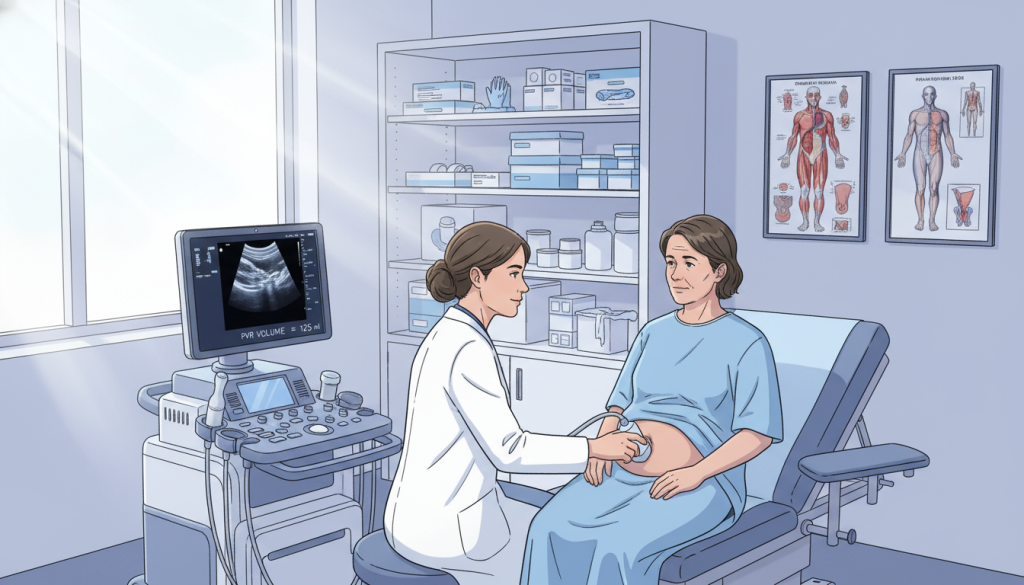
When you see a urologist, you might get a test called the Post Void Residual Test. It’s a simple way to check if your bladder empties well after you pee.
This test looks at how much urine is left in your bladder. Doctors use it to find problems that might cause pain or health issues. Knowing about this test helps you feel confident about your urological care.
This test is a common part of check-ups. We want to help you understand it so you can feel at ease. You’re in good hands as we support your health and well-being.
Key Takeaways
- The procedure is a non-invasive way to check bladder function.
- It measures the volume of urine left after you finish urinating.
- Clinicians use these results to diagnose possible urinary tract issues.
- The process is standard, safe, and straightforward for most patients.
- Understanding this diagnostic tool helps you make informed healthcare decisions.
Understanding the Post Void Residual Test
Learning about the Post Void Residual Test is key to managing your bladder. It measures the urine left in your bladder after you finish urinating.
This urology diagnostic test helps find blockages or nerve problems in the bladder. It helps us understand how your body handles urine.
This test is a simple and painless way to get important info about your body. It shows if your bladder is emptying right or if there’s urine left.
Here’s a quick guide to what the test results mean during your visit:
| Result Category | Volume (mL) | Clinical Interpretation |
|---|---|---|
| Normal | Less than 50 mL | Efficient bladder emptying |
| Borderline | 50 mL to 100 mL | Requires further monitoring |
| Elevated | Greater than 100 mL | Potential retention issues |
Using the Post Void Residual Test helps us make your care plan accurate. We’re here to help you through every step, making sure you’re comfortable and at ease.
Anatomy and Physiology of Normal Bladder Emptying
To understand why bladder function testing is key, we need to look at how the urinary system works. The bladder is a muscular organ that holds urine until it’s time to go. Its main muscle, the detrusor, is essential for this. It contracts to push urine out.
This process needs a team effort. The detrusor muscle and the urinary sphincters must work together. The sphincters act like valves, keeping urine in until it’s time to go. When it’s time, they relax and the detrusor contracts.
Any problem in this teamwork can cause issues. If the brain, nerves, or muscles don’t talk right, urine might stay in the bladder. That’s why bladder function testing is so important.
Keeping the bladder healthy means all parts must work together. Knowing how it works helps patients spot problems. We think informed patients can get the care they need faster.
| Component | Primary Function | Role in Voiding |
|---|---|---|
| Detrusor Muscle | Bladder wall contraction | Forces urine out |
| Internal Sphincter | Involuntary control | Relaxes to open path |
| External Sphincter | Voluntary control | Relaxes to release urine |
| Nervous System | Signal transmission | Coordinates the timing |
Indications for Performing a PVR Test
Changes in your urinary patterns can signal a need for a PVR test. We suggest this test for symptoms like frequent urination, a weak stream, or feeling like your bladder isn’t empty. These signs suggest your body might not be clearing urine well.
A detailed voiding dysfunction evaluation is key to finding the cause of these issues. It measures urine left in the bladder after you’ve finished. This helps us understand your bladder health better. It also helps us tell apart conditions like benign prostatic hyperplasia or neurogenic bladder.
Early detection is truly vital for your health. Spotting these signs early can stop serious problems like urinary tract infections or kidney damage. Quick action helps keep your kidneys healthy and improves your life quality.
We tailor each patient’s care to their unique symptoms and medical history. A thorough voiding dysfunction evaluation is the base of good care. With the PVR test, we work together to find the best health path for you.
Preparing for Your PVR Measurement
We want your PVR measurement to be comfortable and stress-free. Proper preparation is key to get accurate data about your bladder function. By following simple guidelines, you help us give you the best care.
We ask you to come with a comfortably full bladder. This helps us see how well you can empty your bladder during the PVR test. Try not to drink too much before you come, as it might be uncomfortable.

When you arrive, we’ll walk you through the PVR measurement step by step. You’ll urinate in a private area to relax. Then, we’ll do a quick scan or gentle catheterization to check any leftover urine.
Here’s what to remember for your PVR test:
| Preparation Step | Action Required | Goal |
|---|---|---|
| Hydration | Drink water before arrival | Ensure a full bladder |
| Arrival | Check in at the front desk | Minimize wait times |
| Voiding | Use the private restroom | Empty bladder naturally |
| Assessment | Undergo scan or catheter | Measure residual volume |
Our team cares about your comfort during this process. If you have questions or concerns, ask us. We’re here to support you and make sure you’re ready for your visit.
Methods Used for Post-Micturition Residual Volume Assessment
We use two main methods to check how much urine is left after you pee. These tools are key in Bladder Function Testing. They help us give you the best care and support your health goals.
The most common method is the transabdominal ultrasound scan. This non-invasive test uses sound waves to show your bladder’s image. It helps us find out how much urine is left after you pee, known as the Post-Micturition Residual Volume.
Sometimes, we use catheterization instead. This involves putting a thin tube into your bladder to drain and measure urine. It’s more invasive but gives high diagnostic accuracy when ultrasound doesn’t work or when certain conditions need it.
We always choose the least invasive options to keep you comfortable. Our team thinks about your unique needs before picking the best method for checking your Post-Micturition Residual Volume. Your health is our top priority as we work together to understand your bladder health.
Interpreting PVR Test Results
Understanding your bladder function numbers is key to your recovery. It’s a vital step in your Urinary Retention Assessment. It helps us plan your care.
A normal residual volume is less than 50 milliliters for healthy adults. But, we look at your PVR Measurement with your health and symptoms in mind. We are here to ensure you feel confident and informed throughout this process.
If your volume is higher, you might need more tests or special care. Our team will explain your results clearly. This way, you’ll understand how they affect your health.
| Result Range (mL) | Clinical Interpretation | Recommended Action |
|---|---|---|
| 0 – 50 mL | Normal bladder emptying | Routine monitoring |
| 50 – 200 mL | Mild to moderate retention | Clinical follow-up |
| Over 200 mL | Significant retention | Urgent evaluation |
Every Urinary Retention Assessment is unique. We look at your PVR Measurement to make a plan just for you. Your peace of mind is our priority as we navigate these results together.
The Post Void Residual Test in Clinical Practice
The Post Void Residual Test is key in checking how well the bladder works. It helps us make better choices for our patients. This test connects what patients feel with what really happens in their bodies.
We use the Post Void Residual Test to understand bladder health better. It’s important for managing long-term conditions or new symptoms. Regular checks help us keep our patients as healthy as possible.
Adding this voiding dysfunction evaluation to our care makes a big difference. It lets us give our patients the best medical help. This way, we can change treatment plans fast if needed. We think sharing exact data with patients makes their healing journey better and more successful.
Common Causes of Elevated Post Void Residual
Many patients face the challenge of not fully emptying their bladder. This issue can arise from physical or neurological problems. When the bladder doesn’t empty fully, it leaves urine behind, causing discomfort or infections. Our team works hard to find out what’s causing this problem.
An Post-Micturition Residual Volume can be caused by physical blockages in the urinary tract. For men, an enlarged prostate is a common cause. In women, pelvic organ prolapse can also block urine flow.

Neurological conditions also affect bladder function. Damage to nerves can prevent the bladder from contracting properly. This neurological interference often leads to a higher Post-Micturition Residual Volume. We use special tests to understand how nerves and the bladder interact.
Our Urinary Retention Assessment is designed to find the root cause of your symptoms. We work with you to explore all possible causes. By using advanced imaging and your medical history, we aim to improve your life quality.
Impact of Medications on Bladder Emptying
Your daily medications might affect your urinary health in ways you don’t expect. Some drugs, like certain antihistamines, antidepressants, and blood pressure meds, can mess with your bladder’s emptying. This is why we look at your PVR Measurement closely to understand your health better.
We check your medication list carefully as part of our process. By finding out which meds might cause retention, we can tackle your symptoms more effectively. Your comfort and safety are our top priorities during this check-up.
If we think a medication is affecting your bladder, we’ll talk to your doctor. We work together to change your treatment plan safely. Our aim is to improve your health and reduce medication side effects through a detailed PVR Measurement.
Managing Urinary Retention After Diagnosis
After your Urinary Retention Assessment, we start working on improving your bladder health. Getting a diagnosis can be tough, but our team is here to help. We’ll guide you through every step of your recovery.
We create a personalized management plan just for you. This plan might include changes to your lifestyle, pelvic floor therapy, and specific medications. These steps help make it easier for you to empty your bladder.
As a trusted provider of the Urology Diagnostic Test, we know how important education is. Learning about your body and treatment options helps you take charge of your health. This way, you can improve your life quality.
Here’s a table showing some common ways we help patients manage their condition:
| Management Strategy | Primary Goal | Expected Outcome |
|---|---|---|
| Pelvic Floor Therapy | Muscle Strengthening | Improved Bladder Control |
| Lifestyle Adjustments | Fluid Management | Reduced Bladder Strain |
| Medication Therapy | Relaxation/Emptying | Enhanced Voiding Efficiency |
We’re dedicated to supporting you on your journey. Your health and comfort are our top priorities. Together, we aim for long-term wellness and confidence.
Pediatric Considerations for PVR Testing
When we do a voiding dysfunction evaluation for kids, we make sure they feel safe and calm. We know that hospitals can be scary for them. So, we talk softly and gently to help them relax.
Testing for bladder health in kids is different from adults. We look at how their age and behavior affect their bladder. This helps us understand their urinary health better.
We think knowing what’s happening helps families feel better. Our team explains the voiding dysfunction evaluation in simple words that kids can get. This makes them less worried and helps us work together better.
We make sure every child gets the same world-class care as adults. We adjust our methods to fit their special needs. Here’s a table showing how we care for kids differently.
| Feature | Pediatric Approach | Adult Approach |
|---|---|---|
| Communication Style | Age-appropriate, playful | Direct, clinical |
| Environment | Calm, reassuring | Efficient, professional |
| Diagnostic Focus | Developmental milestones | Chronic conditions |
| Evaluation Goal | Voiding Dysfunction Evaluation | Voiding Dysfunction Evaluation |
Technological Advancements in Bladder Scanning
Medical imaging has changed how we do Bladder Function Testing. These new tools help us give care that’s both precise and comfortable for patients.
Modern portable bladder scanners are a big step up in urology. They use ultrasound to quickly find the Post-Micturition Residual Volume without needing to insert a catheter. This move to non-invasive methods makes the patient experience better.
These advanced tools use complex algorithms to map the bladder live. This accuracy means doctors get reliable data fast, which is key for quick decisions. We’re excited to use these systems to offer top-notch Bladder Function Testing to all our patients.
The table below shows how modern scanning compares to old methods for measuring Post-Micturition Residual Volume.
| Feature | Traditional Catheterization | Modern Bladder Scanning |
|---|---|---|
| Invasiveness | High | Non-invasive |
| Speed | Slow | Instant |
| Patient Comfort | Low | High |
| Risk of Infection | Moderate | Negligible |
Risks and Complications Associated with PVR Testing
Learning about the PVR test safety can make you feel better. This test is usually extremely safe and doesn’t pose a big risk to you.
Most tests use non-invasive ultrasound. This technology uses sound waves to see the bladder. It doesn’t touch your internal urinary tract.
But sometimes, a doctor might need to use a catheter. This is rare and might cause a bit of discomfort or a short-term urinary tract infection.
We follow strict sterile protocols for every test. This helps keep risks low and keeps you safe. Our team is ready to talk about any worries you have about the PVR test. We want to give you all the facts to help you stay healthy.
Conclusion
Understanding your bladder health is the first step. The Post Void Residual test is a key tool for your doctors. It shows how well your bladder empties.
Knowledge is the base of good care. Knowing how your bladder works helps us make plans just for you. These plans aim to make your life more comfortable and healthy in the long run.
You should know what’s going on with your body. Our team at Acıbadem Healthcare Group is here to help. We want to guide you in making the best choices for your health.
If you have questions about your bladder, contact us. We’re ready to help you on your path to better health. You’ll get expert care and accurate information from us.
FAQ
Q: What is a Post Void Residual Test and why is it important?
A: The Post Void Residual Test (PVR Test) checks how much urine is left in your bladder after you pee. At Acıbadem Healthcare Group, we use it to see if your bladder empties well. This helps us find problems like blockages or nerve issues that might cause discomfort or health problems later.
Q: When should I consider a Voiding Dysfunction Evaluation?
A: You might need a voiding dysfunction evaluation if you pee a lot, have a weak stream, or feel like your bladder isn’t empty. Getting checked early can help avoid problems like infections or kidney issues.
Q: How should I prepare for my PVR Measurement?
A: To prepare for your PVR measurement, just come to our clinic with a full bladder. You’ll pee in private, and then we’ll check how much is left using special technology.
Q: What happens during a Post-Micturition Residual Volume Assessment?
A: We use two main ways to check your bladder after you pee. Most often, we use ultrasound to see your bladder. Sometimes, we might use a thin catheter to drain and measure the urine for more accurate results.
Q: What is considered a normal result for Bladder Function Testing?
A: For most adults, a normal bladder test shows less than 50 milliliters of urine left. If you have more, we’ll look at your medical history to figure out the best next steps.
Q: What are the common causes of an elevated Urinary Retention Assessment?
A: High urine levels can be due to blockages like an enlarged prostate or pelvic organ prolapse. Neurological problems that affect muscle coordination can also cause it.
Q: Can my current medications affect my PVR Test results?
A: Yes, some medicines can make it hard for your bladder to empty. At Acıbadem Healthcare Group, we check your meds to see if they’re affecting your bladder health.
Q: Are there any risks associated with this urology diagnostic test?
A: The PVR test is safe and low-risk. Ultrasound technology makes it non-invasive. If we need to use a catheter, there’s a small chance of minor discomfort or infection, but we follow strict safety protocols.
Q: How do portable bladder scanners improve the testing process?
A: Portable bladder scanners are a big step forward in testing. They let us quickly and accurately measure bladder volume without invasive procedures. This makes the test more comfortable for patients.
Q: How do you manage pediatric patients requiring a PVR Test?
A: We make sure kids are calm and comfortable during the test. We explain it in a way they can understand and consider their age and development. This way, kids get the same top-notch care as adults at Acıbadem Healthcare Group.
Q: What are the next steps after a diagnosis of urinary retention?
A: After testing, we create a plan just for you. This might include changes to your lifestyle, special therapy, or medicine to help your bladder. We’re here to support you every step of the way to improve your life.