

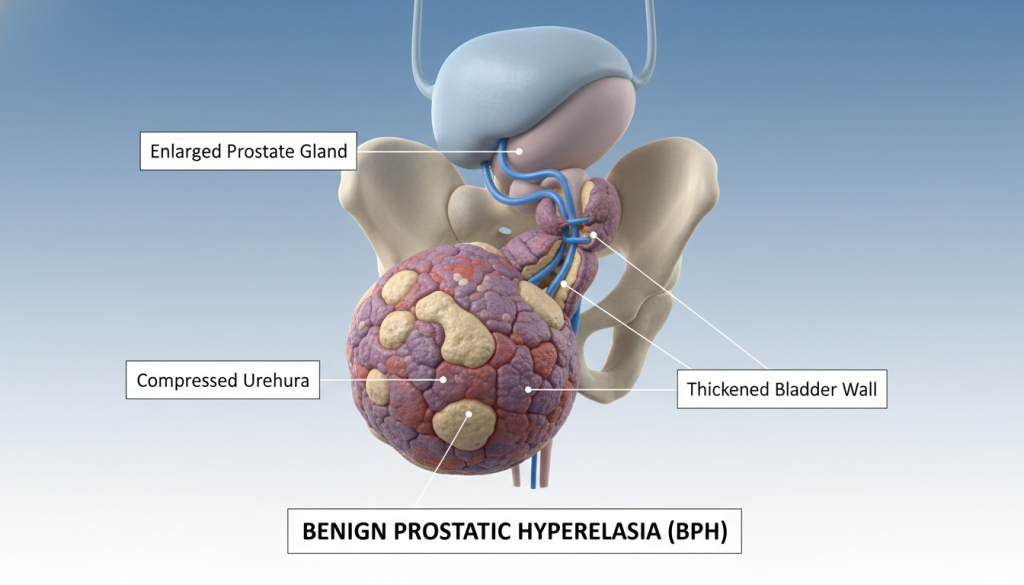
Welcome to our guide on Prostatic Hyperplasia, a common issue for many men as they get older. We aim to give you clear, reliable info to help you understand your health better. This way, you can move forward with confidence and clarity.
Learning about this condition helps you make better choices with your healthcare team. We think knowing more is the first step to managing it well and staying healthy for a long time.
Our team is here to support your health with easy-to-understand medical info and expert advice. We want to make complex ideas simple. This way, you’ll feel fully prepared for your next doctor’s visit.
Key Takeaways
- Prostatic Hyperplasia is a common, non-cancerous enlargement of the gland that occurs with aging.
- Understanding the symptoms early allows for more effective management and better quality of life.
- We prioritize evidence-based medical education to help you make informed healthcare decisions.
- Collaborating with your clinical team is essential for creating a personalized treatment plan.
- Our goal is to provide clarity and reassurance throughout your health journey.
Understanding the Anatomy and Function of the Prostate
Learning about the prostate’s structure is key to keeping it healthy. This small gland is important for men’s health. It’s located between the bladder and penis, controlling both urine and sperm flow.
The prostate wraps around the urethra, which is why changes here can affect urination. Knowing how your body works helps you talk better with your doctor.
The prostate makes a special fluid that helps sperm. This fluid is vital for sperm health. Keeping the prostate healthy is important as you get older.
We’ve listed the prostate’s main jobs below. Understanding these roles shows why doctors check it often.
| Function Category | Primary Role | Impact on Body |
|---|---|---|
| Reproductive Support | Fluid Production | Nourishes and protects sperm |
| Urinary Regulation | Urethral Support | Helps control the flow of urine |
| Hormonal Interaction | Enzyme Secretion | Regulates local chemical balance |
Knowing about your body helps you take care of your prostate. Talk to your doctor about any worries. Being proactive is the best way to keep your body balanced.
Defining Prostatic Hyperplasia
When you hear Prostatic Hyperplasia, it’s natural to feel worried. But understanding it can really help. This condition is when the prostate gland gets bigger, but it’s not cancerous. It’s very common in older men.
This condition is also known as Benign Prostatic Hyperplasia. It’s important to know it’s not cancer. And having it doesn’t mean you’ll get prostate cancer later.
As the prostate grows, it can press on the urethra. The urethra is the tube for urine. This pressure can change how you pee. Knowing about Prostatic Hyperplasia helps us see why and how to fix it.
We focus on managing these changes to keep you comfortable. Early treatment of Benign Prostatic Hyperplasia can improve your life. We’re here to help you every step of the way, with compassion and expertise.
Prevalence and Risk Factors for BPH
BPH is common among men as they age. It’s good to know about it to understand prostate enlargement better.
About 50% of men will show symptoms by age 60. By age 85, this number jumps to nearly 90%. Knowing these numbers is key to keeping healthy for the long term.
Aging is the main cause of BPH. But, other things can also play a part. Family history is one of them, making you more likely to get it.
Metabolic factors like obesity or high blood pressure also matter. They can affect how your prostate changes. Spotting these early helps us guide you better.
We want to help you know when to see a doctor about BPH. Knowing about it lets you take care of yourself at every life stage.
The Pathophysiology of Prostate Enlargement
Many men wonder why their urinary habits change with age. The answer often lies in the prostate’s internal mechanics. An enlarged prostate is not just a sign of aging. It’s a specific biological process where cells in the transition zone grow.
This area, around the urethra, is where most tissue growth happens. As cells multiply, the gland gets bigger. This creates significant pressure on nearby structures. This prostate enlargement is a slow, progressive event that changes urine flow.
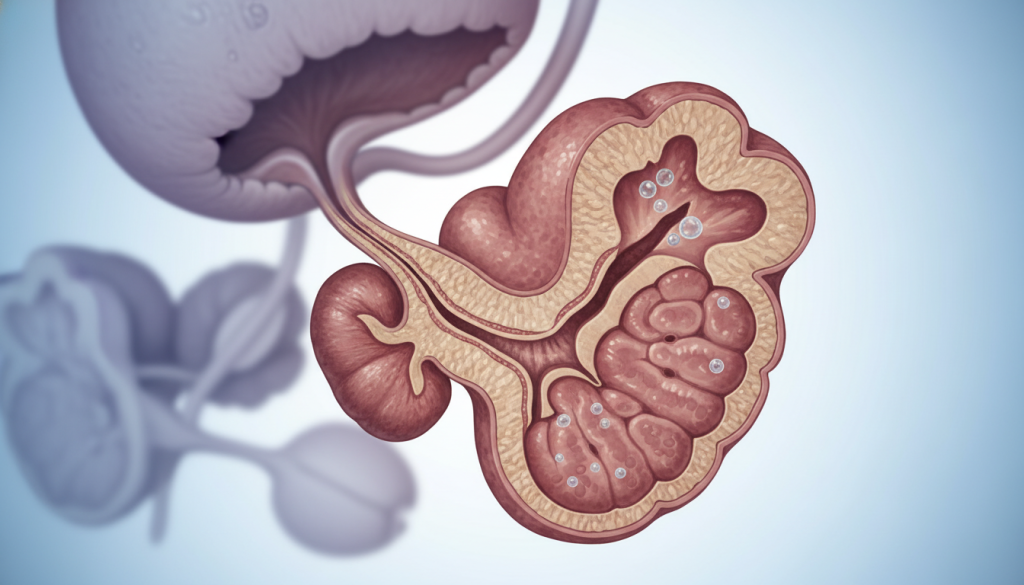
The main effect of this growth is a narrower urethral channel. The urethra goes through the prostate. So, any increase in tissue volume is like a kink in a hose. This makes the bladder work harder to push out urine.
Over time, the bladder muscle gets thicker and more sensitive. You might find you need to urinate more often or with more urgency. Knowing these changes is essential for why early action can prevent bigger bladder problems later.
| Growth Stage | Cellular Activity | Urethral Impact |
|---|---|---|
| Early Phase | Mild cell proliferation | Minimal restriction |
| Intermediate Phase | Moderate tissue expansion | Noticeable flow reduction |
| Advanced Phase | Significant gland growth | Severe bladder strain |
By understanding how prostate enlargement affects your body, you can take steps towards better health. Tackling an enlarged prostate early can lead to better management. We urge you to stay informed about these changes to keep your health in check.
Recognizing Common Prostate Symptoms
Understanding your body’s signals through urinary changes is key to your health. Spotting the early signs of Prostate Enlargement is essential for your well-being. By knowing these signs, you can work with your healthcare team to address them early.
Urinary Hesitancy and Weak Stream
One common Prostate Symptom is a change in starting to urinate. You might struggle to start the stream, even when you need to go. It can be quite frustrating to wait for the flow to start.
Also, the stream might be weak or interrupted. This happens because the enlarged gland presses on the urethra. Paying attention to these changes is important, as they signal your prostate might need a check-up.
Frequency and Nocturia
Many men feel the need to urinate more often during the day. This can mess up your work and social life. Nocturia, waking up to use the restroom, is another issue.
We understand that interrupted sleep can be exhausting. Keeping a log of these Prostate Enlargement symptoms helps your doctor. It gives them the information they need to create the best care plan for you.
Diagnostic Procedures and Clinical Evaluation
Getting an accurate diagnosis is key to treating urinary changes. When you come for a consultation, we use several tests to check your prostate health. Our goal is to find the cause of your prostate symptoms and create a treatment plan just for you.
A Digital Rectal Exam (DRE) is a common tool for checking prostate size and texture. This exam lets our team get quick info about your prostate’s state. It helps us rule out other prostate problems that might look like enlargement.
We also suggest lab tests to fully understand your health. A prostate-specific antigen (PSA) blood test is often used for screening. A urinalysis checks for infections or other problems that might be causing your discomfort.
Medical testing can seem scary. Our team makes sure to explain each step clearly. We want you to feel comfortable and informed as we look into Benign Prostatic Hyperplasia.
| Diagnostic Tool | Primary Purpose | Patient Benefit |
|---|---|---|
| Digital Rectal Exam | Assess size and texture | Immediate clinical insight |
| PSA Blood Test | Screening and monitoring | Early detection of changes |
| Urinalysis | Rule out infections | Targeted treatment planning |
By using these tests together, we can figure out what’s causing your prostate symptoms. We’re here to help you on your health journey with expert advice and care.
Lifestyle Modifications for Managing Prostate Health
Small changes in your lifestyle can greatly help with prostate enlargement. When symptoms are mild, these changes are often the first step to feel better.
Simple habits can greatly improve your life. For example, drinking less water before bed can cut down on nighttime trips to the bathroom. Also, cutting back on caffeine and alcohol can ease an irritated bladder.
Regular exercise is key for prostate health. It helps manage your weight, which is important because extra weight can make urinary symptoms worse. Find fun activities like walking, swimming, or cycling to stay active.
By making these daily changes together, we can often avoid more serious medical treatments. Taking care of your prostate health through these steps is a positive way to improve your health. Small, consistent changes are often the best for managing prostate enlargement.
Pharmacological Treatment for BPH
When lifestyle changes don’t help, we turn to medicine. We know BPH can disrupt your life. Our aim is to offer you relief with proven treatments.
Alpha-blockers are often the first choice for BPH treatment. They relax muscles in the prostate and bladder neck. This makes it easier to urinate and empty your bladder.
For some, 5-alpha-reductase inhibitors are a better option. These drugs target the root cause of BPH. They block a hormone conversion, shrinking the prostate over time. This reduces long-term blockage.
Choosing the right treatment for BPH is a team effort. We look at your medical history and symptoms to find the best fit. Sometimes, combining treatments works best for managing BPH.
| Medication Class | Primary Mechanism | Typical Onset | Main Benefit |
|---|---|---|---|
| Alpha-blockers | Relaxes prostate muscles | Rapid (days) | Improved urine flow |
| 5-alpha-reductase inhibitors | Shrinks prostate tissue | Slow (months) | Reduced gland size |
| Combination Therapy | Dual-action approach | Moderate | Maximum symptom relief |
Minimally Invasive Surgical Therapies
If you’re looking for a treatment for BPH that doesn’t keep you out of action for long, consider minimally invasive therapies. These modern methods are great when meds don’t cut it anymore. They help you get back to your normal life quickly.
These advanced treatments aim to reduce prostate blockage without open surgery. They use cutting-edge technology to target the problem directly. This is how we deliver top-notch care for BPH.
Choosing the right treatment for BPH is a team effort. We work with you to find the best fit for your needs. We make sure you know all about your options, so you can make an informed choice.
These procedures mean you can get back to your routine sooner. They help you manage BPH without messing up your life. We’re here to support you every step of the way, making your recovery as easy as possible.
Traditional Surgical Interventions
We suggest traditional surgery for Benign Prostatic Hyperplasia when other treatments don’t work. If symptoms are severe and affect your daily life, these methods can bring lasting relief.
The Transurethral Resection of the Prostate, or TURP, is the top choice for treatment for BPH. It removes tissue that blocks urine flow. This helps restore normal urine function and improves your health.
We use our top skills to make sure you’re safe and successful. Our teams use the latest techniques to reduce risks and improve results for Benign Prostatic Hyperplasia.
Our team is here to help you at every step. We guide you from the start to your recovery. We focus on your health and comfort every step of the way.
Potential Complications of Untreated Prostate Issues
It’s important to know the risks of not treating prostate problems. An enlarged prostate can cause big issues if not handled. Taking care of your prostate early is key to your health.
Prostate symptoms are like warning lights for your body. If ignored, they can lead to serious problems. Your bladder might not empty right, causing blockages and infections.
Ignoring these signs can also harm your bladder muscle. This can make it hard to do everyday things. We want to help you avoid this with early treatment and advice.
One of the biggest dangers is acute urinary retention. It’s a medical emergency that needs quick help. An enlarged prostate should be caught early by your doctor.
Regular doctor visits are vital to stop these problems. By staying in touch with your doctor, you can keep your health good. Your health is our top concern as we make these decisions together.
Emerging Research and Future Directions
We are in a new era for Prostate Health. Our team is working on new research to help patients. We aim to improve treatment outcomes for everyone.
Scientists are looking into new treatments. They are exploring innovative gene-based treatments and advanced imaging. These new methods promise better precision.

We are leading in medical discovery. This means you get the latest and most effective treatments. We believe in personalized care for better recovery and wellness.
We are committed to sharing new research with you. Our goal is to give you the latest on Prostate Health. This way, you can make informed choices about your health.
Navigating Healthcare Decisions for Prostate Problems
Understanding how to treat an enlarged prostate can be tough. But, we’re here to help. We want you to feel informed and in control. An empowered patient is one who knows their options.
We take the time to explain the risks and benefits of each treatment. Whether it’s managing an enlarged prostate or looking into surgery, we guide you. We want you to make choices that fit your health goals. Don’t hesitate to ask questions and be part of your care plan.
When dealing with prostate problems, it’s important to think about the outcomes and how they affect your life. Here’s a table to help you talk to your doctor.
| Decision Factor | Conservative Approach | Surgical Intervention |
|---|---|---|
| Primary Goal | Symptom management | Long-term relief |
| Recovery Time | Minimal to none | Several weeks |
| Invasiveness | Low | Moderate to High |
| Patient Role | High daily compliance | Post-operative recovery |
Your journey with prostate problems is personal. We’re here to support you in every decision. We want you to feel confident and supported in your health choices.
Conclusion
Managing Prostatic Hyperplasia is a journey that needs patience, professional help, and a proactive health approach. You can improve your daily life by knowing more about your body.
Knowing the symptoms and treatment options for Prostate Issues lets you take charge of your health. By working with your medical team, you can keep your quality of life high.
We are proud to help you tackle these Prostate Problems with our top-notch expertise and caring at Acıbadem Healthcare Group. Our specialists give you clear, personalized advice.
If you have concerns about your symptoms, please contact our team. We’re here to guide you towards better health with confidence and clarity.
FAQ
Q: What exactly is Prostatic Hyperplasia?
A: Prostatic Hyperplasia, also known as Benign Prostatic Hyperplasia (BPH), is a non-cancerous growth of the prostate gland. This growth can press on the urethra, causing urinary problems. It’s important to know that this condition doesn’t increase your risk of prostate cancer.
Q: What are the most common Prostate Symptoms I should look out for?
A: Look out for urinary hesitancy, which is hard to start urinating. You might also notice a weak flow. Increased daytime urination and needing to get up many times at night are other signs. If you notice these, talk to our team.
Q: How common is an Enlarged Prostate in men?
A: An enlarged prostate is common with age. About 50% of men have it by 60, and up to 90% by 85. We help you recognize symptoms early and get checked at Acıbadem Healthcare Group.
Q: How do you diagnose various Prostate Issues?
A: We use several tools to check your prostate. A Digital Rectal Exam (DRE) checks the gland’s size and feel. We might also do a PSA blood test and urinalysis. These help us find the cause of your symptoms.
Q: What are the primary options for the Treatment for BPH?
A: We tailor treatments to you. For mild symptoms, we suggest lifestyle changes. For more severe cases, we offer medications and surgeries like TURP.
Q: Can Prostatic Hyperplasia lead to serious health complications?
A: Untreated BPH can cause big problems. These include infections, stones, and bladder damage. In severe cases, it can even cause you to be unable to urinate. We aim to prevent these serious issues.
Q: What is the pathophysiology behind why the prostate grows?
A: The prostate grows due to more cells in the transition zone. This expansion narrows the urethra. This makes your bladder work harder, leading to urinary symptoms.
Q: How can I make better decisions regarding my Prostate Health?
A: Being informed helps you make better choices. Understanding prostate issues and staying updated with research is key. Ask us questions at Acıbadem Healthcare Group to ensure your treatment fits your needs.