

Getting a Prostate Cancer diagnosis can be tough for many men and their families. It’s the second most common cancer in men in the United States. It’s important to understand how it affects the reproductive system.
We think that knowledge is the first step toward empowerment. We want to make this complex health issue clearer. Our goal is to give you a reliable resource for your health journey. We aim to offer clarity and stress the importance of being proactive with your health.
You’re not alone in this journey. We’re here to support you with expert guidance and care. We want to help you make informed healthcare decisions.
Key Takeaways
- Prostate Cancer is the second most common malignancy in American men.
- Early detection is key to successful health outcomes.
- Understanding the male reproductive system helps demystify the diagnosis.
- Being proactive with your doctor improves your long-term health.
- Having reliable information is the base for making confident treatment choices.
Understanding the Anatomy and Function of the Prostate
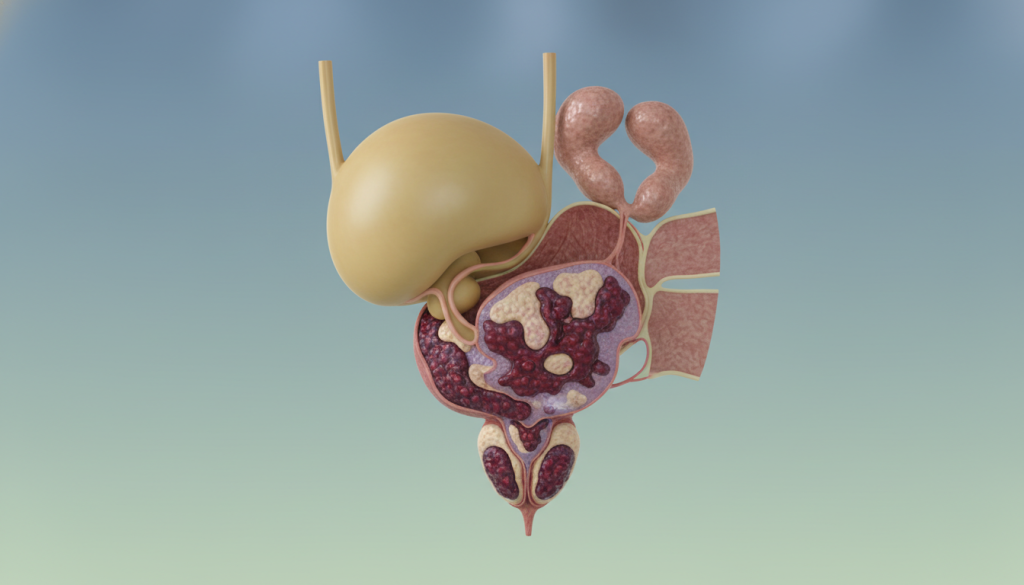
Knowing the basics of the prostate is key to staying healthy. This small, walnut-sized gland is deep in the male pelvis. It’s between the bladder and the penis base, surrounding the urethra.
Its location means changes in the gland can affect urination. Visualizing this area helps patients grasp where problems, like Prostate Cancer, might start.
The prostate’s main job is to help the male reproductive system. It makes a special fluid that mixes with sperm during ejaculation. This fluid is essential for fertility as it nourishes and protects sperm.
Keeping the prostate healthy is important for the reproductive system’s function. When we talk about Prostate Cancer, we’re looking at abnormal cell growth in this gland. Knowing the anatomy is key to understanding why catching it early is so important for health.
The Biology of Prostate Cancer
The start of prostate cancer is a complex journey. It begins with small changes in cells. Normally, cells in the prostate grow and divide in a controlled way. This keeps the gland the right size and working well.
But, prostate cancer happens when cells start growing too much. This is due to genetic changes that ignore the body’s stop signals. Over time, these cells build up and can form a tumor that doctors can find.
Not all tumors are the same. Some prostate cancer grows slowly and might not harm much. But, others grow fast and can spread. That’s why finding cancer early is so important.
We aim to explain these complex cell changes in simple terms. By understanding how prostate cancer develops, patients can feel more in control. Knowing that these changes can be treated gives hope to those facing a diagnosis.
Key Prostate Cancer Risk Factors
Knowing the prostate cancer risk factors is key to staying healthy. Many men wonder what affects their health. But, understanding these factors helps you take charge of your health.
Several things can lead to prostate cancer. These include your age, family history, and genes you might inherit.
Men over 50 are more likely to get prostate cancer. So, it’s important to see your doctor more often as you get older. Early detection is a powerful tool for good health.
By knowing these prostate cancer risk factors, you can talk better with your doctor. Understanding your risk helps you control your health future. We suggest looking at the table below to see how different factors affect your health.
| Risk Category | Description | Impact Level |
|---|---|---|
| Age | Risk increases significantly after age 50 | High |
| Family History | Close relatives with the condition | Moderate to High |
| Genetics | Inherited gene mutations | Moderate |
| Lifestyle | Diet and physical activity levels | Low to Moderate |
Recognizing Prostate Cancer Symptoms
Prostate cancer often starts without any symptoms, making it important for men to get regular check-ups. In the early stages, there are no noticeable changes. This is why regular health checks are key to your health.
As prostate cancer grows, some men notice certain prostate cancer symptoms. These include needing to urinate more often, even at night. You might also find it hard to start urinating or have a weak stream.

Other signs to watch for are blood in the urine or semen. Some men feel pain in their pelvis, hips, or lower back. But remember, these prostate cancer symptoms don’t always mean you have cancer.
Many of these symptoms can also be caused by other, non-cancerous issues. For example, benign prostatic hyperplasia (BPH) can cause similar problems. Infections or inflammation can also affect your urine flow.
Because these symptoms can also be signs of less serious conditions, see a doctor if you notice any changes. A doctor can figure out what’s causing your symptoms. Taking action early is the best way to manage your health and feel at ease.
The Importance of Prostate Cancer Screening
Prostate cancer screening is key to catching cancer early. It’s a cornerstone of long-term health and peace of mind. Early detection can greatly improve patient outcomes.
We tailor screening schedules based on your risk. We use the Prostate-Specific Antigen (PSA) blood test and the digital rectal exam (DRE). These tools help us monitor your health with precision and care.
Knowing how these tests work empowers you. The PSA test checks blood protein levels. The DRE examines the prostate gland. Together, they give a full picture of your prostate health.
| Screening Method | Primary Purpose | Procedure Type |
|---|---|---|
| PSA Blood Test | Measures protein levels | Simple blood draw |
| Digital Rectal Exam | Checks physical texture | Manual examination |
| Risk Assessment | Determines frequency | Clinical consultation |
Talk to our team about your health history and family background. This helps us find the right prostate cancer screening schedule for you. Regular checks are about keeping your life quality high through informed medical care. Your health is our priority, and we’re here to support you every step of the way.
Navigating the Prostate Cancer Diagnosis Process
Getting a prostate cancer diagnosis can be tough, but we’re here to guide you. Your health journey is unique, and we aim to make it clear and confident. We value open communication to support you through each step.
The first steps usually involve screenings to gather key information. If these tests show something odd, we might use multiparametric MRI. This tool lets us see the prostate clearly, helping us find any issues that need more checking.
Next, a biopsy might be needed to confirm if you have prostate cancer. During this, we take small tissue samples for a pathologist to check. We know this part can worry you, so we explain everything clearly before, during, and after.
We’re all about making complex medical info easy to understand. By simplifying the results, we help you grasp your situation. Informed decision-making is key to our care, keeping you in charge of your treatment.
| Diagnostic Tool | Primary Purpose | Patient Experience |
|---|---|---|
| Multiparametric MRI | Detailed imaging of prostate tissue | Non-invasive and painless |
| Prostate Biopsy | Tissue sample collection | Requires local anesthesia |
| Pathology Review | Microscopic cell analysis | Involves laboratory processing |
Getting a prostate cancer diagnosis is a big moment. We promise to support you with both knowledge and care. You are not alone as we figure out the best way to move forward for your health.
Understanding Prostate Cancer Grading and Staging
Knowing the details of your condition is key in the prostate cancer diagnosis process. After a biopsy shows cancer cells, we look at grading and staging. These steps tell us how aggressive the cancer is and how far it has spread.
Grading looks at the cancer cells under a microscope. The Gleason score compares them to normal cells. A lower score means the cells look more normal and grow slowly. A higher score means they look abnormal and might grow or spread faster.
Staging tells us how widespread the disease is, using the TNM system. This system checks the tumor size, if it’s in nearby lymph nodes, and if it’s in distant parts of the body. By combining the Gleason score with the stage, we understand your prognosis and treatment options better.
We share this detailed information to make you a part of your care plan. Knowledge is a powerful tool for making medical decisions with confidence. Here’s a table to help you understand the stages.
| Stage | Description | Clinical Focus |
|---|---|---|
| Stage I | Confined to a small area | Active surveillance |
| Stage II | Larger but localized | Curative treatment |
| Stage III | Spread to nearby tissues | Multimodal therapy |
| Stage IV | Spread to distant organs | Systemic management |
Your prostate cancer diagnosis is a unique case that guides our treatment. We aim to explain these details clearly so you can focus on your health. You’re not alone in this journey, and we’re committed to your long-term health.
Current Approaches to Prostate Cancer Treatment
Exploring prostate cancer treatment can seem daunting. But we’re here to help you every step of the way. We tailor our approach to fit your unique needs and goals. Our aim is to offer clarity and support as you choose the best treatment for you.
For those with slow-growing tumors, active surveillance is often a good choice. It means regular check-ups and tests without immediate treatment. This way, we can catch any changes early and act quickly.

When treatment is needed, we have several effective options. Surgery, like prostatectomy, aims to remove the cancer. Radiation therapy targets cancer cells with energy. Hormone therapy lowers hormones that help tumors grow.
Our team works together to find the right balance for you. We consider your quality of life and personal preferences. Your comfort and long-term well-being are our top priorities.
We combine top medical care with caring support. This ensures your prostate cancer treatment is effective and manageable. We want to empower you with the knowledge to make informed choices. Together, we aim for the best health outcomes for you.
Emerging Trends in Prostate Cancer Research
We are in a new era of prostate cancer research that offers hope to patients and their families. The field of oncology is changing fast as we find new ways to fight cancer. By keeping up with medical science, we make sure our patients get the best treatments today.
New immunotherapy methods are changing how we treat advanced cases. These treatments help the body’s immune system fight cancer cells better. This is a big step forward in managing tough-to-treat diseases.
Targeted genetic therapies are also key in prostate cancer research. We look at a tumor’s genes to create treatments that target specific mutations. This approach helps avoid harming healthy cells while attacking cancer more effectively.
We are dedicated to turning these scientific discoveries into real benefits for our community. Our team always checks new data to improve our treatment plans. Through prostate cancer research, we aim to better outcomes and improve life quality for all our patients.
Managing Side Effects and Quality of Life
We think your quality of life is as important as beating the disease. Prostate cancer treatment aims to fight the disease, but it can sometimes affect your comfort and how you move.
Our care goes beyond just treating the disease. We care about your dignity and happiness at every step of your recovery.
Some patients face issues like trouble with urination or sex. These prostate cancer symptoms are common, but you don’t have to deal with them alone. We offer special therapies and counseling to help you feel more confident.
We create a personalized recovery plan for each patient. This way, we take care of your body and mind. Our aim is to help you keep your lifestyle and comfort while you heal.
Prostate Cancer Prevention Strategies
We can’t avoid all risks, but making healthy choices is key to your health. Knowing the prostate cancer risk factors helps you make better choices. While some risks like age or genetics are out of our hands, we can control our daily habits.
Eating well is a big part of staying healthy. Eat lots of colorful fruits and veggies. They’re full of antioxidants and nutrients that fight inflammation and boost your immune system. This is important for prostate cancer prevention.
Being active is also very important. Exercise helps keep hormone levels in check and improves your metabolism. Activities like walking, swimming, or cycling are great for your health.
Keeping a healthy weight is linked to these habits. Being overweight can affect hormone levels, which can harm your health. Eating right and staying active are steps toward better health.
We urge everyone to see these habits as a commitment to their future. Small, consistent changes can make a big difference in your life. Adopting these prostate cancer prevention strategies is a way to care for your health and fight environmental prostate cancer risk factors.
Disparities in Prostate Cancer Statistics
We are committed to health equity, starting with a close look at prostate cancer statistics in the U.S. These numbers show big differences in who gets prostate cancer and who doesn’t survive it. It’s key to see these gaps to help every patient get the best care.
Understanding these trends helps us focus our education and make sure everyone can get screened. Prostate cancer research is vital in finding out why these differences happen. It helps us find ways to close these gaps. We think knowing the truth is the first step to changing our healthcare for the better.
We aim to close these gaps by sharing medical info that’s open to everyone. We want to make sure everyone, no matter their background, gets the support they need. Health equity is key to better health for all our patients.
We’re committed to a future where everyone has a fair chance at early detection and treatment. Together, we can change prostate cancer statistics to show progress and better survival rates for all. Your health and well-being are our top priorities as we keep working on this important task.
Empowering Patients Through Informed Decision Making
We believe you are the most important part of your medical team. Our approach puts you at the center of your healthcare journey. Your voice matters, and we’re here to help you make choices with confidence.
We give you the tools and knowledge to compare treatment options. Knowing the risks and benefits helps you set health goals that fit your life. Regular prostate cancer screening is key, helping catch problems early and tailor care plans.
Open talks between you and our medical experts build trust. We want you to ask questions and share your worries. This transparent communication lets us tailor care to your needs and lifestyle.
Our goal is to support you in making choices that reflect your values. Raising prostate cancer awareness keeps our community informed and proactive. We’re committed to guiding you toward wellness with peace of mind.
Conclusion
Managing your health is a mix of expert advice and your own actions. Staying informed is key to long-term wellness.
Knowing about prostate cancer stats is vital. It shows why regular check-ups are important. This knowledge lets you make choices that protect your future. We urge you to talk about your risk with a doctor.
Preventing prostate cancer is essential for a healthy life. Small daily changes can greatly improve your health. Make sure to get regular screenings and talk openly with your healthcare team.
At Acıbadem Healthcare Group, we offer top-notch support for your health journey. Our specialists are ready to help with advanced tests and tailored treatment plans. We hope this guide helps you make informed health choices.
Contact our medical experts for a consultation today. Your health is our main focus.
FAQ
Q: What exactly is prostate cancer and how common is it?
A: Prostate cancer is a type of cancer that grows in the prostate gland. This gland is a small, walnut-shaped part of the male reproductive system. It’s the second most common cancer in men in the United States.
At Acıbadem Healthcare Group, we know it’s serious. But many cases grow slowly and can be treated well if caught early.
Q: What are the primary prostate cancer risk factors I should be aware of?
A: The main risks are age, family history, and genetics. Men over 50 are more likely to get it. If you have a close relative with the disease or certain genetic mutations, watch your health closely.
Q: What are the most frequent prostate cancer symptoms?
A: Early on, there are no symptoms. But as it grows, you might have trouble urinating or feel pain in your pelvic area. These signs can also mean other health issues, so see a doctor if you notice anything different.
Q: Why is prostate cancer screening so important?
A: Screening is key to finding cancer early. We use the PSA blood test and a digital rectal exam (DRE). Finding it early means we have more treatment options and better outcomes.
Q: What does the prostate cancer diagnosis process involve?
A: To diagnose, we start with screening tests. If those show something’s off, we might do a biopsy or use MRI. At Acıbadem Healthcare Group, we use these tools to find and understand the cancer.
Q: How is the severity of the disease measured?
A: We look at the cancer’s grade and stage. The Gleason score tells us how aggressive it is. This helps us plan the best treatment for you.
Q: What are the current options for prostate cancer treatment?
A: Treatment choices depend on the cancer. They range from watching it to surgery, radiation, hormone therapy, and chemotherapy. We aim to find the best treatment for you, keeping your quality of life in mind.
Q: What are the latest breakthroughs in prostate cancer research?
A: Research is moving fast, with new treatments like immunotherapy and genetic therapies. These advances mean we can tailor treatments to fit each tumor. They offer hope, even for advanced cases.
Q: Are there effective prostate cancer prevention strategies?
A: While some risks can’t be changed, lifestyle choices can help. Eating well, staying active, and keeping a healthy weight are good for your overall health. They might also lower your risk of aggressive cancer.
Q: What do current prostate cancer statistics tell us about different populations?
A: Global stats show big differences in cancer rates and deaths. For example, African American men face higher risks. Knowing this helps us work towards fair care and education for all.
Q: How does your team support prostate cancer awareness and patient education?
A: We believe in the power of awareness for early detection. Through outreach and education, Acıbadem Healthcare Group helps men understand their health. Our goal is to empower them with knowledge, not fear.