

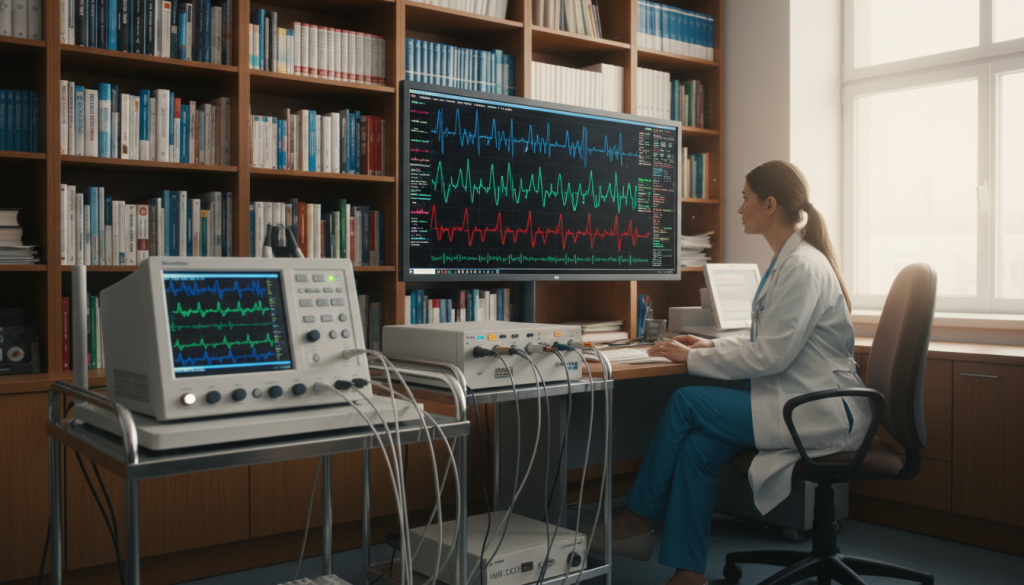
Welcome to our guide on Clinical Neurophysiology, a key part of medicine. It studies the central and peripheral nervous systems. We know it can be tough to understand complex health issues, but you’re not alone.
At Acıbadem Healthcare Group, we mix deep knowledge with a patient-centered approach. Our aim is to give you the clarity and confidence to make smart health choices.
We work together to give you the basics of your neurological health. We think knowing more helps you take care of yourself better.
Key Takeaways
- Clinical Neurophysiology focuses on the function of the nervous system.
- We prioritize patient education to simplify complex medical concepts.
- Our team provides expert guidance through every stage of your diagnosis.
- Collaborative care ensures that your specific health needs are met.
- Understanding your body is the first step toward better health outcomes.
Understanding the Scope of Clinical Neurophysiology
Clinical neurophysiology looks at the electrical language of the human nervous system. It studies the electrical activity in the brain, spinal cord, and nerves. This helps us understand how the body talks to itself to keep vital functions going.
Today’s neurodiagnostics turn these complex signals into useful medical information. They help us find the cause of strange symptoms with great accuracy. Finding the problem is the first step to fixing it and getting better.
We aim to make neurodiagnostics easy for everyone to access. We avoid using hard-to-understand terms. Our goal is to make you empowered and informed during your tests.
We use the latest technology to connect hidden body processes to your health. Whether we’re checking nerve signals or brain waves, our focus is on clear care. We’re here to help you make informed health choices with reliable and transparent information.
The Role of the Neurophysiology Lab in Modern Medicine
The Neurophysiology Lab is at the center of our diagnostic services. It combines advanced technology with caring expert care. This place is key for our work, letting us watch the nervous system’s electrical activity closely.
We think accurate diagnosis is the first step toward healing. With top-notch equipment in one place, we make sure every patient gets the best data. This helps guide their treatment.
In our Neurophysiology Lab, neurologists, technicians, and specialists work together. This teamwork is key. It helps turn complex electrical signals into clear health insights for patients.
We use the best diagnostic tools to help make smart healthcare choices. Whether checking nerve function or brain activity, our aim is clear. We want to give patients clarity and peace of mind through detailed analysis.
Our Neurophysiology Lab blends technical skill with a focus on patients. It’s a key part of modern medicine. We’re dedicated to keeping safety and accuracy high. This ensures the best results for everyone we help.
Core Principles of EEG Testing
When we do EEG testing, we listen to your brain’s rhythm. This method is non-invasive and records your brain’s electrical activity. It shows us how your brain works when you’re resting or active.
We start by placing small, metal discs called electrodes on your scalp. These sensors connect to a computer that boosts the tiny electrical signals from your brain cells. You’ll feel comfortable and informed during the setup, as it’s painless and has no recovery time.
After the recording begins, the technology shows these signals as wavy lines on a screen. We look at these patterns to find signs of conditions like epilepsy or sleep disorders. This diagnostic clarity helps us create a care plan that fits your health needs.
| Brain Wave Type | Frequency Range | Typical State |
|---|---|---|
| Delta | 0.5 – 4 Hz | Deep, dreamless sleep |
| Theta | 4 – 8 Hz | Drowsiness or meditation |
| Alpha | 8 – 12 Hz | Relaxed, wakeful state |
| Beta | 12 – 30 Hz | Active, focused EEG testing |
We watch these changes to spot normal activity versus possible issues. Our team uses your EEG testing data for a detailed look at your neurological health. We’re here to support you with compassionate expertise every step of the way.
Advancements in Nerve Conduction Studies
New technologies have made Nerve Conduction Studies more comfortable and accurate. These tests check how well your nerves work by seeing how fast electrical signals move. They help us find where nerve problems might be.
Older tests were often scary or uncomfortable. Now, modern equipment lets us get detailed data without much discomfort. We make sure you’re comfortable while we get the precise info we need.
Here’s how new tech has changed these tests for the better:
| Feature | Traditional Methods | Modern Advancements |
|---|---|---|
| Signal Clarity | Moderate | High-Definition |
| Patient Comfort | Variable | Optimized/Gentle |
| Processing Speed | Manual/Slow | Automated/Instant |
| Diagnostic Range | Limited | Comprehensive |
With these advanced Nerve Conduction Studies, we get a clearer view of your nerve health. This helps us spot problems early and create better treatment plans. We’re always looking for the latest tech to help you get healthier.
Electromyography and Muscle Health
Electromyography is a key tool for checking how your nerves and muscles talk to each other. It helps us see if there are problems in your muscle tissue. This way, we can find out if your symptoms are from nerve damage, muscle disease, or muscle and nerve connection issues.
During EMG testing, we use special tools to catch the electrical signals from your muscles. We might put small electrodes on your skin or use thin needles in your muscles. Don’t worry, our team makes sure you’re comfortable and the needles are used carefully.
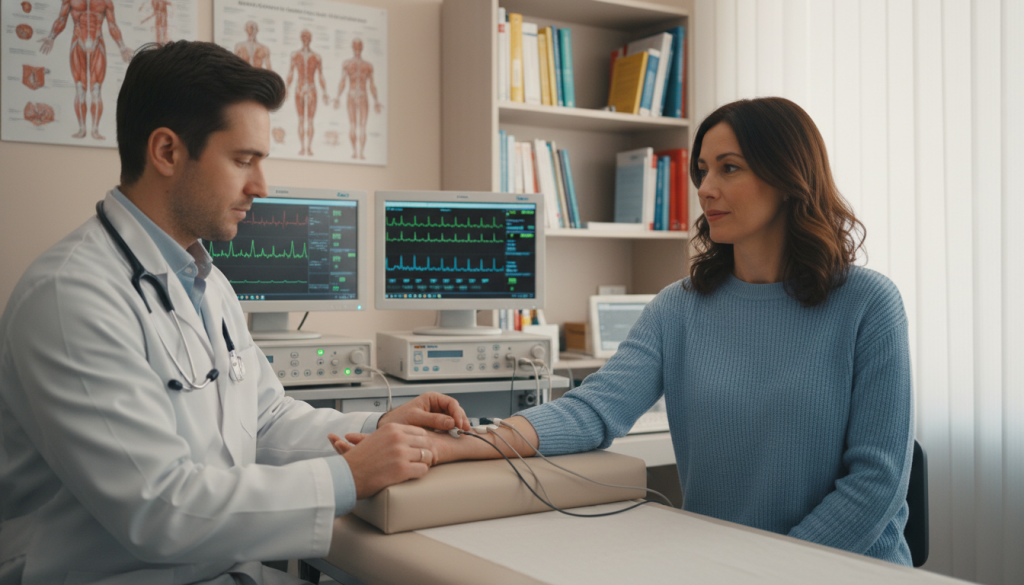
The signals we get are shown as waves on a screen. Our experts look at these patterns to see if your muscles are working right. This method is very good at finding problems like carpal tunnel syndrome, nerve issues, and muscle diseases.
Some people worry about the safety and comfort of Electromyography. But, our trained team follows strict rules to make sure you’re okay. Most people find it not too bad and really appreciate knowing what’s going on with their health.
| Diagnostic Feature | Surface Electrodes | Needle EMG |
|---|---|---|
| Primary Use | General signal tracking | Deep muscle assessment |
| Invasiveness | Non-invasive | Minimally invasive |
| Clinical Goal | Screening | Detailed diagnosis |
| Patient Comfort | High | Moderate |
In the end, EMG testing is a key part of modern medicine. It helps us understand your health better. We’re here to help you every step of the way.
Evoked Potentials as Diagnostic Tools
Evoked Potentials help us see how sensory signals move from your body to your brain. These tests measure the electrical signals in your nervous system when it gets certain kinds of stimulation. This can be light, sound, or touch.
By watching how these signals move, we can understand your neurological health better. Understanding these pathways is essential for spotting any problems that might not be obvious.
We use Evoked Potentials to get a detailed look at how your body processes sensory information. This method helps us find out where a signal might be slowing down or not getting through.
We make sure every test is done with great care. By looking at these electrical signals, we can give you accurate insights into your health. This helps support your path to better health.
| Stimulus Type | Pathway Tested | Clinical Goal |
|---|---|---|
| Visual | Optic Nerve | Detecting nerve inflammation |
| Auditory | Brainstem | Assessing hearing pathways |
| Somatosensory | Spinal Cord | Identifying nerve compression |
Continuous Seizure Monitoring and Epilepsy Care
Continuous seizure monitoring gives us a deep look into your brain health. Managing epilepsy can be tough, so we aim to give you clear, useful insights. We watch your brain activity for a long time to find patterns that might not show up in short tests.
Our team uses EEG testing to track your brain’s electrical signals all day and night. This long-term method is key to catching small events that happen outside of doctor’s offices. We are dedicated to your comfort, making sure the process is easy and stress-free while we collect the data.
Good seizure monitoring is the base for a treatment plan made just for you. Our experts analyze the data to adjust your treatment to fit your needs. This helps us aim for better seizure control and a better life for you.
We think knowing more about your health is a big help. With detailed EEG testing, we give you the clarity to manage your health with confidence. Your well-being is our priority, and we’re here to guide you every step of the way.
Neurodiagnostics for Neuromuscular Junction Disorders
When your nerves and muscles don’t connect right, we need special tests to figure out why. The neuromuscular junction is key. It turns electrical signals from nerves into muscle movement. We are dedicated to making sure this connection works well.
To check these signals, we use Nerve Conduction Studies. These tests help us find where signals might be lost or weak. We use a small electrical shock to see how well nerves talk to muscles.
Our tests are detailed and aim to make you feel at ease. We use Nerve Conduction Studies to spot problems at the neuromuscular junction. This helps us create a treatment plan just for you.
The table below shows what we look at during our tests. It helps us find neuromuscular issues accurately.
| Diagnostic Metric | Purpose of Measurement | Clinical Significance |
|---|---|---|
| Repetitive Stimulation | Assessing signal fatigue | Identifies junction weakness |
| Nerve Conduction Studies | Measuring signal velocity | Rules out peripheral nerve damage |
| Amplitude Analysis | Evaluating signal strength | Detects muscle response levels |
| Latency Timing | Checking transmission speed | Locates blockages in signaling |
We use top-notch tools and our knowledge to help you understand your health. Your comfort and understanding are our main goals during testing.
Autonomic Nervous System Testing
Many tests focus on muscles you can move. But autonomic nervous system testing looks at the parts you can’t control. It checks on heart rate, blood pressure, and digestion. Unlike Electromyography, it looks at the systems that keep your body balanced.
Understanding these hidden processes is essential for your health. Problems here can cause dizziness, fainting, or fatigue. Our tests can find these issues with great accuracy.
Our tests watch how your body reacts to small changes. This helps us see if your autonomic system is working right. It gives a clearer picture of your health than just looking at muscle control.
| Feature | Autonomic Testing | Electromyography |
|---|---|---|
| Primary Focus | Involuntary Functions | Voluntary Muscle Control |
| Key Indicators | Heart Rate & Blood Pressure | Nerve & Muscle Signals |
| Patient Goal | Regulatory Balance | Motor Function Assessment |
We aim to make complex medical ideas easy to understand. With advanced diagnostic tools, we check every part of your nervous system. Our goal is to help you make smart choices about your health.
Intraoperative Neurophysiological Monitoring
We use advanced real-time monitoring of the nervous system during complex surgeries. This field, known as intraoperative neurophysiological monitoring, is a vital safeguard for patients. It helps surgeons avoid sensitive areas with more precision.
We use Evoked Potentials to check your sensory and motor pathways. These signals are made by stimulating nerves and recording the brain’s response. If something changes, we tell the surgical team right away, so they can adjust their plan.
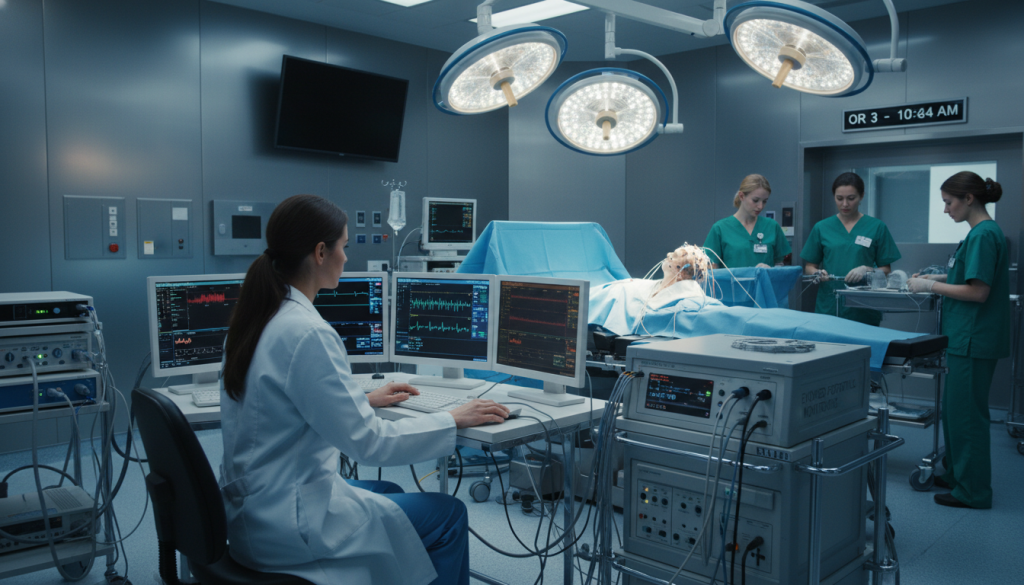
We always keep an eye on your neurological health. This way, we minimize the risk of problems during surgeries. Our goal is to provide the best care for every patient.
| Monitoring Technique | Primary Purpose | Clinical Benefit |
|---|---|---|
| Evoked Potentials | Assess sensory pathways | Early warning of nerve stress |
| EMG Monitoring | Track muscle activity | Prevents nerve root damage |
| EEG Analysis | Monitor brain function | Ensures adequate blood flow |
Sleep Studies and Polysomnography
We use advanced sleep studies to connect restful sleep with brain health. Polysomnography records your brain waves, oxygen levels, and heart rate at night. This helps us find issues that mess with your sleep patterns.
These tests are key for diagnosing health problems that affect your well-being. We add seizure monitoring to our sleep tests. This way, we can understand brain activity at night better. It helps us tell apart normal sleep issues from serious brain events.
We mix clinical authority with a caring environment. We know sleep studies can seem scary, so we make sure you’re comfortable. Our team works hard to help you sleep better and live better through accurate tests.
When we do seizure monitoring in sleep studies, we look for specific signs. These signs show us if there are abnormal electrical signals. This helps us create treatment plans that fit your needs. Here’s what we track during a polysomnography session.
| Metric | Purpose | Clinical Significance |
|---|---|---|
| EEG Activity | Brain wave tracking | Detects seizure activity |
| Pulse Oximetry | Oxygen saturation | Identifies sleep apnea |
| EMG Sensors | Muscle movement | Monitors limb twitching |
| ECG Leads | Heart rhythm | Assesses cardiac stress |
Pediatric Clinical Neurophysiology
We focus on a gentle, family-centered approach for kids’ neurophysiological tests. Our experts know that a clinical setting can be scary for young ones. So, we make it warm and supportive, helping kids feel safe and secure.
Working with kids means we have to adapt our methods. For example, we adjust EMG testing to fit their needs and attention spans. Our team uses special techniques to make these tests accurate and as comfortable as possible.
Good communication is key in our practice. We make sure parents get clear, actionable information about their child’s health. By explaining EMG testing in easy terms, we help families make informed choices for their child’s care.
We’re dedicated to excellence in every test. We use advanced medical technology with care, focusing on your child’s comfort and wellbeing. Your child’s safety and happiness are our top priorities during every test.
Patient Preparation and Safety Protocols
At our Neurophysiology Lab, we believe that informed patients are empowered patients. That’s why we provide detailed preparation guidelines. Proper preparation ensures your diagnostic experience is both comfortable and effective.
For an EEG, arrive with clean, dry hair. Oils or styling products can affect electrode placement. Continue taking your prescribed medications unless your doctor tells you to stop. Your health and safety are our top priority during the diagnostic process.
Before your visit to the Neurophysiology Lab, consider this preparation checklist. Wear comfortable, loose-fitting clothing for easy access. If you have questions about your test, our staff is ready to help.
We follow strict safety protocols to protect everyone. Our team checks on your comfort levels throughout the procedure. Below is a summary of common preparation requirements for our diagnostic services.
| Procedure Type | Hair/Skin Prep | Medication Status | Activity Level |
|---|---|---|---|
| EEG Testing | Clean and dry | As prescribed | Restful |
| Nerve Conduction | No lotions | Consult doctor | Normal |
| Muscle Studies | Clean skin | As prescribed | Avoid exertion |
| Neurophysiology Lab | Follow instructions | Verify with staff | Stay relaxed |
Interpreting Complex Neurophysiological Data
Understanding neurodiagnostics is key to making an accurate diagnosis. It needs both advanced technical skills and deep clinical experience. We aim to make this process clearer, so you can feel more confident in your healthcare journey.
Our specialists focus on precision and clarity when reviewing data. They look at the electrical signals and waveforms from your tests. This careful review helps us draw reliable conclusions.
We see interpreting neurodiagnostics as a team effort. By explaining how we turn complex data into useful insights, we build trust. Your peace of mind is our top priority. We’re committed to keeping you informed at every step of your neurological assessment.
| Analysis Phase | Primary Objective | Patient Benefit |
|---|---|---|
| Data Acquisition | Signal Capture | High-fidelity results |
| Pattern Recognition | Identifying Anomalies | Accurate diagnosis |
| Clinical Correlation | Symptom Matching | Personalized care plans |
Conclusion
Understanding your nervous system is key to managing your health. This guide on Clinical Neurophysiology helps you see how we watch over your body’s electrical paths.
At Acıbadem Healthcare Group, we aim to educate and care for you. We think knowing more helps you make better health choices.
Today’s tools let us look deeper than just symptoms. Our experts use Clinical Neurophysiology to understand nerves and muscles better. This means we can tailor care just for you.
Your health journey is a team effort. If you have questions, don’t hesitate to contact us. We’re ready to help you on your way to better health.
FAQ
Q: What is the primary focus of Clinical Neurophysiology at Acıbadem Healthcare Group?
A: Clinical Neurophysiology studies the nervous system. At Acıbadem Healthcare Group, we use special tests to find and understand complex neurological conditions. This helps us diagnose with great accuracy.
Q: How do Neurodiagnostics help in identifying neurological symptoms?
A: Neurodiagnostics help find the source of symptoms like numbness or seizures. We use advanced tools to monitor electrical signals. This gives us important health insights to help our patients.
Q: What should I expect during a visit to the Neurophysiology Lab?
A: Our Neurophysiology Lab is a place where experts use the latest technology. You’ll find a professional and caring atmosphere. Our team uses top-notch equipment to test your nervous system while making sure you’re comfortable.
Q: How does EEG testing monitor brain activity?
A: EEG testing records the brain’s electrical activity. We place small electrodes on your scalp. This helps us find patterns linked to conditions like epilepsy or sleep disorders.
Q: What is the purpose of Nerve Conduction Studies?
A: Nerve Conduction Studies check the health of nerves. We measure how well electrical impulses travel through your nerves. This helps us find nerve damage or problems.
Q: What is the difference between Electromyography and EMG testing?
A: Electromyography is also known as EMG testing. It checks muscle and nerve health. We use small electrodes or needles to record electrical activity during rest and contraction.
Q: How are Evoked Potentials used as diagnostic tools?
A: Evoked Potentials measure how your nervous system responds to stimuli. This includes light, sounds, or skin pulses. It helps us find blockages or delays in neural pathways.
Q: Why is prolonged Seizure Monitoring necessary for epilepsy care?
A: Long-term Seizure Monitoring captures detailed brain activity. It’s essential for finding the right treatment for epilepsy. This gives patients and their families peace of mind.
Q: Can you explain the role of Intraoperative Neurophysiological Monitoring?
A: Intraoperative monitoring gives surgeons real-time feedback during surgery. It uses Evoked Potentials and other methods. This helps protect the nervous system during complex procedures.
Q: Is EMG testing safe for pediatric patients?
A: Yes, we offer specialized EMG testing for children. Our team at Acıbadem Healthcare Group makes sure it’s safe and supportive. We adapt techniques for kids’ needs.
Q: How should I prepare for my neurodiagnostic procedures?
A: Preparing well is important for your visit to our Neurophysiology Lab. Follow our guidelines on medication and dress comfortably. Our staff will guide you with clear instructions for a safe and accurate test.
Q: How does the team interpret complex neurophysiological data?
A: Our team uses advanced skills and experience to analyze data. We look at electrical data from tests like Nerve Conduction Studies or EEG. Then, we explain the findings in a way you can understand.